Sweden’s higher policy rate is forcing mortgage borrowers to make a more active choice between paying down debt and keeping cash available, as every extra krona amortized now delivers a larger risk-free return than it did in the low-rate era.
Sweden Rate Hike Raises Mortgage Amortization Appeal
The Riksbank raised its benchmark rate from 1.75% to 2% on Nov. 4, and several banks are still penciling in more increases next year. That keeps pressure on households with floating-rate mortgages, where borrowing costs can rise quickly, but it also improves the economics of amortization: paying down 100,000 kronor on a mortgage at 3.5% saves about 3,500 kronor a year before tax, or 2,450 kronor after the standard 30% interest deduction in a typical underskuld av kapital scenario.
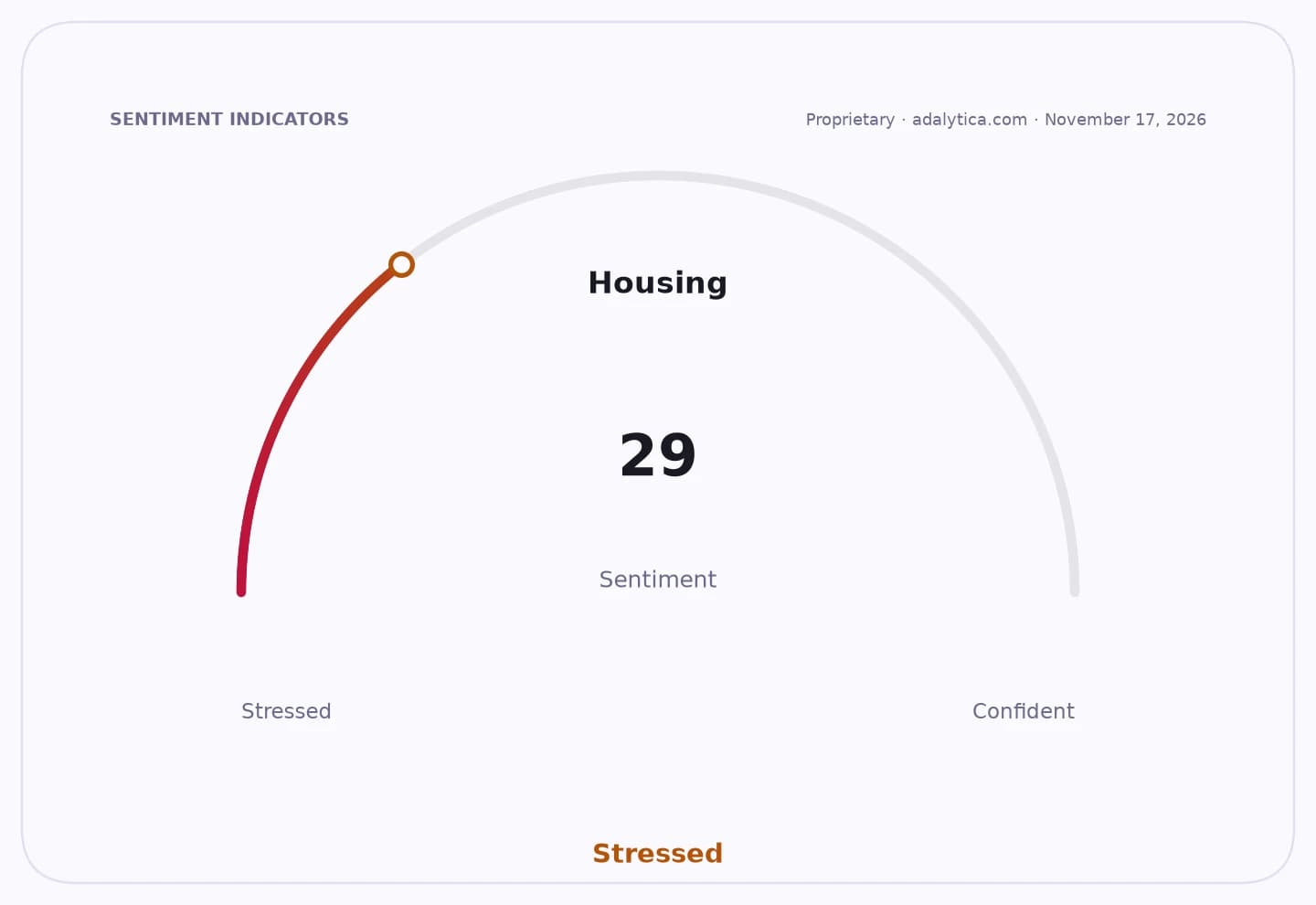
Sentiment Indicators
For policymakers, the shift matters because it tightens financial conditions beyond the central bank’s headline move. Sweden’s housing market has been one of the main transmission channels for monetary policy, and higher monthly mortgage bills reduce disposable income, slow consumption and make indebted households more cautious. SEB has calculated that a cumulative 0.75 percentage-point increase in rates would make a 3 million kronor mortgage about 22,500 kronor more expensive per year before tax. SBAB chief economist Robert Boije has warned that further inflation and rate increases would be unwelcome for households with floating-rate loans.
At the same time, the rate backdrop makes debt reduction look increasingly attractive relative to other uses of cash. Amortization functions like a guaranteed return equal to the mortgage rate saved, while stock-market investing can offer higher long-run gains but with much more volatility. Privata Affärer cites a 7.9% average annual return for the SIX Return Index since the start of 2000, but that comparison also includes the 2008 slump, when the Stockholm market fell 39%. For households prioritizing stability, the case for faster amortization strengthens as rates rise.
The policy change also comes as Sweden has relaxed its borrowing rules. The removal of the tightened amortization requirement on April 1 gave some households more flexibility, especially those with debt above 4.5 times income. Felicia Schön at Avanza said that for a family with 3 million kronor in loans and 3% amortization, that change alone freed up 2,500 kronor a month, or 30,000 kronor a year. That breathing room may now be used to absorb higher interest costs, or redirected into paying down debt faster.
Investor implications are broader than the mortgage market. Swedish banks stand to benefit from a higher-rate environment if mortgage margins hold up, but credit quality and loan growth could come under strain if households pull back. For housing-related equities and consumer discretionary names, the key risk is that higher debt-service costs continue to suppress spending. The krona has also firmed in recent trading, with SEK/X hovering around 10.11 against the dollar, reinforcing the signal that markets are still digesting a less accommodative rate backdrop.
The bigger narrative is that Sweden’s mortgage market is shifting from a world where cheap leverage encouraged minimal amortization to one where debt reduction again has a clear financial payoff. If the Riksbank and other banks are right about more hikes ahead, the incentive to amortize extra will only grow.
| Entity | Gains | Losses |
|---|---|---|
| Mortgage borrowers who amortize | ▲Higher risk-free return | ▼Less cash on hand |
| Banks | ▲Wider lending margins | ▼Slower loan demand |
| Riksbank | ▲Stronger anti-inflation transmission | ▼Higher housing-sector strain |
| Equity investors | ▲Less debt in households long term | ▼Near-term consumer spending pressure |