Taiwan residents are traveling to the Chinese mainland in far greater numbers this year, a recovery that matters economically because it signals a thaw in one of Asia’s most politically sensitive travel corridors and a boost for airlines, tour operators and mainland consumer destinations.
Taiwan Mainland Travel Rebounds in 2026
More than 2.49 million Taiwan residents visited the mainland in the first eight months of 2026, up 19.63% from a year earlier, according to Taiwan’s tourism department. The mainland remained the island’s second-most popular outbound destination, and monthly trips topped 300,000 from March through August, with double-digit growth in each of those months. That pace outstripped the 15.24% increase in Taiwan residents’ total outbound travel, suggesting the mainland is regaining share even as broader overseas demand improves.
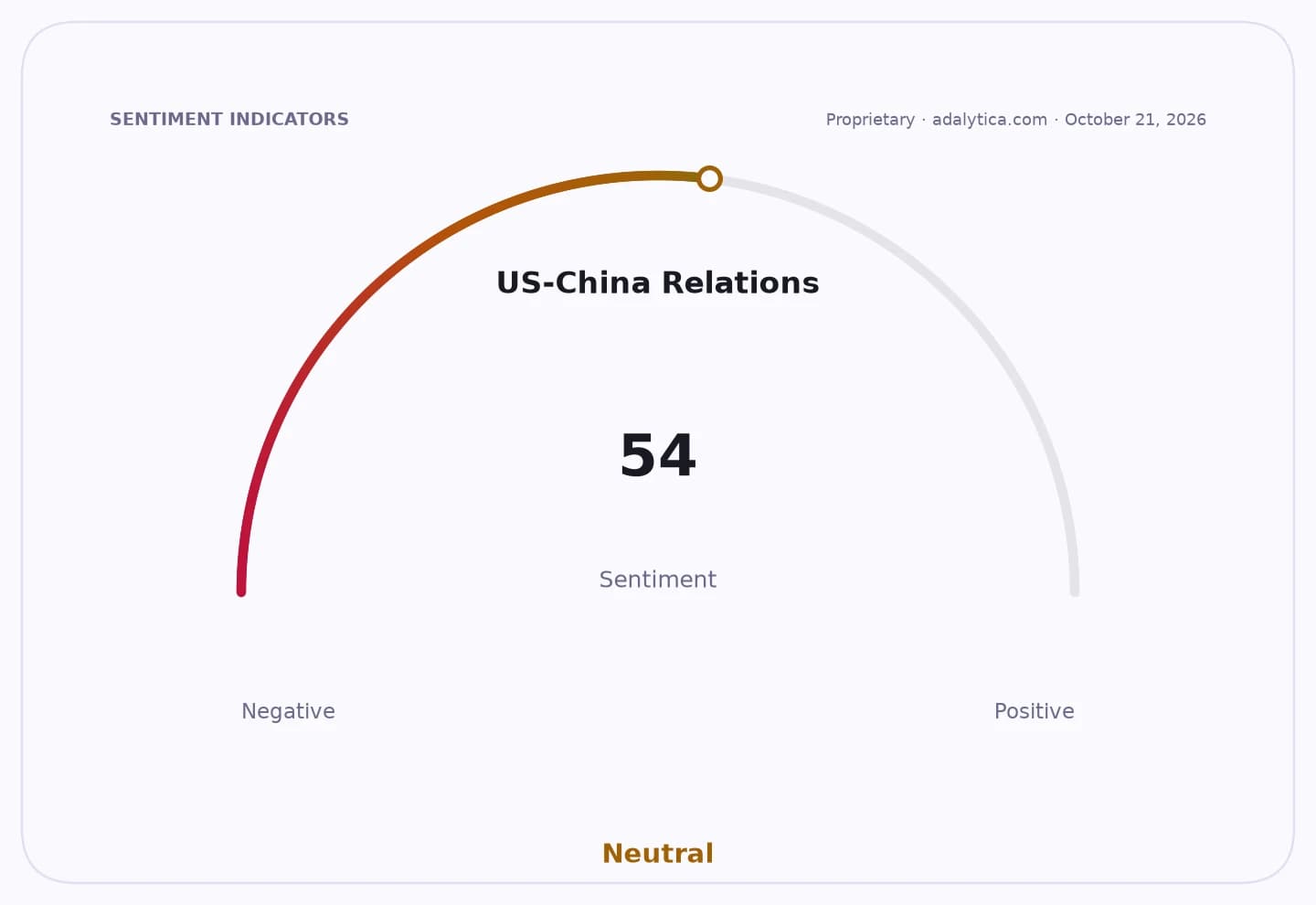
Sentiment IndicatorsⓘProprietary · adalytica.com · October 21, 2026
This is a snapshot — live sentiment, awareness and momentum for 130+ markets update continuously in the dashboard.Open AlphaPulse
The numbers point to more than a simple post-pandemic travel normalization. For the mainland, more Taiwanese arrivals mean more spending in hotels, restaurants, transport and attractions at a time when domestic consumption remains uneven. For Taiwan’s travel industry, it strengthens one of the few destinations with enough scale to move group-tour volumes and business-travel traffic. Yu Sheng International Travel Service Chairman Tsai Tsung-yu said his company’s group tours to the mainland increased this year, reflecting renewed demand for destinations such as Xinjiang and Yunnan, as well as city breaks to Chongqing and Shanghai.
Economically, the rebound underscores how travel demand often tracks with sentiment and convenience as much as politics. Shared language, familiar transport links and cultural similarities lower the friction for repeat travel, especially for older tourists booking package tours. Younger travelers are being pulled by social-media-driven itinerary choices, with Xiaohongshu helping popularize mainland city trips that are presented less as cross-border travel than as value-oriented leisure breaks. That matters because it broadens the market beyond traditional tour groups and can make demand more resilient.
The trend also lands in a cross-strait environment that remains strategically fraught even as ordinary travel normalizes. Any sustained increase in people-to-people flows can modestly ease commercial frictions and support service-sector ties, but it does not erase the political risk premium around Taiwan–mainland relations. For investors, that means the story is constructive for travel intermediaries and mainland hospitality names, but it should be read alongside the possibility that diplomatic tensions or policy shifts could interrupt the rebound quickly.
For market participants, the key question is whether the current pace can hold into year-end and into peak holiday periods. If it does, travel agencies, airlines and tourism-linked businesses stand to benefit from higher load factors and better pricing power. If not, the recovery may prove to be a cyclical bounce rather than a durable rerating of cross-strait travel demand.
| Entity | Gains | Losses |
|---|---|---|
| Taiwan travel agencies | ▲Higher tour bookings | ▼Fewer unused outbound seats |
| Mainland hotels and attractions | ▲More Taiwan visitors | ▼Limited if tensions rise |
| Airlines on cross-strait routes | ▲Stronger passenger volumes | ▼Competitors on weaker routes |
| Travelers | ▲More destination choice | ▼Higher exposure to policy shocks |