Taiwan’s foreign minister is heading to Arizona to open a new de facto consular office in Phoenix, underscoring how TSMC’s massive semiconductor buildout has turned the state into a strategic hub in the U.S.-Taiwan relationship.
Taiwan Opens Phoenix Office as TSMC Expands in Arizona
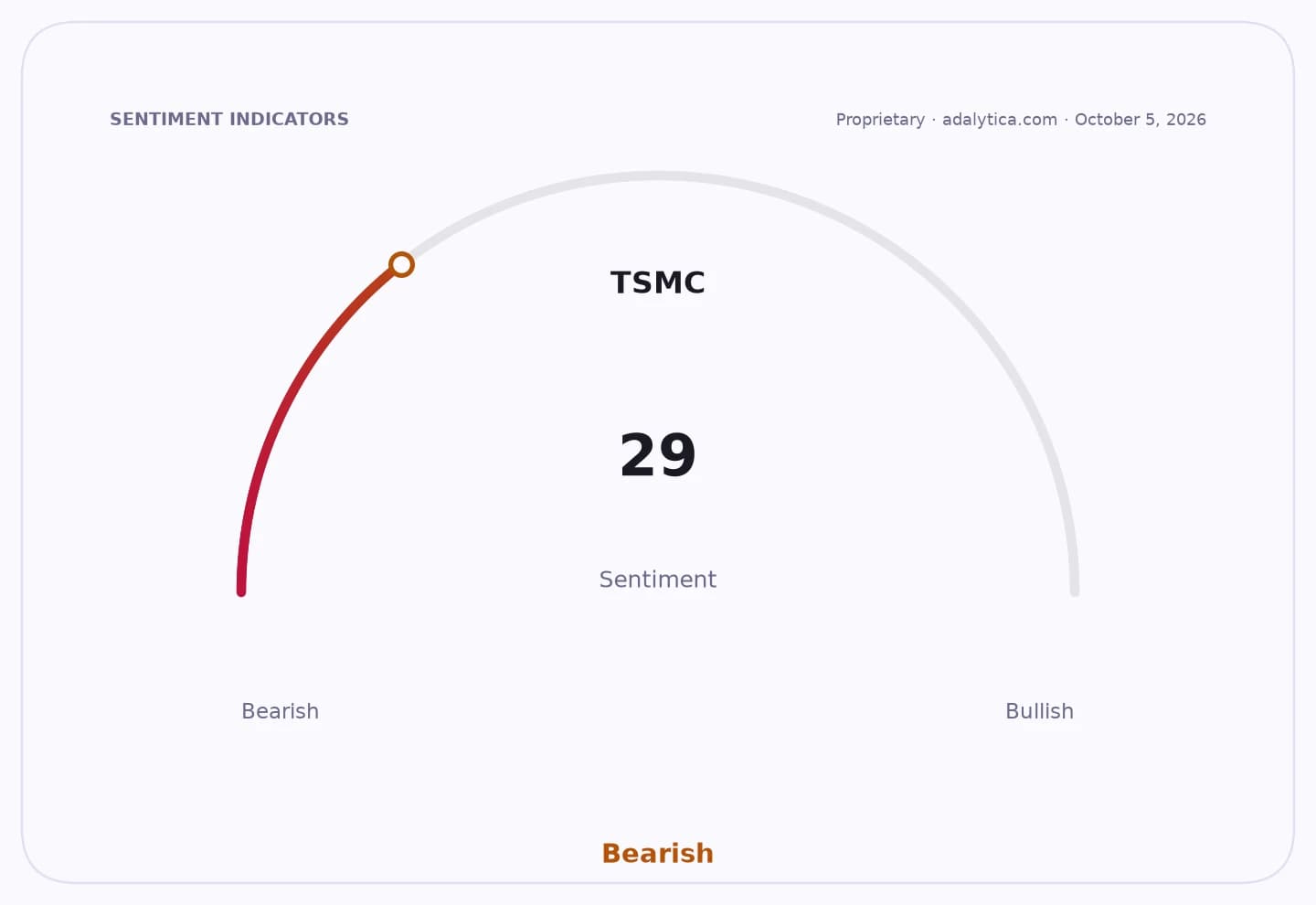
The office opening matters because it formalizes a deeper political and commercial link at a moment when Washington and Taipei are trying to steady ties under pressure from Beijing and a more transactional White House. Taiwan’s foreign ministry called the Phoenix office a “major step” in the economic and trade partnership, and said it would help connect diplomacy, commerce, industry and investment.
Sentiment IndicatorsⓘProprietary · adalytica.com · October 5, 2026
This is a snapshot — live sentiment, awareness and momentum for 130+ markets update continuously in the dashboard.Open AlphaPulse
The move is closely tied to TSMC’s $265 billion investment in Arizona, where the chipmaker is building advanced manufacturing capacity for the U.S. market. For investors, that reinforces Arizona’s role in the global semiconductor supply chain and points to continued capital spending, local hiring and supplier opportunities around TSMC’s U.S. expansion.
It also comes as Taiwan’s President Lai Ching-te has yet to visit the United States since Donald Trump returned to office, while Trump has kept new arms sales to Taiwan on hold, calling them negotiating leverage after talks with Beijing. That makes any visible diplomatic step in the U.S. more important for Taiwan, and a potential watchpoint for Chinese reaction.
TSMC shares were down 0.4% in the latest session, but the stock has surged over the past several months and remains well above its 50-day and 200-day moving averages. The broader chip sector has also been strong, with SOXX and SMH both near recent highs, though their RSI readings are elevated, suggesting the group may be stretched after the run.
For investors, the key question is whether the Arizona project becomes a durable political and industrial anchor for TSMC’s U.S. growth, or whether trade friction and U.S.-China tensions make the expansion more complicated. Attention now turns to any further signals from Washington and Beijing, and to how quickly TSMC can keep scaling U.S. output.
| Entity | Gains | Losses |
|---|---|---|
| TSMC | ▲U.S. expansion and political access | ▼Geopolitical scrutiny and execution risk |
| Taiwan government | ▲Stronger U.S. ties | ▼Exposure to China backlash |
| Arizona economy | ▲Jobs and investment | ▼Dependence on one mega-project |
| China | ▲— | ▼Diplomatic pressure around Taiwan |