Tajikistan has started buying oil and refined products from Iran, a small but symbolically important move that shows how Russia’s grip on Central Asia’s fuel market is loosening and how Washington’s sanctions net could soon be tested again.
Tajikistan Starts Buying Oil From Iran

For investors, the bigger story is not the volume — which Tajikistan and Iran have not disclosed — but the direction of travel. A landlocked country that has relied on Russia for more than 91% of its petroleum imports in the first half of 2026 is now looking elsewhere as Russian fuel shortages, export limits and Ukrainian drone strikes disrupt supply. That makes the Central Asian energy map more fragile, more politicized and potentially more expensive.
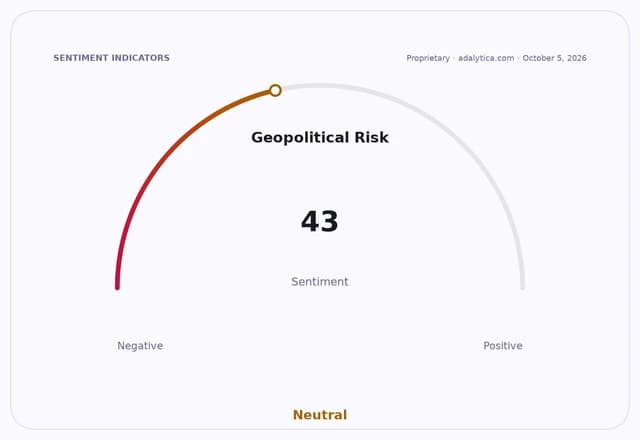
Sentiment IndicatorsⓘProprietary · adalytica.com · October 5, 2026
This is a snapshot — live sentiment, awareness and momentum for 130+ markets update continuously in the dashboard.Open AlphaPulse
Tajikistan’s energy ministry said deliveries from Iran began at the end of August after talks on expanding oil and gas cooperation. Dushanbe has asked Tehran to supply as much as 2.55 million tons a year of crude and petroleum products, including gasoline, diesel and jet fuel, though that figure appears to be a request rather than current supply. Even so, the mere start of shipments matters because it gives Tajikistan another option at a time when dependency on Russia is proving risky.
The challenge is logistics. Tajikistan has no coastline, so moving large volumes of Iranian oil would require a workable transit route across a region shaped by sanctions, geography and politics. That makes this less a quick fix than a strategic hedge. Still, in energy markets, optionality has value. Countries that can diversify supply tend to have more bargaining power and fewer vulnerability spikes when one source is interrupted.
The move also sharpens the sanctions question. The United States has been stepping up pressure on Iran’s oil revenue, and any meaningful expansion in trade with Tehran raises the possibility of secondary sanctions on counterparties. For now, the trade appears modest. But investors should not dismiss the precedent. Once a sanctioned producer finds a willing buyer outside its usual orbit, enforcement gets harder and the risk of broader knock-on measures rises.
The timing is no accident. Russia’s fuel system has been strained by domestic shortages and export restrictions, while Central Asian buyers have been forced to look for backup supplies. Tajikistan said in July it was already talking with neighboring countries to secure future fuel needs. Iran is now part of that answer, helped by a broader warming in ties between Dushanbe and Tehran.
That warming has an economic dimension too. The two countries said bilateral trade reached $438 million in 2025, up 28% from a year earlier, and they have signed more than 200 agreements and memorandums. In May, officials discussed energy, transport, industry, investment and technology. Oil may be the headline, but the deeper story is a regional realignment driven by necessity: countries under supply pressure are widening their supplier base, even if that means dealing with sanctioned actors.
For commodity investors, the immediate market impact is limited. Oil benchmarks will be driven far more by OPEC+, U.S. shale, global demand and sanctions on major producers than by Tajikistan’s import mix. But the geopolitical signal is worth noting. When smaller states begin to bypass traditional suppliers and test sanctioned channels, it reinforces the case for a higher risk premium across energy trade routes and a more volatile backdrop for sanctions-sensitive flows.
In the long run, that is what matters most for investors: not whether Tajikistan’s Iranian shipments are large today, but whether they mark another crack in the post-Russia supply structure across Central Asia. If they do, expect more countries to shop around, more sanctions complexity and a market where security of supply becomes as important as price. For now, this is worth watching closely.
| Entity | Gains | Losses |
|---|---|---|
| Tajikistan | ▲More fuel options | ▼Russian supply dependence |
| Iran | ▲New oil buyer | ▼Sanctions exposure |
| Russia | ▲None directly | ▼Lost market share |
| U.S. sanctions policy | ▲Enforcement leverage | ▼Compliance complexity |