Together AI expects a Saudi data center partnership to generate more than $5 billion in annualized revenue, underscoring how power, permitting and geopolitics are now pushing some of the most energy-hungry AI infrastructure outside the US.
Together AI Saudi data center deal tops $5 billion

The American company’s agreement with HUMAIN, the Saudi state-backed artificial intelligence group, calls for a 250-megawatt facility in the kingdom with roughly 120,000 semiconductors. Rather than buying the chips outright, Together AI will use HUMAIN’s hardware and split revenue with its local partner, a structure that ties a US AI operator to a sovereign-backed infrastructure platform in one of the world’s most capital-rich energy markets.
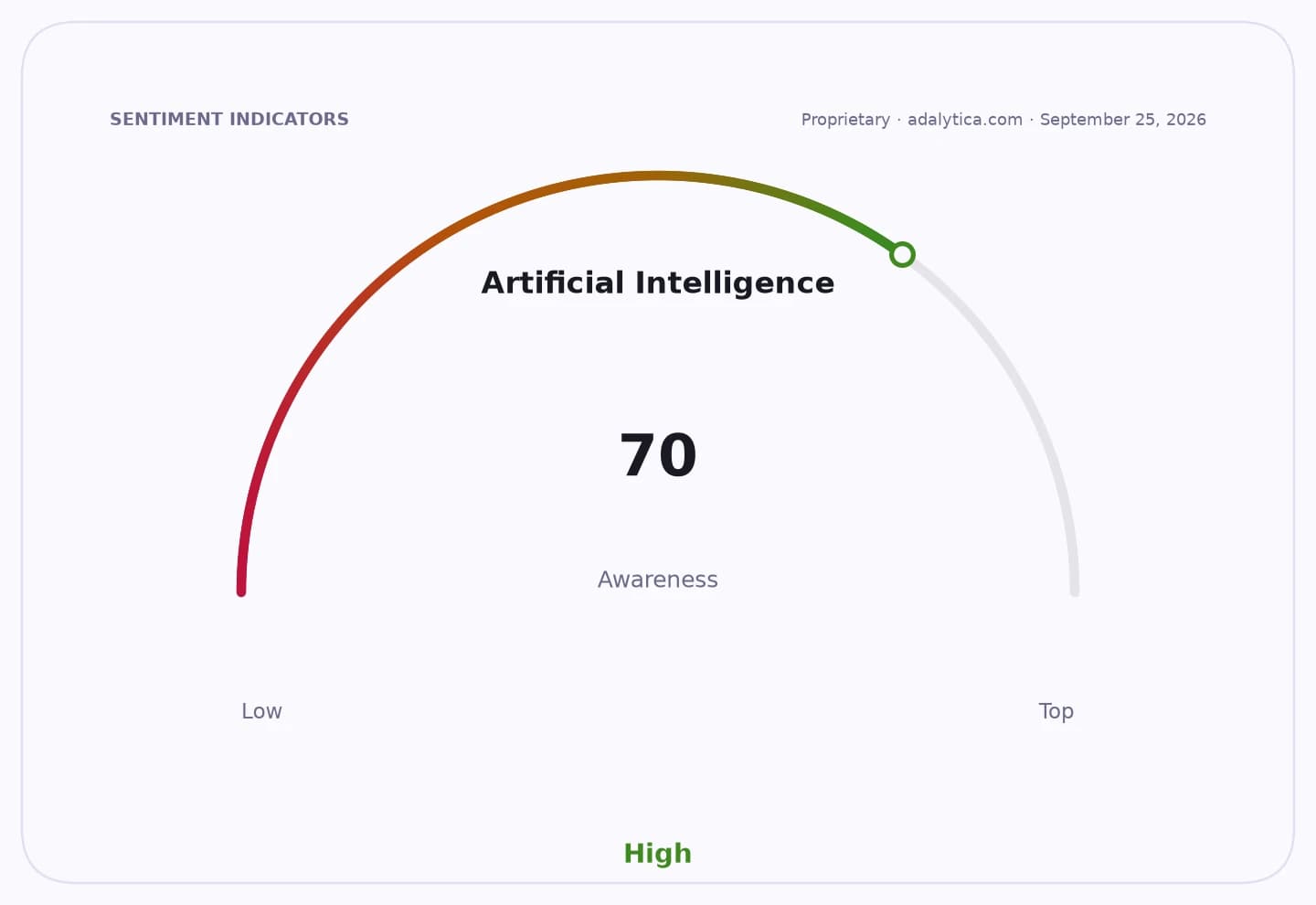
Sentiment IndicatorsⓘProprietary · adalytica.com · September 6, 2026
This is a snapshot — live sentiment, awareness and momentum for 130+ markets update continuously in the dashboard.Open AlphaPulse
The deal matters because it captures a central constraint on the AI buildout: compute may be the strategic asset, but the physical site for that compute is increasingly shaped by electricity access, land use and politics. In the US, large data centers have run into community opposition, utility bottlenecks and increasingly fraught permitting. For a 250-megawatt project, those hurdles can add years and still fail to deliver the grid capacity needed.
Saudi Arabia offers the opposite mix. Power is comparatively cheap and abundant, land is less contested and the state is openly using AI infrastructure to accelerate economic diversification away from oil. That makes the kingdom a natural host for compute-intensive projects that are difficult to place in the US, especially as Washington has spent two years tightening control over where advanced chips can be deployed.
The arrangement also shows how Gulf capital is moving from being a passive source of financing to an operating partner in the AI supply chain. HUMAIN has already lined up relationships with Microsoft and Qualcomm, a $1.2 billion financing package for 250 megawatts of data center space and separate plans with center3 that point toward gigawatt-scale ambitions. The common thread is a state-backed counterparty willing to provide power, hardware access and balance-sheet support in exchange for revenue participation or equity.
For investors, the immediate read-through is mixed. On one hand, the deal is supportive for AI infrastructure suppliers and hardware makers, because it points to another source of large-scale demand for chips, networking gear and data center systems. Nvidia, whose stock has rallied sharply and whose conventional technical indicators still point to a strong trend, stands to benefit if more of these facilities are built. Microsoft and other cloud and AI operators may also look more closely at Gulf partnerships as a way to expand capacity without absorbing all the permitting and construction risk at home.
On the other hand, the structure raises questions about concentration and control. Together AI serves open-weight models, which are often marketed as a counterweight to centralized AI power. But open weights do not eliminate infrastructure bottlenecks if the practical ability to serve those models at scale sits in a small number of sovereign-backed facilities. The leverage, in other words, can move from the model layer to the compute layer.
The broader implication is that the next wave of AI buildout may not be defined only by model performance or chip supply, but by geography. If other US AI companies follow Together AI into Saudi Arabia or the wider Gulf, the market will have to price a more international infrastructure map for artificial intelligence — one in which access to compute is determined as much by state policy and energy economics as by software demand.
| Entity | Gains | Losses |
|---|---|---|
| Together AI | ▲Faster expansion, $5B revenue run-rate | ▼Less infrastructure control |
| HUMAIN / Saudi Arabia | ▲AI investment, strategic influence | ▼Capital and operational risk |
| Nvidia and suppliers | ▲More chip and systems demand | ▼Less domestic buildout concentration |
| US regulators / local communities | ▲N/A | ▼More compute offshore |