Treasury’s successful rollout of a new safeguard to stop payments to deceased individuals marks a small operational fix with outsized economic value: it reduces avoidable leakage in a payments system that now moves trillions of dollars a year and has become more exposed to fraud, administrative error and cross-agency mismatch.
Treasury Fix Highlights Payment Controls

The significance is less about the specific payments blocked than about what it says on the state of the plumbing. As electronic transactions accelerate and the government leans more heavily on automated disbursement, Treasury’s ability to prevent improper transfers becomes a direct issue of fiscal efficiency and public trust. Every prevented overpayment trims waste, lowers recovery costs and reduces the risk that already-tight agency budgets are tied up in clawbacks.
Sentiment IndicatorsⓘProprietary · adalytica.com · July 21, 2026
This is a snapshot — live sentiment, awareness and momentum for 130+ markets update continuously in the dashboard.Open AlphaPulse

The move also fits a wider policy push to harden payment rails. Recent commentary from policymakers has stressed the need to improve electronic payment efficiency, while fraud concerns in card networks and broader debates over payment deferrals show that the sector is under pressure to deliver faster transfers without sacrificing controls. Treasury’s safeguard suggests the government is trying to keep pace with that trade-off rather than merely chase speed.
For investors, the implication is that payment infrastructure is becoming more valuable not just for volume growth, but for compliance and verification. Firms such as Fidelity National Information Services, Global Payments and ADP sit closer to the center of that shift than headline merchants do. Their earnings are tied to transaction flows, but also to the reliability of the systems that route, match and validate those flows. Better controls can support adoption and lower fraud-related friction, though they can also raise implementation costs and demand more investment in screening tools.
Liquidity Conditions — 30-day sentimentadalytica.com
Explore this data interactively — full history, time series and cross-market comparisons.Open AlphaPulse
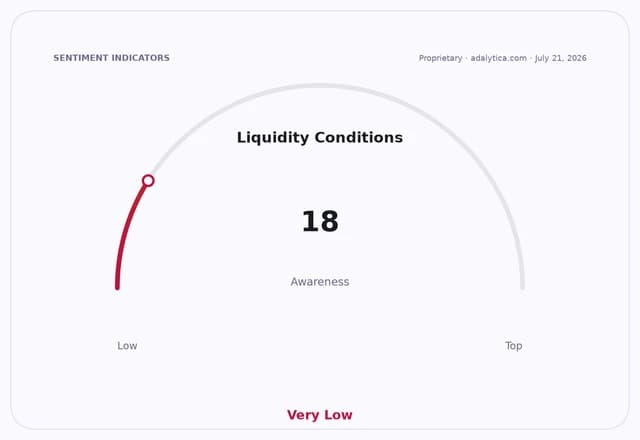
The broader macro backdrop is one of heavier digital usage and tighter money conditions. Treasury’s balance sheet remains large by historical standards, while M2 growth has stabilized after the pandemic-era surge and the federal funds rate is still elevated, leaving less room for operational slippage across public finance and private payments alike. In that environment, even modest efficiency gains matter because they preserve liquidity, reduce administrative drag and help keep money moving cleanly through the economy.
The bull case is that improved safeguards will reduce fraud, cut losses and strengthen confidence in digital disbursements, supporting further migration away from paper-based processes. The bear case is that more controls can create bottlenecks, false positives and added compliance costs, particularly for processors and intermediaries that must integrate with government systems.
For investors, the key question now is whether Treasury’s fix proves scalable across other high-volume payment channels. If it does, it could reinforce a broader re-rating of firms that provide verification, orchestration and secure settlement. If it does not, the episode will underscore how difficult it remains to modernize payments without introducing new frictions.
| Entity | Gains | Losses |
|---|---|---|
| Treasury / taxpayers | ▲Less payment leakage | ▼Higher implementation burden |
| Payment processors | ▲More demand for controls | ▼Higher compliance costs |
| Fraudsters / bad actors | ▲Fewer openings | ▼Reduced access to funds |
| Digital payment users | ▲More trust in rails | ▼Potential added friction |