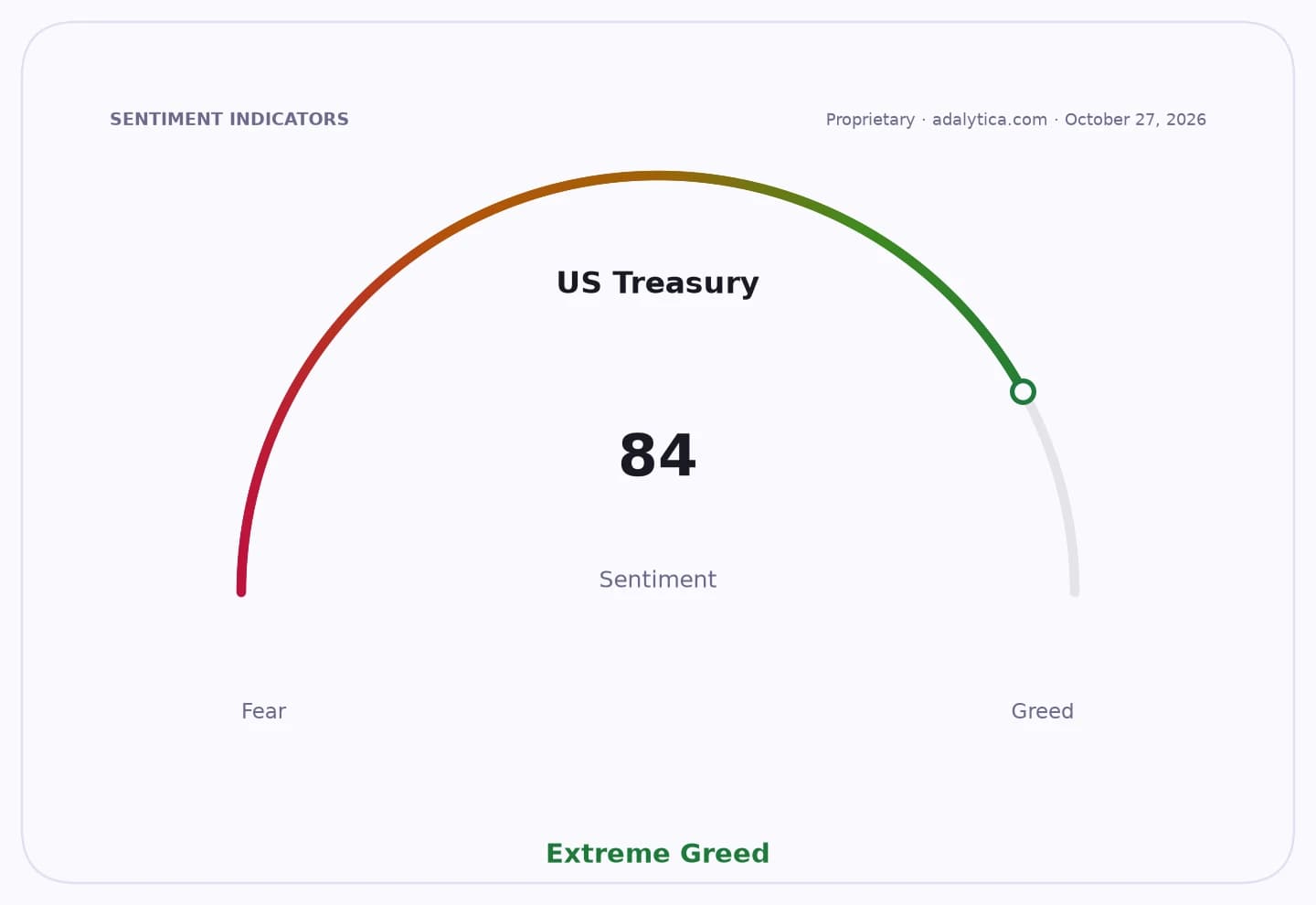
JPMorgan Asset Management’s Bob Michele is pressing the Treasury to eliminate the 20-year bond, arguing the maturity has become an “orphan” that no longer serves the government’s funding needs as long-dated yields sit near their highest levels since 2002.
Treasury May Scrap 20-Year Bond, Bob Michele Says

The call matters because Treasury debt management is now a live market issue, not just a policy footnote. With the 10-year yield around 4.89% and the 2-year near 4.59%, investors are already grappling with a steep financing bill for the government and a curve that has repriced sharply higher over the past year.
Sentiment Indicators
Michele said the Treasury could shift more issuance toward bills and shorter-dated notes, where money-market funds hold roughly $8 trillion and demand is deep. That would support the long end of the curve by reducing supply pressure in the 20-year sector, which has lagged other maturities since it was revived in 2020.
The debate has intensified after Treasury Secretary Scott Bessent surprised traders with plans to boost buybacks of long-maturity Treasuries, a move that has not delivered lasting yield relief. At the same time, the Treasury has said it expected no auction-size changes for at least the next several quarters, underscoring how far Michele’s proposal would go if adopted.
For investors, the issue goes beyond one bond line. A deletion of the 20-year tenor would reshape duration supply, affect hedging and relative-value trades, and potentially benefit existing long-duration Treasuries and funds such as TLT, which has climbed to about 81.93 and trades above its 50-day moving average.
The market is still not pricing the move as the base case, with no dealer surveyed by Bloomberg forecasting an outright scrapping of the maturity. But the fact that a senior fixed-income manager is openly floating it highlights how quickly rising yields and Treasury financing pressure are forcing a rethink of the government’s debt mix.
The next catalyst is Treasury’s quarterly refunding announcement, which will show whether officials keep defending the 20-year bond or begin tilting more visibly toward shorter paper.
| Entity | Gains | Losses |
|---|---|---|
| Money-market funds | ▲More bill supply | ▼Less demand for 20-year bonds |
| Existing long-bond holders | ▲Scarcity premium | ▼None |
| Treasury Department | ▲Easier front-end financing | ▼Loss of policy flexibility |
| Dealers/relative-value traders | ▲More volatility opportunities | ▼20-year sector liquidity |