Trump’s renewed push to cap credit card interest rates at 10% could reshape consumer lending if Congress takes up the idea, offering billions of dollars in relief to households while threatening a hit to bank margins, approvals and rewards programs.
Trump’s 10% credit card rate cap could hit banks
S&P 500
The proposal has moved from a campaign talking point to a live policy fight because Trump is now openly courting incoming Democrats, including Sen. Elizabeth Warren, to build bipartisan support. That makes it more than political theater: a nationwide cap would force lenders to reprice one of the most profitable corners of consumer finance, where the median card rate is about 22%, more than twice the proposed ceiling.
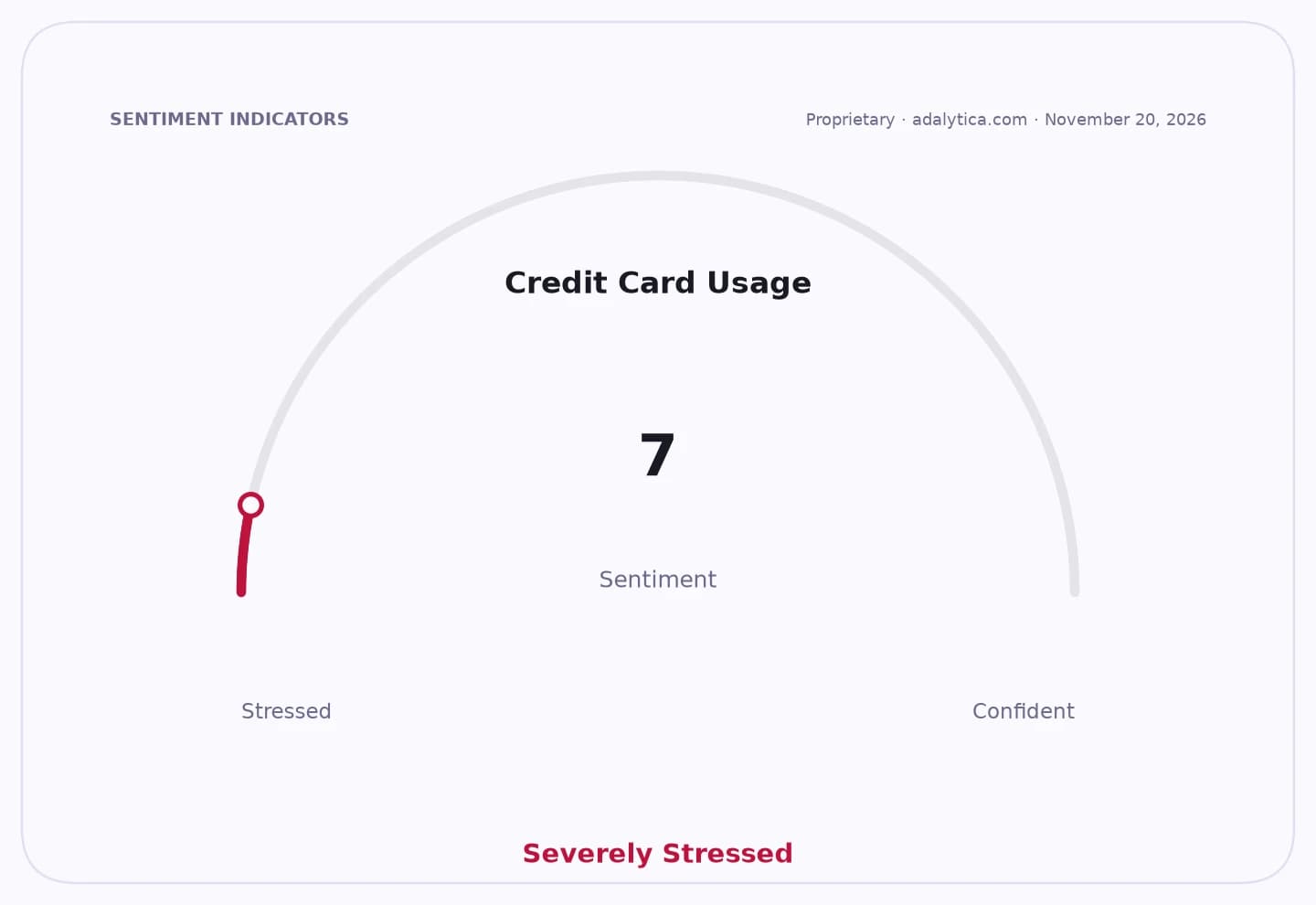
Sentiment Indicators
For borrowers carrying revolving balances, the math is straightforward. Analysts cited by the source estimate the cap could save consumers roughly $100 billion a year in interest payments, a meaningful transfer from banks to households at a time when debt stress remains elevated. Adalytica’s Household Debt Stress sentiment is at 100, underscoring the strain on consumers even as unemployment holds near 4.1% and the 2-year Treasury yield sits around 4.63%, a reminder that funding costs have not fallen back to pre-tightening levels.
For lenders, the consequence could be a smaller pool of credit rather than simply cheaper credit. Banks have warned they would likely respond by tightening approvals, cutting limits and scaling back rewards, especially for borrowers with weaker credit histories. That is the core policy trade-off: lower interest bills for millions of cardholders versus reduced access to unsecured credit for higher-risk consumers who often rely on cards as a liquidity buffer.
The proposal also lands in a market where card companies remain active and profitable, but not immune to pressure. JPMorgan, Capital One and Synchrony all have large credit card books and would be exposed to any cap, although the impact would differ by funding model, customer mix and reward structure. JPMorgan’s shares have retreated from early-November highs and are trading below both the 50-day and 200-day moving averages, while Capital One and Synchrony have also fallen sharply, leaving investors more cautious on consumer credit stocks even before any legislative action.
The political coalition is unusual but not airtight. Warren’s support gives the idea populist credibility on the Democratic side, while Republicans are split between critics who call it price fixing and supporters who see it as relief for overburdened households. That division makes passage uncertain, but it also gives the proposal unusual momentum for a policy that has long been seen as politically popular and economically disruptive.
Investors will be watching whether the debate broadens from rhetoric into draft legislation. If it does, the immediate winners would be revolving cardholders and consumer advocates; the losers would be card issuers, rewards-heavy customers and, potentially, lower-income borrowers who could be pushed into costlier alternatives such as payday loans if banks pull back lending.
| Entity | Gains | Losses |
|---|---|---|
| Revolving cardholders | ▲Lower interest bills | ▼Fewer reward perks |
| Banks/card issuers | ▲Policy clarity if defeated | ▼Margin pressure, lower approvals |
| Consumer advocates/Democrats | ▲Political momentum | ▼Risk of implementation backlash |
| Riskier borrowers | ▲No direct gain if access tightens | ▼Reduced credit access, higher-cost alternatives |