President Donald Trump’s unexpectedly cordial treatment of New York Mayor Zohran Mamdani is undermining one of Republicans’ most reliable midterm attack lines: that Democrats are being taken over by the far left.
Trump Warmth Toward Mamdani Complicates GOP Midterms
That matters because the GOP is already trying to frame next year’s congressional races around democratic socialism at a moment when Trump’s own approval ratings are weak on the economy and on foreign policy. If the party cannot keep Mamdani cast as an electoral bogeyman, it loses a simple message designed to unify Republicans and scare swing voters away from Democratic candidates.
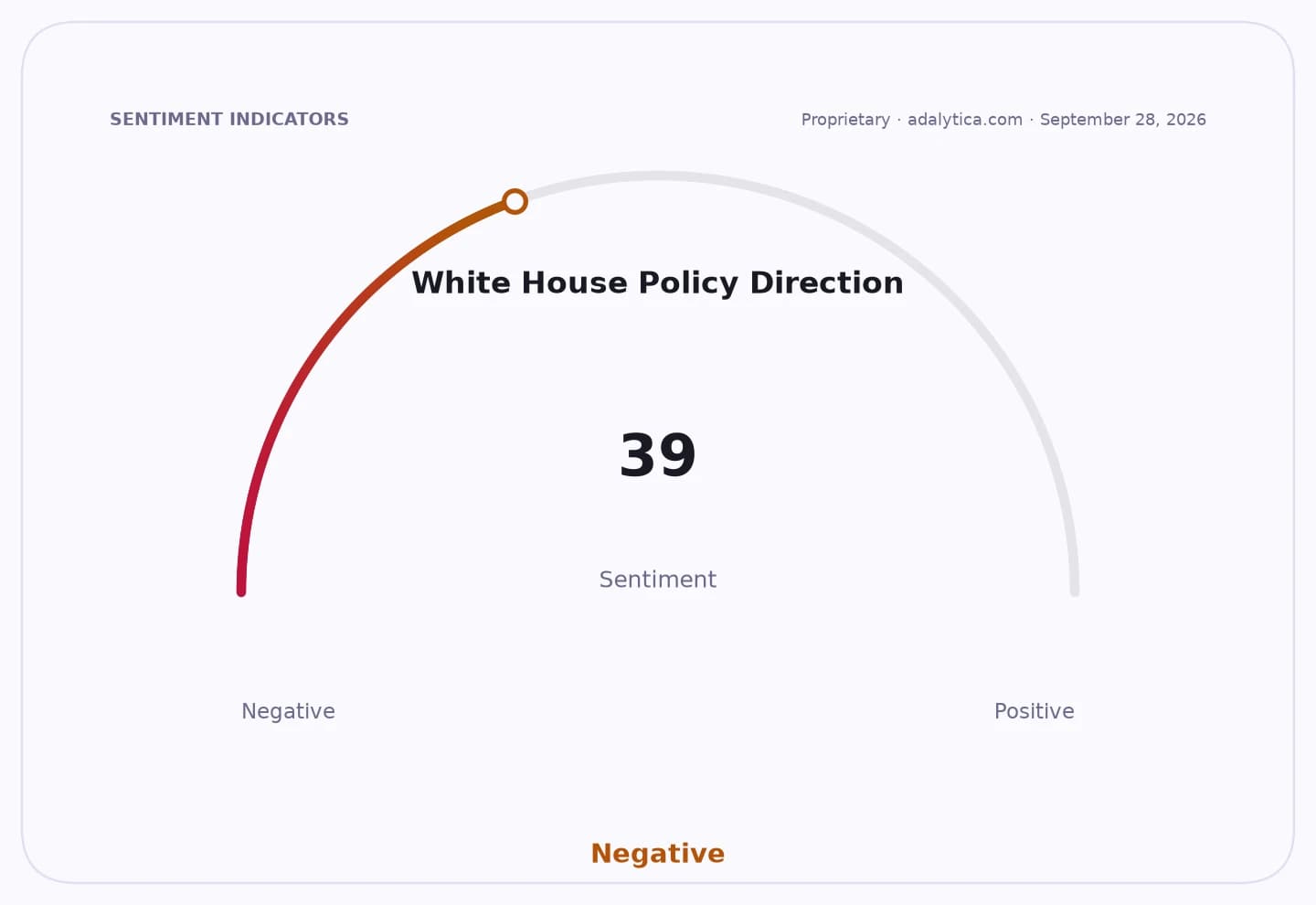
Sentiment IndicatorsⓘProprietary · adalytica.com · September 27, 2026
This is a snapshot — live sentiment, awareness and momentum for 130+ markets update continuously in the dashboard.Open AlphaPulse
Republicans have spent weeks elevating Mamdani as shorthand for a broader warning about Democratic radicalism. At a Trump-backed midterm convention in Texas earlier this month, the New York mayor’s name was invoked repeatedly. Sen. Ted Cruz called him “Comrade Mamdani,” while House No. 3 Tom Emmer called him “Mamdani the commie.” Trump used similar language, saying Democrats who call themselves democratic socialists are really “communists.” The point was clear: attach the party’s most visible socialist to candidates running far from New York and make him the face of the opposition.
But Trump’s behavior has muddied that script. In New York this week, he greeted Mamdani warmly at Gracie Mansion and praised his early performance, saying he was “off to a start” to being a great mayor. That follows a pattern of unusual personal warmth that has already included surprisingly convivial Oval Office meetings. For Republicans, the image problem is obvious: it is harder to tell voters that Mamdani represents an existential left-wing threat when the president is smiling beside him and offering compliments.
The political significance is amplified by the broader state of the race. Republicans are entering the midterm season with Trump carrying weak standing on core issues, including the economy. That leaves the party looking for a compact, emotionally resonant message that can travel beyond its base. Democratic socialism is one of the few such themes. It is easy to explain, easy to repeat and useful for linking local Democratic candidates to a national brand. Trump’s friendliness with Mamdani complicates that branding exercise and gives Democrats a chance to argue that the GOP’s rhetoric is more theatrical than consistent.
There is also a real contrast in the economics of the message. Republicans are trying to make inflation, taxes and urban decline the center of the campaign, with Mamdani’s platform serving as a proxy for bigger fears about government overreach and anti-business policy. If Trump appears willing to work with the very politician he once described as dangerous to New York, the attack can lose force with independents who already distrust partisan exaggeration.
The episode also highlights a familiar Trump dynamic: his personal dealmaking instincts often collide with the party’s need for disciplined messaging. Republicans in New York tried to brush off the latest friendliness as proof Trump can negotiate from strength with anyone. But for a national party trying to nationalize the midterms around socialism, the president’s willingness to play nice undercuts the caricature.
The risk for Republicans is not that Mamdani alone changes the balance of power. It is that he stops being a useful symbol. If Trump keeps alternating between praise and criticism, Democrats can argue the GOP’s “commie” routine is opportunistic, while Republicans struggle to turn one mayor into a broader warning about the party of Zohran Mamdani. For investors in political risk, the key takeaway is that message discipline matters: when the president changes the frame, it can alter the battlefield for congressional candidates, especially in tight suburban and metropolitan districts where swings in tone can matter as much as policy.
| Entity | Gains | Losses |
|---|---|---|
| Republicans | ▲Clearer anti-socialist contrast | ▼Message discipline |
| Democrats | ▲Opportunity to mock GOP inconsistency | ▼Easy target framing |
| Zohran Mamdani | ▲Broader legitimacy, less demonization | ▼Ease of being cast as bogeyman |
| Trump | ▲Flexibility to deal and pivot | ▼Party messaging coherence |