President Donald Trump is becoming a liability for Republicans in the 2026 midterms, with a new poll showing voters are leaning Democratic by double digits and overwhelmingly say they are voting against the president rather than for him.
Trump approval weakens GOP midterm outlook
The NPR/PBS News/Marist survey is the clearest sign yet that Trump’s return to the White House is translating into a political drag on his party, and that matters because midterm elections in a polarized but still fluid Congress often turn on a handful of Senate and House contests. If the president’s approval remains this weak, Republicans risk losing control of the House and could even face pressure in the Senate, where several competitive races are unfolding in states Trump carried comfortably last year.
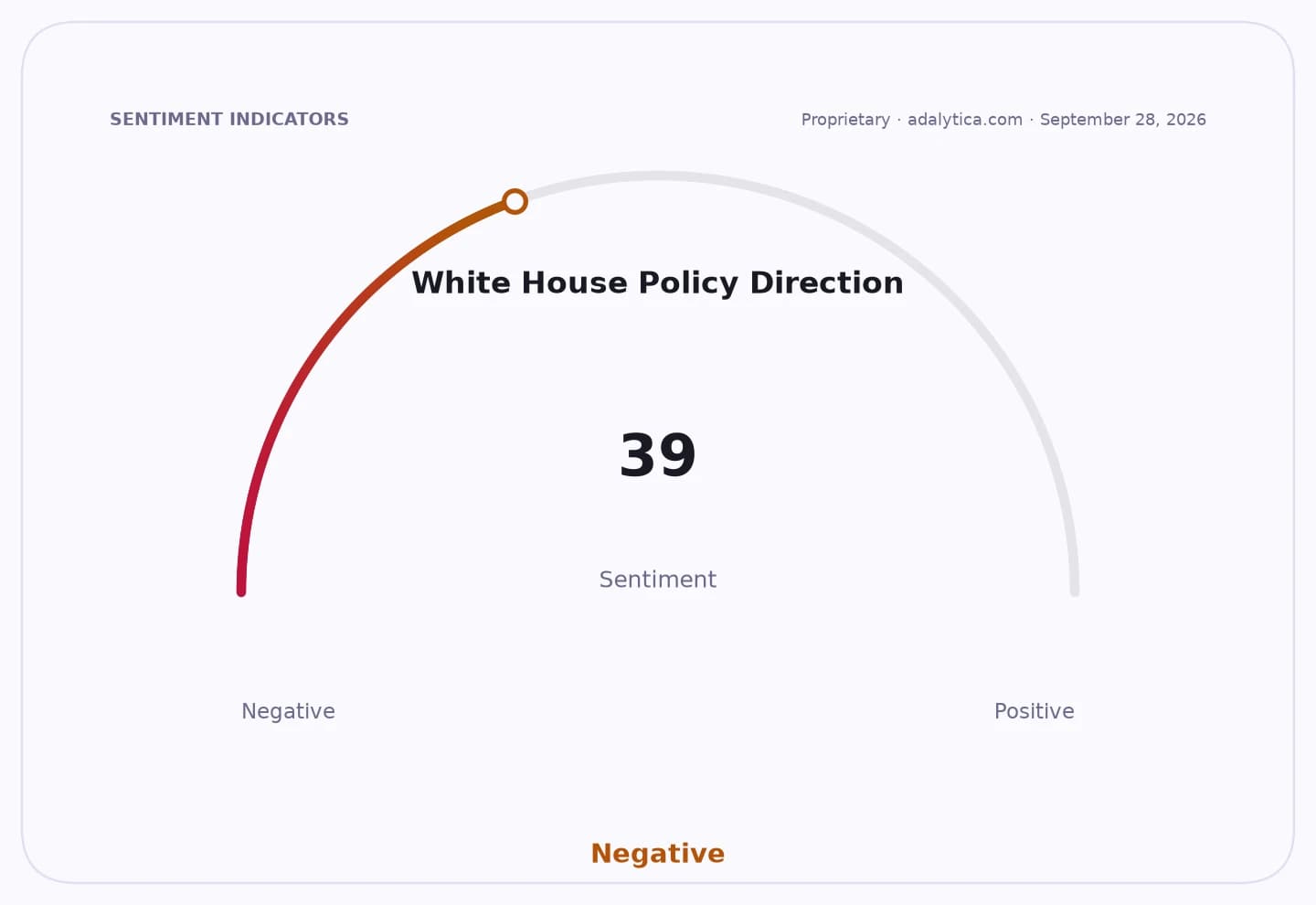
Sentiment IndicatorsⓘProprietary · adalytica.com · September 28, 2026
This is a snapshot — live sentiment, awareness and momentum for 130+ markets update continuously in the dashboard.Open AlphaPulse

By a 12-point margin, registered voters said they would prefer a Democrat in Congress over a Republican, 53% to 41%. More tellingly, 45% said their vote was a rebuke of Trump, including four in five Democrats and about half of independents, while only about a quarter said they were voting to support him. Trump’s approval rating sat at 39%, with 59% disapproving, and 53% saying they strongly disapprove — the highest level recorded in the survey since the question was first asked in 2017.
That is more than a headline approval problem. It points to a voter mood that can reshape turnout, donor confidence and candidate strategy in the final stretch of the campaign. Republicans have begun to distance themselves from the president on issues that usually help them, especially immigration, the economy and gas prices, because the polling suggests Trump is no longer a universal asset even among his own voters. The survey found Democrats ahead on the economy by 42% to 38%, on gas prices by 40% to 27% and on foreign policy by 42% to 36%.
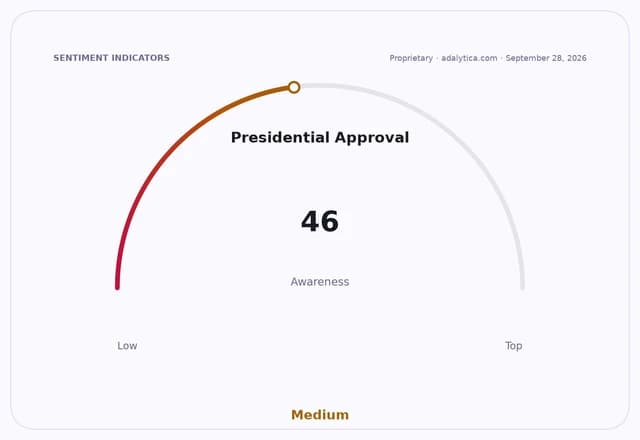
Presidential Approval vs DJTadalytica.com
Explore this data interactively — full history, time series and cross-market comparisons.Open AlphaPulse
The political implications are especially serious in the Senate. The poll’s dynamic helps explain why Democrats are competitive in states such as Ohio, Alaska, Iowa and Texas, all places where Trump won decisively in 2024 but where higher prices and war-related anxieties are giving Democrats a path back into races that once looked out of reach. It also reinforces a broader trend: Trump voters are less engaged in the 2026 midterms than supporters of Kamala Harris, and less likely to say they are following the election closely, a gap that could prove decisive in low-turnout contests.
Economic conditions are feeding the backlash. Rising prices, particularly for fuel, are shaping voter perceptions of the administration and the party in power. The poll found voters think Democrats would handle gas prices and the economy better, and that is a warning sign for Republicans because these are the issues most likely to determine whether swing voters split their tickets or simply stay home. In practical terms, high prices give Democrats a simple argument and force Republicans to defend an incumbent president whose brand still dominates the ballot even when he is not on it.
That leaves Republicans in an increasingly awkward position. Some have started to break with Trump on policy, not ideology, but out of electoral necessity. The question now is whether those breaks are enough to stem losses, or whether the midterms become a referendum on a president whose approval is sinking and whose political style is animating opponents more than supporters. For investors watching Washington, the stakes are less about party labels than about policy continuity: a weaker Trump grip on Congress would raise the odds of legislative gridlock, while a Democratic rebound would shift the balance on taxes, regulation and spending just as markets continue to price in higher rates and stubborn inflation.
| Entity | Gains | Losses |
|---|---|---|
| Democrats | ▲Midterm momentum | ▼Republican control of Congress |
| Republicans | ▲Base loyalty | ▼Swing voters and independents |
| Trump | ▲Party centrality | ▼Approval ratings, coattails |
| Consumers | ▲Potential policy restraint | ▼Little immediate relief on prices |