The UK’s Employment Committee is set to hear expert evidence on whether workers’ minimum entitlements are still adequate, a review that could shape the next round of labor policy, raise compliance costs for employers and alter the outlook for sectors that rely on large, lower-paid workforces.
UK Entitlements Review Could Pressure Labor-Heavy Firms

The hearing matters because minimum entitlements are not just a social policy issue; they feed directly into household income, consumption and the cost base of consumer-facing businesses. In an economy where unemployment is forecast at 4.18% in July from 4.2% in June and inflation is still running far above long-run norms, the debate is likely to focus on whether existing protections are keeping pace with living costs and the structure of modern work.
Sentiment IndicatorsⓘProprietary · adalytica.com · July 27, 2026
This is a snapshot — live sentiment, awareness and momentum for 130+ markets update continuously in the dashboard.Open AlphaPulse
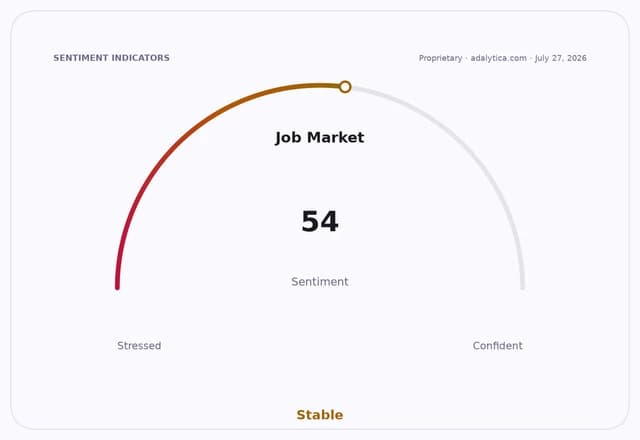
That makes the committee’s timing significant. UK labor markets remain relatively tight by historical standards, but that does not mean workers are insulated. Adalytica’s Job Market Sentiment snapshot is neutral at 54, while its awareness reading points to fear, suggesting a fragile backdrop for labour-related headlines. Against that, policymakers are under pressure to determine whether statutory minimums on pay, leave, notice periods and other benefits are sufficient, particularly for low-paid and precarious workers who often have little bargaining power.
For employers, the risk is that any recommendation to strengthen entitlements would flow through to wages, benefits administration and staffing flexibility. Retailers, food service operators and other labor-intensive businesses would be most exposed, especially if lawmakers move from review to reform. That is where the market relevance becomes clearer: the policy debate could eventually affect operating margins, wage inflation and the valuation premium investors are willing to pay for consumer companies with thin profit buffers.
The macro backdrop argues for caution. Consumer prices remain elevated relative to the pre-pandemic era, with the CPI at 332.568 in June versus 332.407 in April, while employment levels continue to rise, with payrolls at 158,984 in June and forecast to edge higher in July. That combination usually strengthens the case for better protections, but it also means businesses have less room to absorb additional labour costs without passing them on to consumers or trimming hiring.
The issue is already resonating in markets that are sensitive to labour expense. McDonald’s shares have fallen sharply from a February high and recent technical readings show the stock below its 200-day moving average, reflecting investor concern over operating pressure and weakening momentum. Walmart and Amazon have also seen recent volatility, and while their business models are stronger, both face the same broad question: how much more cost inflation can consumer companies absorb before it hits earnings quality.
The bear case is that a broader entitlements push could harden wage expectations just as growth remains uneven, forcing employers to choose between lower margins and slower hiring. The bull case is that clearer minimum standards would improve labour stability, reduce turnover and support consumer demand by strengthening disposable income at the bottom end of the market.
For investors, the key question is not whether the committee will generate headlines, but whether it signals a policy shift toward more expansive worker protections. If it does, the winners are likely to be households and higher-productivity firms able to absorb higher labour costs, while the losers may be low-margin employers and outsourcers that depend on flexible staffing.
| Entity | Gains | Losses |
|---|---|---|
| Low-paid workers | ▲stronger protections | ▼little immediate downside |
| Large retailers | ▲clearer rules | ▼higher payroll costs |
| Restaurants and food service | ▲steadier staffing | ▼margin pressure |
| Consumers | ▲more income support | ▼risk of higher prices |