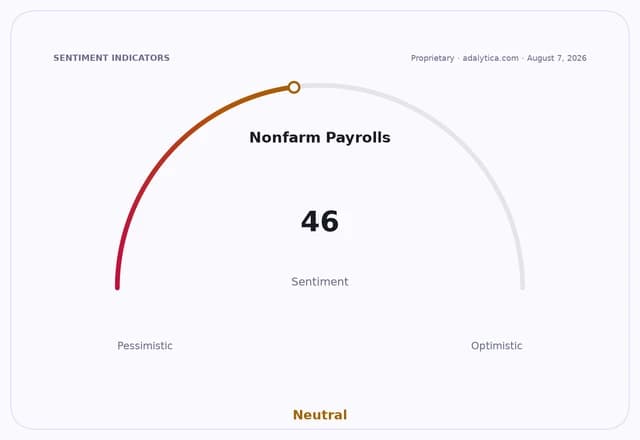
U.S. payroll growth is expected to inch higher in August, with economists looking for a 158,959 increase in nonfarm jobs, a move that would support the view that January’s jump was an outlier rather than the start of a new hiring boom.
U.S. August Payrolls Seen Rising 158,959

That matters because the labor market remains the key variable for the economy, wages and Federal Reserve policy. A modest pickup in hiring would point to a still-resilient job market, but not one strong enough to force a sharp rethink on rates or inflation.
Sentiment IndicatorsⓘProprietary · adalytica.com · August 7, 2026
This is a snapshot — live sentiment, awareness and momentum for 130+ markets update continuously in the dashboard.Open AlphaPulse

The forecast for August follows a patchy stretch in which payrolls were projected at 158,861 in May, 158,881 in June and 158,858 in July, suggesting essentially flat employment growth through the summer. The unemployment rate is seen edging down to 4.09% from 4.1% in July and 4.2% in June, a level that remains low by historical standards and consistent with a labor market that is cooling only gradually.
January’s apparent jump in jobs, by contrast, now looks more like a statistical blip than a durable acceleration. Investors will read that as evidence that the economy is not running hot enough to reignite wage spirals, even though pay pressures remain in focus.
That tension is showing up in market positioning. The Industrial Select Sector SPDR Fund, XLI, closed at $185.15 on Aug. 7, above its 50-day moving average of $179.59 and its 200-day average of $167.42, while the RSI reading of 65 suggests firm momentum. The Financial Select Sector SPDR Fund, XLF, finished at $57.62, also above both its 50-day and 200-day moving averages, as traders continue to favor cyclical exposure when labor data stays firm but not overheated.
Wage sentiment is still running hot in Adalytica’s gauge, with the latest reading at 71 and awareness at 100, underscoring why investors remain sensitive to any upside surprise in payrolls or earnings. A stronger-than-expected jobs report would likely lift Treasury yields and pressure rate-sensitive assets; a softer print would reinforce bets that the Fed can keep easing inflation without a recession.
The next catalyst is the August employment report itself, which will show whether hiring is stabilizing near current levels or slipping further as higher borrowing costs and slower growth work through the economy.
| Entity | Gains | Losses |
|---|---|---|
| Workers | ▲steadier hiring | ▼bargaining power if labor cools |
| Employers | ▲easier wage control | ▼weaker demand if hiring slows |
| Fed | ▲clearer soft-landing path | ▼less room to cut if jobs reaccelerate |
| Cyclical stocks | ▲support from stable labor data | ▼pressure from a sharp downside surprise |