The United States has lost more of its lead over China in Asia than at any point since the Lowy Institute began tracking regional power, a shift that matters because it points to a slower, more contested era for trade, security and investment across the world’s most important growth market.
U.S. Lead Over China in Asia Narrows
Geopolitical Risk
The Australian think tank said the gap between the two powers narrowed to 5.3 points, the smallest in the Asia Power Index since the series began in 2018. The U.S. score in Asia fell to 78.9 out of 100, while China continued to close the distance across diplomacy, military reach and regional influence.
Sentiment Indicators
Geopolitical Risk
For investors, that is not just a geopolitical headline. A narrower U.S. lead in Asia usually means more policy uncertainty around supply chains, defense spending, technology controls and market access. Those are the fault lines that shape everything from semiconductor demand to shipping routes, critical minerals and the valuation of companies exposed to China’s domestic economy and broader Asia growth.
The Lowy findings suggest Washington’s biggest weakness is no longer just hard power. The institute said diplomatic influence suffered its steepest decline on record, and that loss has been linked to a more transactional U.S. foreign policy under President Donald Trump. In practical terms, that kind of retreat can unsettle allies and make regional governments hedge rather than align, which tends to benefit China’s long game.
The military balance is still tilted toward the U.S., but even there the gap has narrowed, from 27 points in 2018 to a little more than 15 in the latest reading. The report also pointed to strained trust with allies after Washington cut the scale of joint exercises with South Korea and treated $14 billion in weapons for Taiwan as bargaining leverage in talks with Beijing.
That is why this matters economically. Asia is where global manufacturing, consumer demand and strategic supply chains overlap. If U.S. influence erodes, companies can face a messier operating environment: more export controls, more incentive for nations to diversify away from American-aligned systems, and a greater push to localize production in China and neighboring markets.
The report also highlights a key long-term market theme: China’s rise is not happening in a vacuum. India strengthened its regional standing, underscoring that Asia is becoming more multipolar rather than simply shifting from American to Chinese dominance. That can be good news for investors who favor broad diversification across Asian equities, but it also raises the odds that winners will be harder to identify and geopolitical swings more frequent.
For exchange-traded fund investors, the message is straightforward. China-focused funds such as the iShares China Large-Cap ETF have been under pressure, with the fund recently trading below its 50-day and 200-day moving averages, while the leveraged YINN fund has remained deeply volatile. That kind of price action reflects the market’s wider hesitation: China may be gaining strategic weight, but investors still want clearer evidence that growth, policy and corporate earnings are moving in the same direction.
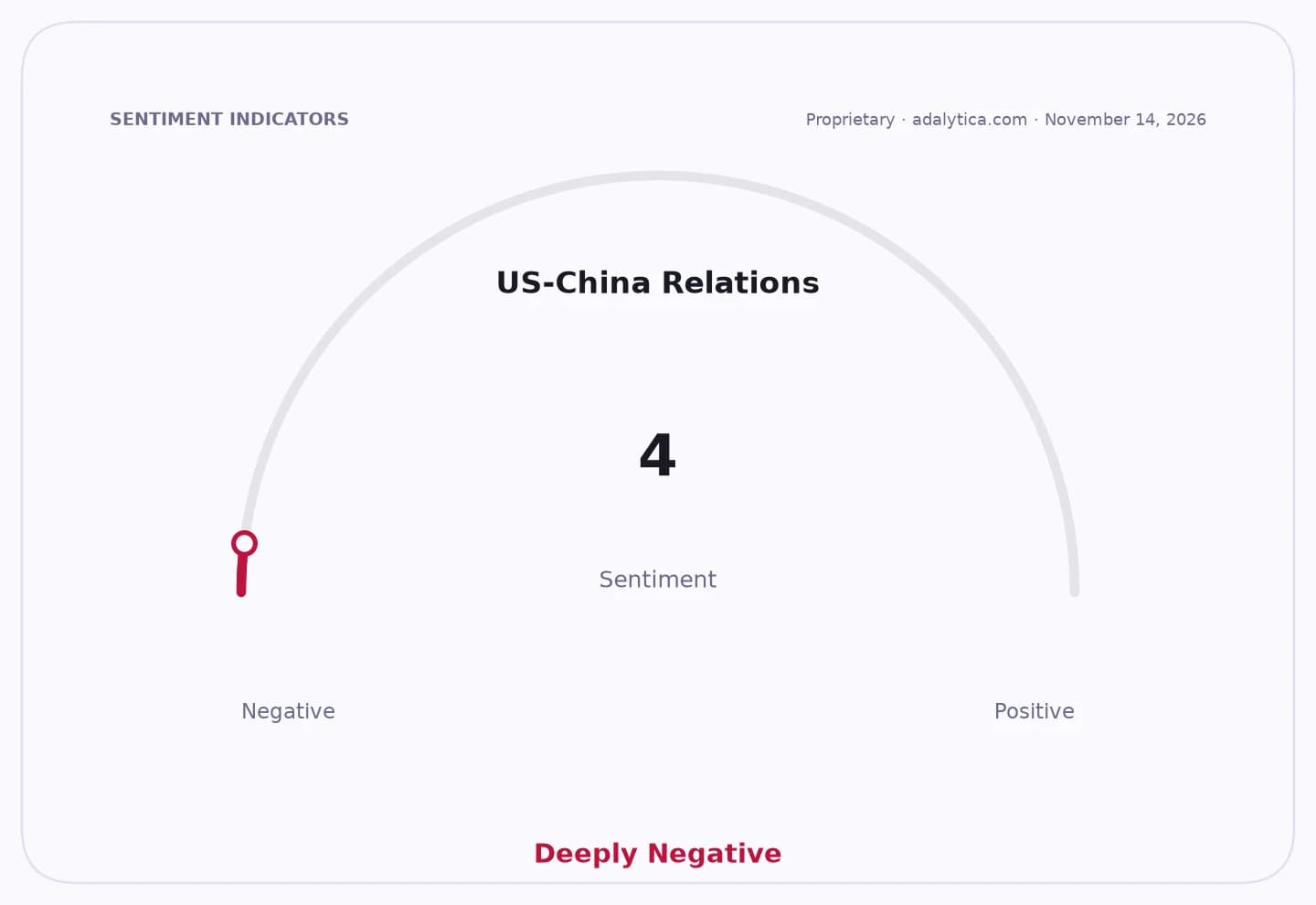
Adalytica’s U.S.-China Relations Sentiment gauge shows intense attention around the relationship, while global stability readings remain fragile. That combination fits the broader story: markets are bracing for a world in which competition between Washington and Beijing is structural, not temporary.
Over the next several years, investors should think less about a clean winner and more about a prolonged contest that will reshape sectors tied to defense, AI, rare earths, advanced manufacturing and Asia-Pacific trade. For patient investors, that argues for staying diversified, watching policy closely and focusing on companies with durable moats rather than trying to time every geopolitical swing.
| Entity | Gains | Losses |
|---|---|---|
| China | ▲More regional influence | ▼Less U.S. restraint |
| United States | ▲Military edge remains | ▼Diplomatic credibility |
| Asia-Pacific allies | ▲More strategic leverage | ▼Greater uncertainty |
| China-linked assets | ▲Policy tailwinds | ▼Volatility from tensions |