External pressure on China is not breaking Beijing’s trajectory — it is hardening it, and that is exactly why investors should care now.
China Pressure, ETFs, and Industrial Policy

Frans-Paul van der Putten’s argument is more than a historical thesis. It is a roadmap for how the market should read the current U.S.-China fight: sanctions, export controls and diplomatic isolation may slow China in the short run, but they also force the country to adapt, localize and ultimately deepen its industrial base. That makes the contest economically significant far beyond geopolitics. It is reshaping capital spending, supply chains and the future winners in semiconductors, infrastructure and China-linked equities.
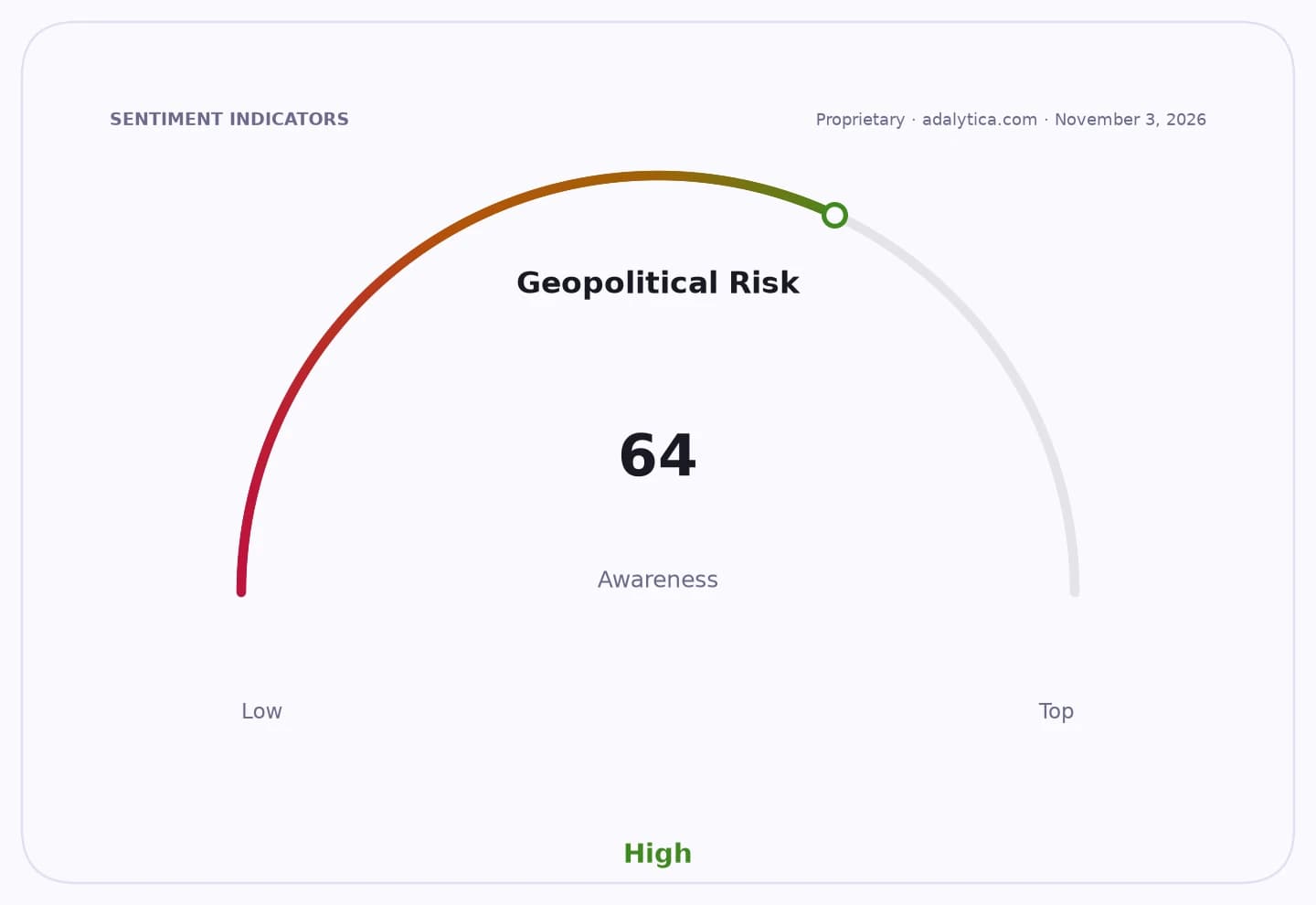
Sentiment Indicators
US-China Relations
The market is already telling that story, even if the consensus still treats China as a simple risk-off trade. The iShares MSCI China ETF, MCHI, has slid to $49.75 from $63.84 in January, while the Tech-heavy China proxy remains below both its 50-day and 200-day moving averages. RSI readings near the high-50s and a still-negative MACD show a market that has stabilized but has not rebuilt conviction. The broader China A-share ETF, ASHR, is also under pressure at $30.45, beneath both its 50-day and 200-day averages. That is the kind of setup that often precedes a policy-driven rebound, not a clean confirmation of permanent weakness.
What the market may be underestimating is the second-order effect of pressure. Van der Putten is blunt: cutting China off from the most advanced chips hurts in the short term, but over time it pushes Beijing to become more self-reliant. That matters for investors because every layer of forced substitution creates a new pool of domestic demand — for chip equipment, industrial software, power infrastructure, advanced manufacturing and capital goods. The loser is the global supplier that assumed China would stay dependent forever. The winner is the company positioned to serve a country that is being compelled to spend its way toward autonomy.
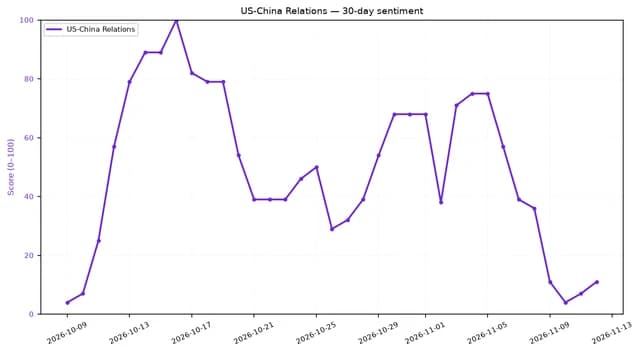
That is why the U.S.-China relationship remains one of the most investable geopolitical themes in global markets. The sentiment gauge from Adalytica.com on U.S.-China relations is now in “Extreme Fear,” a sign that positioning is already heavily pessimistic. Historically, those are the moments when the market most often misses the upside from policy response. Beijing does not usually retreat when pressured; it mobilizes. It uses the threat to justify more state support, more domestic industrial policy and more strategic patience. That is why the long-term trade is not simply “avoid China.” It is to own the parts of the ecosystem that benefit when China accelerates its own self-sufficiency drive.
The implication is broader than one country. Europe, for example, still depends on China’s market access and on European semiconductor tools, even as it talks tougher on strategic dependency. That creates a narrow but important opening for firms that sit in the leverage points of the system — especially equipment makers, automation suppliers and high-end industrial exporters. At the same time, companies and funds exposed to broad Chinese demand may continue to oscillate until the market stops treating external pressure as a growth killer and starts pricing it as an accelerant for domestic substitution.
My view is that this is an inflection point, not a breakdown. The market underestimates how much external pressure can strengthen Beijing’s hand over a multi-year horizon, and that mispricing creates opportunity. I would not chase the weakest China exposure blindly, but I would be looking for selective entry into ETFs and stocks tied to Chinese domestic reindustrialization, semiconductor localization and infrastructure buildout. When the fear is this intense, the best asymmetric trade is often the one built on a simple idea: pressure does not always weaken a system — sometimes it makes it stronger.
| Entity | Gains | Losses |
|---|---|---|
| Chinese industrial policy | ▲More urgency, more subsidies | ▼Short-term growth efficiency |
| Domestic chip suppliers | ▲Forced localization demand | ▼Foreign advanced suppliers |
| U.S. exporters to China | ▲Near-term leverage from scarcity | ▼Long-term market share if China substitutes |
| Broad China ETFs | ▲Rebound potential from fear | ▼More volatility and policy risk |