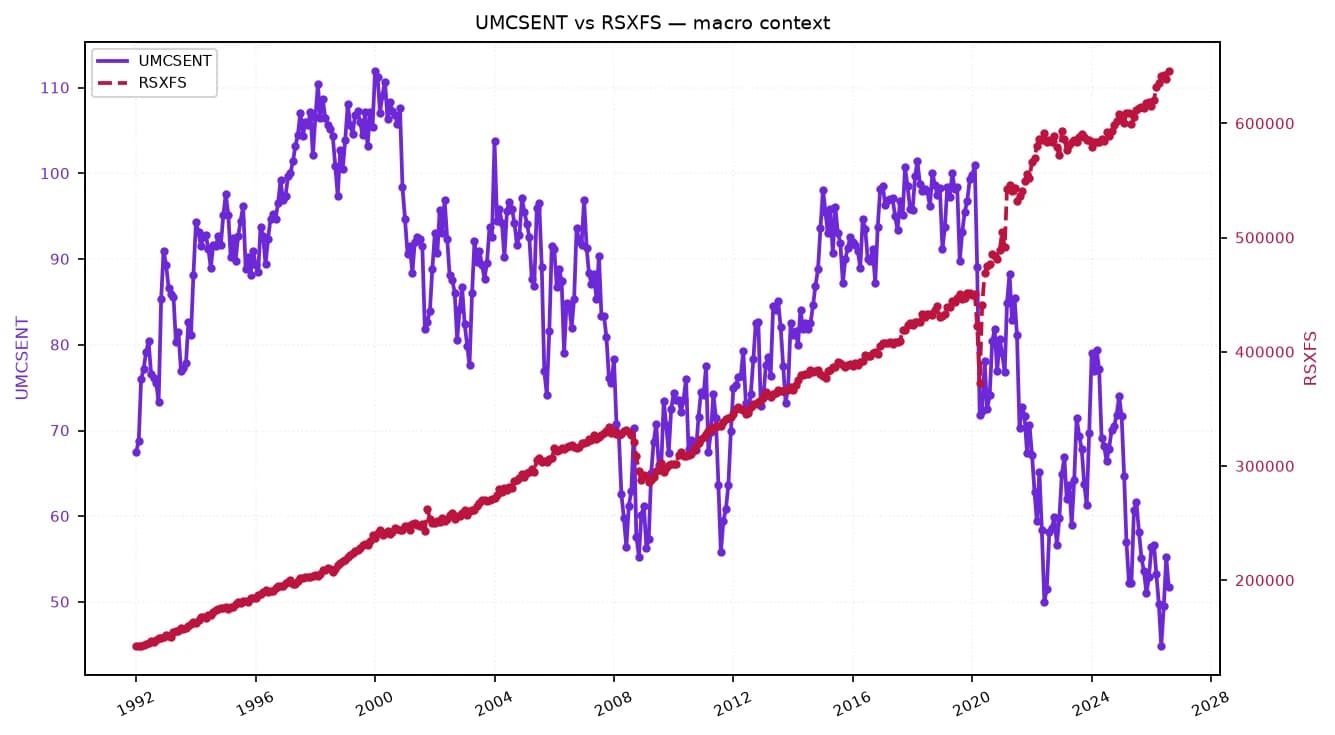
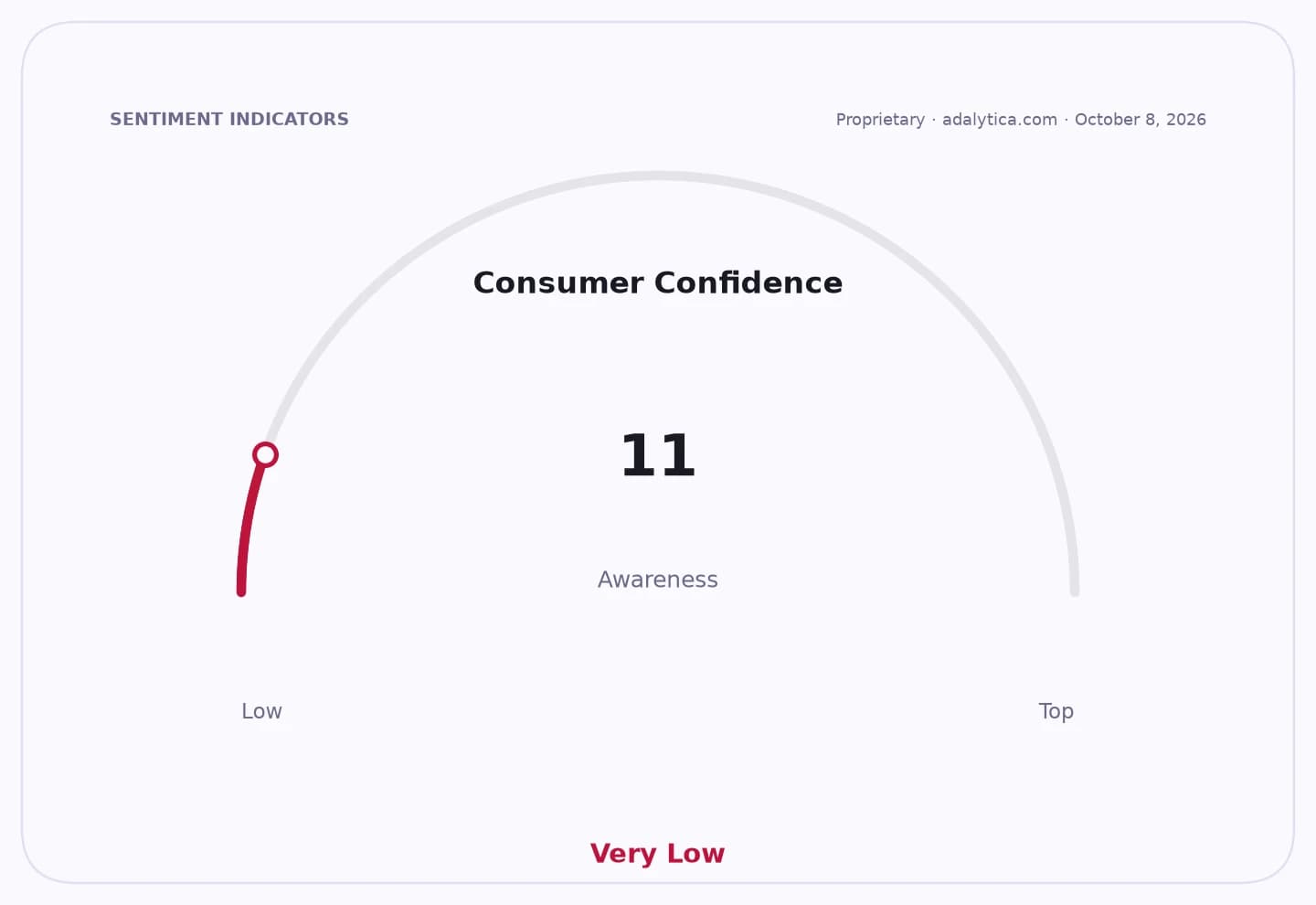
U.S. consumer confidence slipped in October to 46.3, missing expectations and underscoring growing pressure on household spending just as inflation fears tick higher again.
U.S. Consumer Confidence Falls to 46.3 in October
The University of Michigan’s preliminary reading fell 1.8 points from September’s 48.1 and marked the weakest level since May, a sign that American households are becoming more cautious about the economy heading into the final stretch of the year. The market had expected 47.5.
Sentiment IndicatorsⓘProprietary · adalytica.com · October 13, 2026
This is a snapshot — live sentiment, awareness and momentum for 130+ markets update continuously in the dashboard.Open AlphaPulse

The deterioration was concentrated in how consumers viewed current conditions. The index tracking assessments of present economic conditions dropped 6.2 points to 44.7, while the expectations gauge rose 1 point to 47.3, suggesting households still see some resilience ahead even as the near-term backdrop worsens.
What matters for the broader economy is that softer confidence can translate into slower discretionary spending, especially if consumers also become more uneasy about prices. That is particularly relevant for retailers, travel names and other consumer-facing companies that depend on stable demand.
Inflation expectations moved in the wrong direction. Short-term expectations for price growth edged up to 4.7% from 4.6%, while long-term expectations rose to 3.5% from 3.4%. Both measures climbed for a second straight month to their highest since May and remained above the ranges seen earlier in 2024.
For investors, the report reinforces the tension between a still-solid labor market and households that remain uneasy about purchasing power. Consumer discretionary stocks, tracked by the XLY ETF, tend to be more exposed to that squeeze, while staples such as XLP can draw support when shoppers turn defensive.
The readout also comes as broader market gauges still show risk appetite holding up, with the S&P 500 near record territory, but that optimism could be tested if weaker sentiment starts showing up in sales data, earnings guidance or a slowdown in holiday demand.
| Entity | Gains | Losses |
|---|---|---|
| Consumer staples stocks | ▲Defensive spending | ▼Cyclical demand |
| Consumer discretionary stocks | ▲Better if spending holds | ▼Slower discretionary sales |
| Retailers | ▲Stable traffic if labor market stays firm | ▼Margin pressure from cautious shoppers |
| Consumers | ▲Less immediate price shock if spending eases | ▼Lower confidence and inflation anxiety |