The U.S. government’s debt load has climbed to a record that now works out to roughly $300,000 for every household, a reminder that America’s long-running borrowing habit is becoming an even bigger economic and investing issue.
U.S. debt tops $40.4 trillion, weighs on rates

That figure matters because debt is not just a political talking point — it eventually filters into interest rates, tax policy, bank balance sheets and consumer spending. With federal borrowing now above $40.4 trillion and the debt burden running at more than 127% of GDP, the cost of financing the U.S. economy is rising into a market that is already highly sensitive to rates.
Sentiment Indicators

For investors, the key question is less about the headline number itself than what it implies for returns over the next several years. Heavy public borrowing can keep pressure on Treasury yields, influence the Federal Reserve’s room to cut rates and reshape valuations across stocks, bonds and dividend-paying sectors. When the government needs to refinance such a large debt stock, even small moves in rates can have an outsized effect on the federal budget and on markets that price off Treasury benchmarks.
The latest numbers also help explain why financial stocks and consumer lenders remain worth watching. American Express recently said card net write-offs rose to $1.13 billion in the third quarter, while peer lenders continue to track credit performance closely as households juggle higher borrowing costs. At the same time, bank and financial ETFs such as XLF and KRE have held up better than broader risk assets, reflecting a market that is trying to price resilient lending alongside slower growth and sticky funding costs.

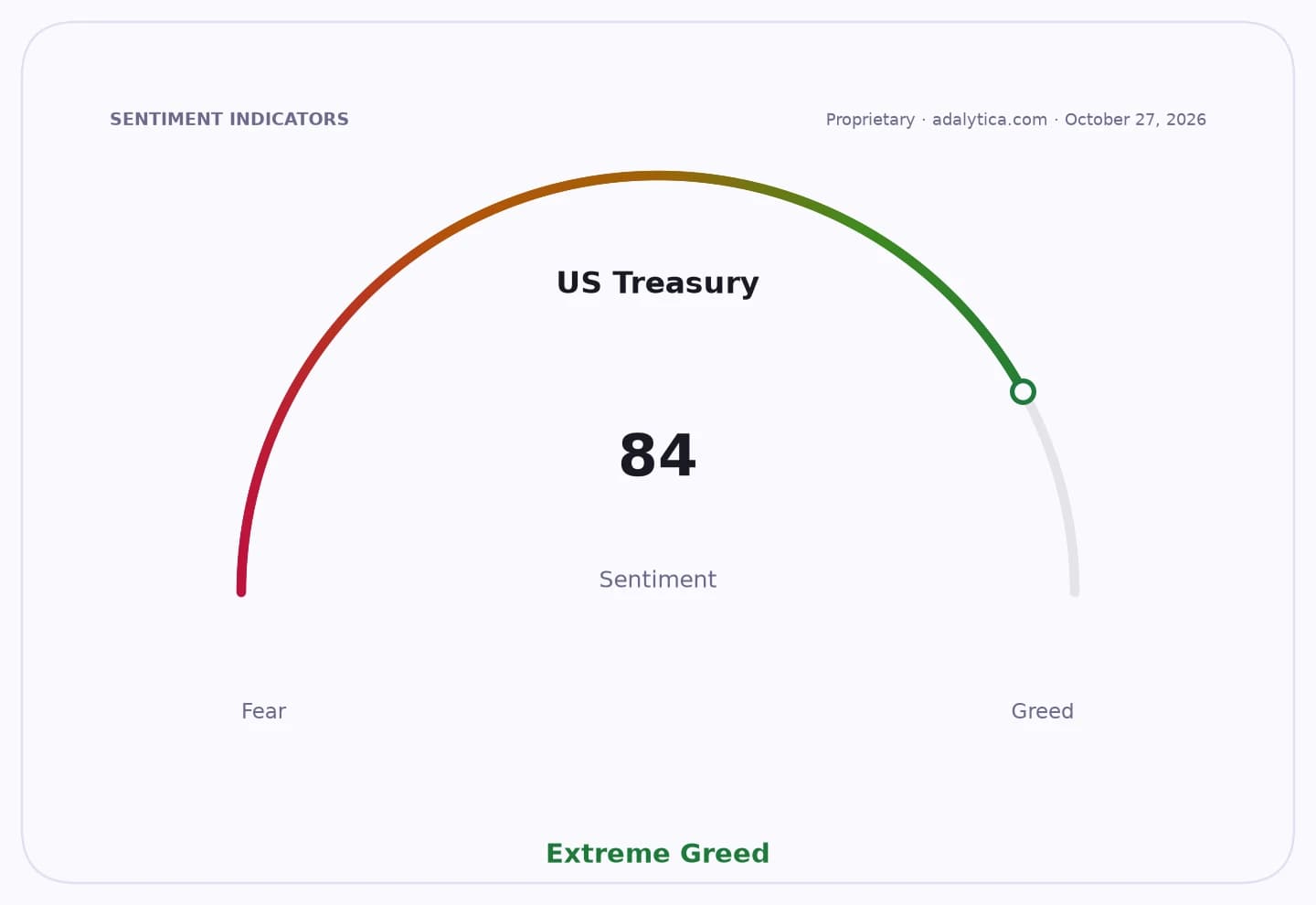
Treasury market signals point to the same tension. Adalytica’s U.S. Treasury bonds snapshot shows “extreme greed” in sentiment even as “awareness” sits at “extreme fear,” a combination that suggests investors are seeking safety while remaining highly attuned to fiscal strain. In plain English, the bond market is still listening carefully to Washington’s borrowing needs.
The long-term takeaway is that record household exposure to federal debt is more than a statistic — it is a structural backdrop for savers, borrowers and stock pickers. A country can carry a large debt load for a long time, but it usually does not do so without consequences in growth, rates and market leadership. For patient investors, that makes quality balance sheets, pricing power and diversified exposure more important than ever. Keep this trend on your watchlist.
| Entity | Gains | Losses |
|---|---|---|
| Treasury bondholders | ▲Higher demand for safe assets | ▼Yield volatility |
| Banks and lenders | ▲Wider lending opportunities | ▼Rising credit risk |
| Equity investors in defensive sectors | ▲Relative stability | ▼Faster rate pressure |
| U.S. taxpayers and households | ▲None immediately | ▼Larger future financing burden |