America’s debt bill has crossed a line investors can’t ignore: net interest on the federal debt has surged to a record $1.05 trillion in fiscal 2026, now larger than the Pentagon’s $956 billion budget.
U.S. net interest hits $1.05 trillion in 2026

That matters because interest is no longer a background line item. It is competing with the core functions of government and widening the budget squeeze at a time when the deficit is already deepening. The Treasury’s year-end report showed the fiscal 2026 deficit rose to $1.99 trillion, up 12% from 2025, while net interest became the third-biggest federal expense after Social Security and Medicare. In other words, more of every tax dollar is being diverted to past borrowing instead of current priorities, and that leaves Washington with less room to respond to the next recession, war or financial shock.
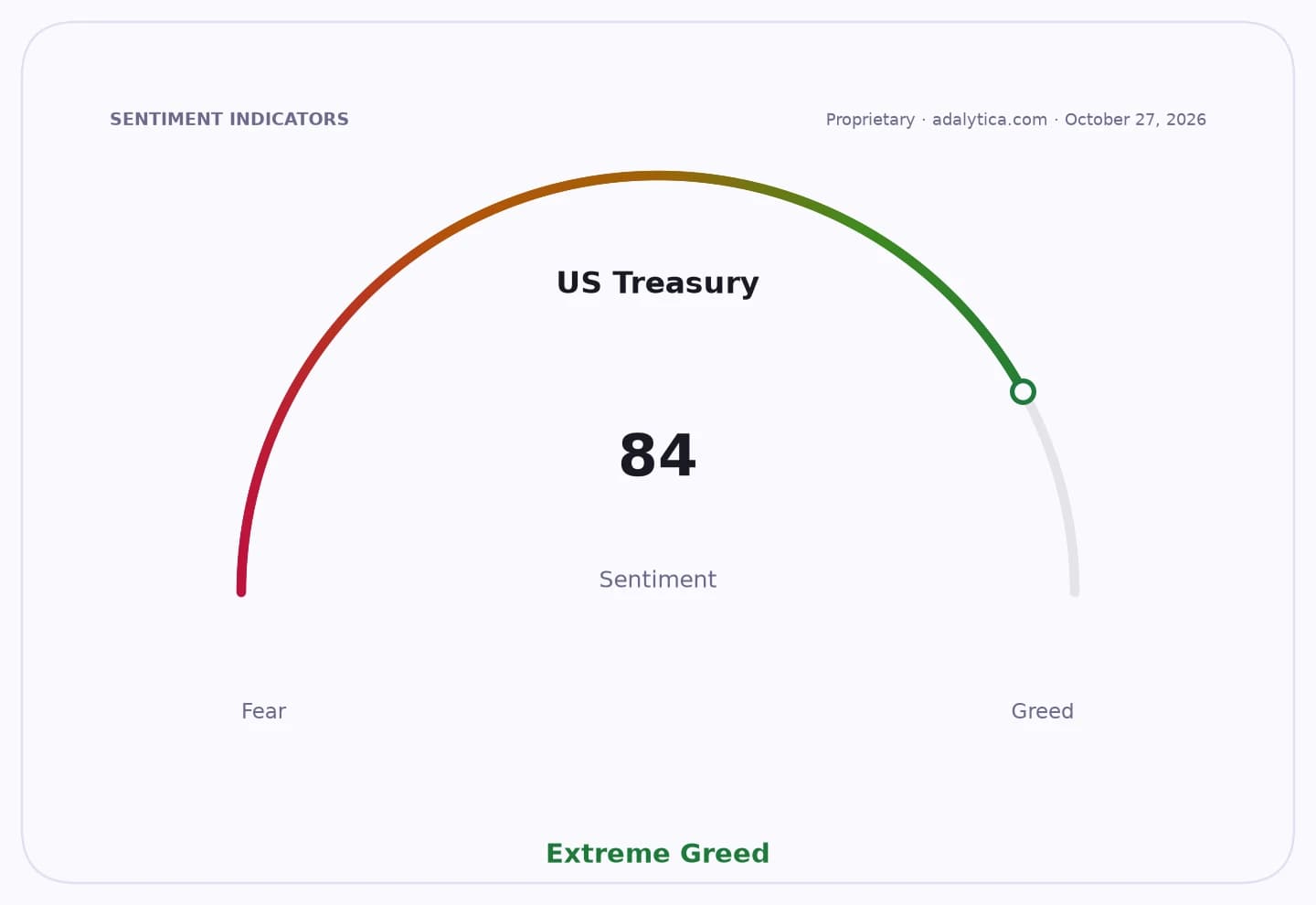
Sentiment Indicators
The math behind the surge is straightforward and ominous. Higher long-term rates have pushed the average interest rate on federal debt to 3.53%, more than double the 1.6% level in 2021, before the Federal Reserve began its tightening cycle to fight inflation. The Congressional Budget Office said the 11% increase in debt-service costs from 2025 was driven by those higher rates. Even more concerning, interest payments are now rising faster than the economy itself: the latest increase outpaced revenue growth, total spending growth and nominal GDP growth, a pattern that is hard to sustain indefinitely.
For investors, this is not just a Washington problem. It is a bond-market problem, a currency problem and, eventually, an earnings problem. When the government must refinance trillions of dollars at rates near 5% on the 10-year Treasury, the crowding-out effect becomes real. That can keep pressure on longer-term yields, support the dollar at times, and complicate valuations across stocks, especially for companies that rely on cheap borrowing to fund growth. It also helps explain why Treasury ETFs such as TLT and IEF have remained volatile even as they try to recover from earlier rate shocks.
There is also a global angle. French and British borrowing costs are already flashing warning signs of their own, showing that sovereign debt stress is not uniquely American. But the U.S. is still the benchmark market, and when the world’s deepest debt market sees interest expense jump above defense spending, investors tend to reassess what “safe” really means. That can ripple through everything from bank balance sheets to housing finance to the discount rates used on future corporate earnings.
None of this means the U.S. is headed for an immediate fiscal crisis. The dollar still has reserve-currency advantages, and Treasury debt remains the world’s preferred collateral. But the direction of travel is clear: if rates stay elevated and deficits remain close to $2 trillion, the government’s interest burden will keep compounding faster than policymakers would like.
For long-term investors, the lesson is simple: the debt burden is now part of the macro backdrop, not a side story. Favor diversified portfolios, focus on businesses with real pricing power and strong free cash flow, and keep an eye on the bond market, because Washington’s interest bill is becoming one of the most important numbers in finance. Worth watching closely.
| Entity | Gains | Losses |
|---|---|---|
| Treasury bondholders | ▲Higher interest income | ▼Credit risk if deficits worsen |
| U.S. government | ▲Short-term financing access | ▼Growing interest burden |
| Taxpayers | ▲None | ▼Less fiscal room for services |
| Long-duration assets | ▲Potential relief if yields fall | ▼Pressure from higher discount rates |