The U.S. economy is still growing, but a new round of forecasts from more than 40 banks and consulting firms suggests investors should expect a year of slower momentum, firm inflation and a dollar that stays relevant in global markets.
U.S. GDP Forecast 1.29% and CPI 0.89% in July 2026
That matters because the combination of decent GDP growth and stubborn inflation is exactly what keeps the Federal Reserve from cutting too quickly, and it helps explain why Treasury yields, the dollar and equity valuations have all remained sensitive to every new economic print. The latest forecast now puts U.S. GDP growth at 1.29% for July 2026, up from a 1.91% pace in April and a 1.41% reading in January, while consumer prices are projected to rise 0.89% in July after a 0.42% decline in June.
Sentiment IndicatorsⓘProprietary · adalytica.com · August 5, 2026
This is a snapshot — live sentiment, awareness and momentum for 130+ markets update continuously in the dashboard.Open AlphaPulse
In plain English, the economy is not rolling over, but it is not giving policymakers much room to relax either. A GDP path like that points to a late-cycle environment where growth is positive but uneven, leaving companies to fight for pricing power and margins instead of relying on a broad demand boom. For investors, that usually means the market rewards businesses with durable free cash flow, strong balance sheets and genuine pricing power — and punishes those that depend on cheap money or a falling dollar to do the heavy lifting.
The bond market is already telling that story. U.S. Treasury ETF TLT has swung sharply, with recent prices around $82.82 after touching $88.79 in February, while Adalytica’s U.S. Treasury Bonds Trade Signals still show elevated awareness and greed. That kind of positioning says investors are trying to game the next move in rates rather than bet on a clean, fast disinflation trend.

The dollar is also holding its own. UUP, which tracks the U.S. dollar, has been trading around $28.16, above its 50-day and 200-day moving averages, even after some short-term cooling in momentum. A steady dollar can be a headwind for multinational earnings and commodities, but it also reflects continuing confidence in U.S. assets relative to much of the world.
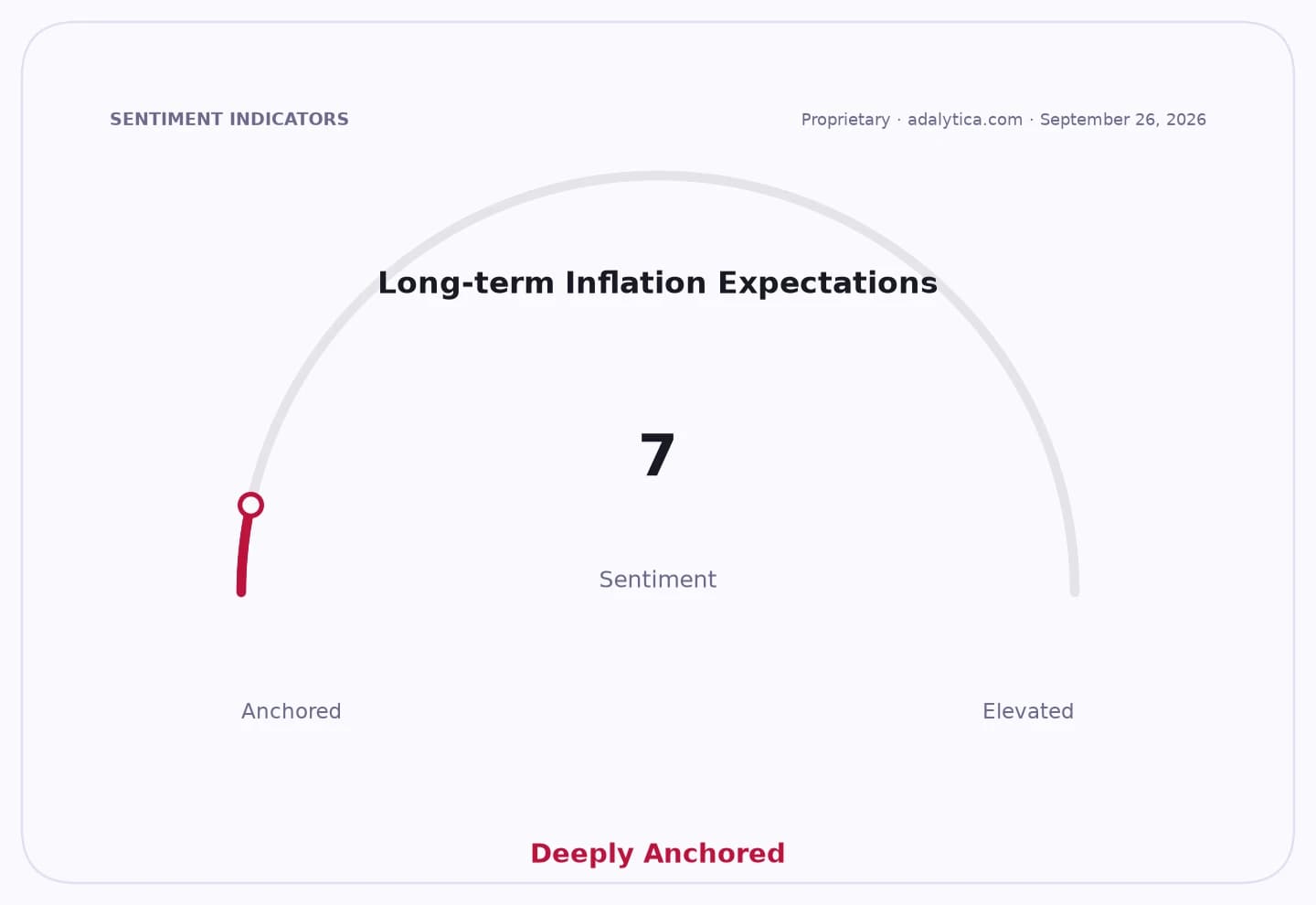
Inflation expectations are the key swing factor here. Adalytica’s gauge for confidence in the Fed’s 2% target has climbed sharply to 82, a sign that markets are leaning back toward faith that price pressures can eventually normalize. But the actual CPI forecast still points to a 0.89% monthly increase in July, a reminder that the path lower may be uneven.
That puts the Federal Reserve in a familiar bind: growth is good enough to avoid recession panic, but inflation is sticky enough to keep policy restrictive. For stock investors, that usually favors quality over speculation. Large-cap U.S. equities remain in a better position than rate-sensitive, highly leveraged businesses, and broad indexes can still compound over time — but only if earnings growth, not just multiple expansion, does the work.
The long-term takeaway is simple. If this forecast is right, 2026 looks less like a dramatic turning point and more like a year of slow, steady adjustment: a moderate GDP backdrop, cooling-but-not-cured inflation, and a dollar that remains an important force in global portfolios. That is not a recipe for euphoria, but it is a good environment for patient investors who own resilient businesses and stay diversified for the next 3 to 10 years.
| Entity | Gains | Losses |
|---|---|---|
| Dollar bulls | ▲Stronger U.S. assets | ▼Exporters and multinationals |
| Treasury holders | ▲Yield support from sticky inflation | ▼Long-duration bond prices |
| Quality stocks | ▲Pricing power and cash flow | ▼High-debt, rate-sensitive names |
| Consumers | ▲Employment and growth hold up | ▼Purchasing power stays squeezed |