The United States’ dissatisfaction with Germany’s hard line on Russia at the G20 is more than a diplomatic spat — it is another sign that the transatlantic bloc is struggling to stay aligned on the war in Ukraine, trade and economic policy at a moment when investors are pricing a fragile global outlook.
US-Germany Rift Over Russia at G20

That matters because policy unity is the hidden support beneath markets that depend on energy flows, sanctions enforcement, defense spending and the euro’s stability. When Washington is irritated with Berlin over how forcefully it confronted Russian finance officials in a G20 setting, the message is that the West is not moving in lockstep on how long to isolate Moscow or how to manage the costs of that isolation.

Bloomberg reported that U.S. officials conveyed their displeasure after German representatives publicly criticized Washington’s currency-intervention posture and took an especially combative stance toward Russia at the meeting. U.S. Treasury Secretary Scott Bessent was said to be particularly unhappy with German Finance Minister Lars Klingbeil’s uncompromising approach toward Russian counterpart Anton Siluanov. The friction underscores a widening policy gap between Washington and European capitals on tariffs, Ukraine and Russia, even as the conflict continues to shape capital flows and commodity risk premia.
For investors, the important point is not the dinner-table drama. It is that every fresh crack in the Western coalition raises the odds of a more erratic sanctions regime, more unpredictable energy trade, and a slower return to policy normality in Europe. That is not bullish for cyclical confidence, but it is constructive for companies tied to defense, energy security, cybersecurity and infrastructure hardening — the sectors that benefit when geopolitics stays elevated and governments keep spending.
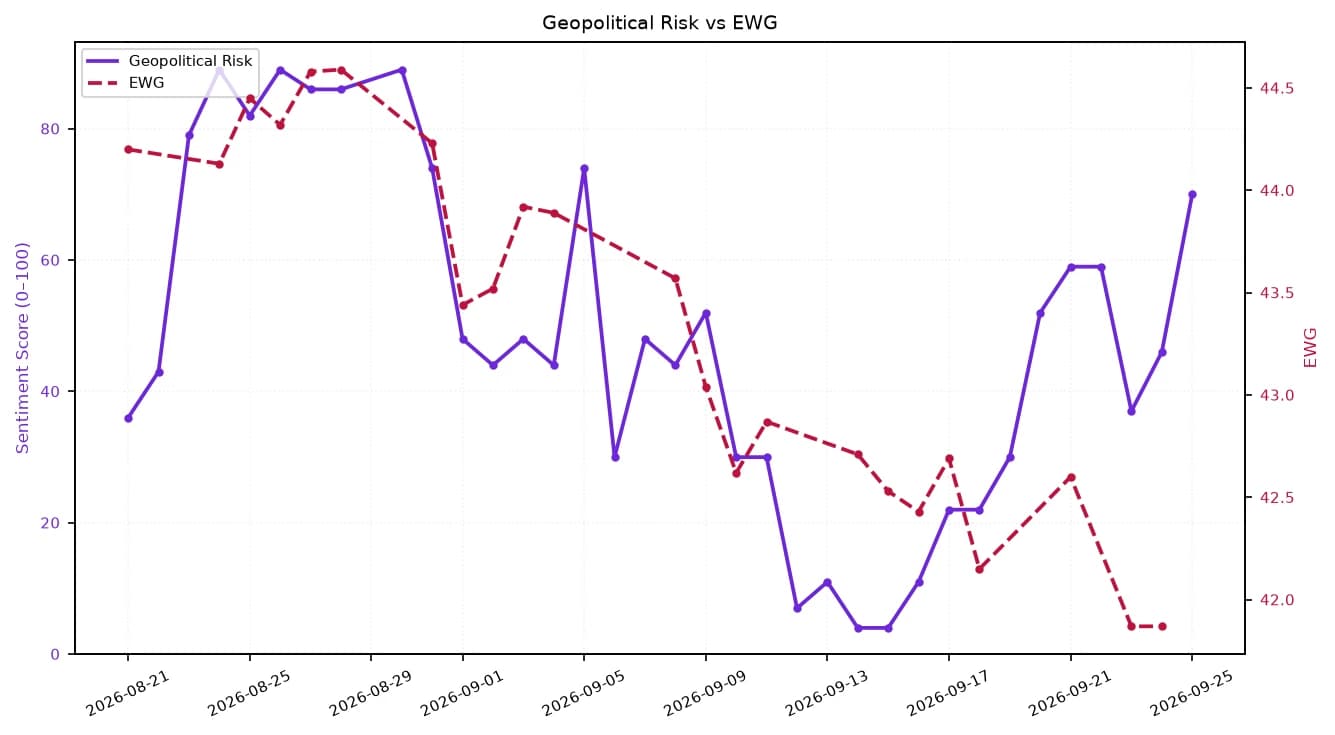
Geopolitical Risk — 30-day sentimentadalytica.com
Explore this data interactively — full history, time series and cross-market comparisons.Open AlphaPulse
The macro backdrop adds to the significance. U.S. recession risk, as tracked by the context data, is effectively near zero at the moment, while high-yield credit spreads remain contained. That combination tells you markets are not yet pricing acute financial stress from geopolitical tension. The bigger risk is a regime of persistent uncertainty: enough to keep Europe cautious, enough to keep sanctions and countermeasures in place, and enough to support a premium on assets exposed to strategic supply chains rather than discretionary global growth.
Adalytica’s Global Stability Sentiment gauge sits in neutral territory, but that is a misleading comfort. Awareness is extreme, and the recent swings in sentiment show that investors are increasingly alert to geopolitical shocks even if they are not panicking. The euro’s trade-signal snapshot is similarly mixed, with sentiment still neutral after sharp recent moves, reflecting how hard it is for the currency to gain a clean macro narrative while Europe remains at the center of the Russia question.
This is where the market is still underestimating the second-order trade. A more divided West does not automatically mean a crisis, but it does mean more defense procurement, more LNG and pipeline security spending, more sanctions-related compliance costs, and more capital going into resilient industrial assets. Those are the kinds of cash flows that can compound even when growth slows.
My view is that investors should treat the G20 dispute as another reason to own the geopolitical winners rather than chase the weakest parts of the European recovery. The beneficiaries are clear: defense contractors, energy producers with global optionality, and industrial names tied to reshoring and critical infrastructure. The losers are the companies and currencies most exposed to a clean normalization of Russia-Europe trade — a normalization that now looks farther away, not closer.
The next catalyst is not whether Berlin and Washington exchange sharper words. It is whether that split starts to influence sanctions policy, energy procurement and fiscal priorities into year-end. If it does, the market will keep rewarding the same theme: geopolitical insulation is the new growth.
| Entity | Gains | Losses |
|---|---|---|
| Defense contractors | ▲Higher procurement demand | ▼Peace dividend hopes |
| Energy producers | ▲Persistent security premium | ▼Normalized Europe-Russia trade |
| European exporters | ▲Strategic spending tailwinds | ▼Policy uncertainty |
| Euro / risk assets | ▲Short-term none | ▼Confidence in policy unity |