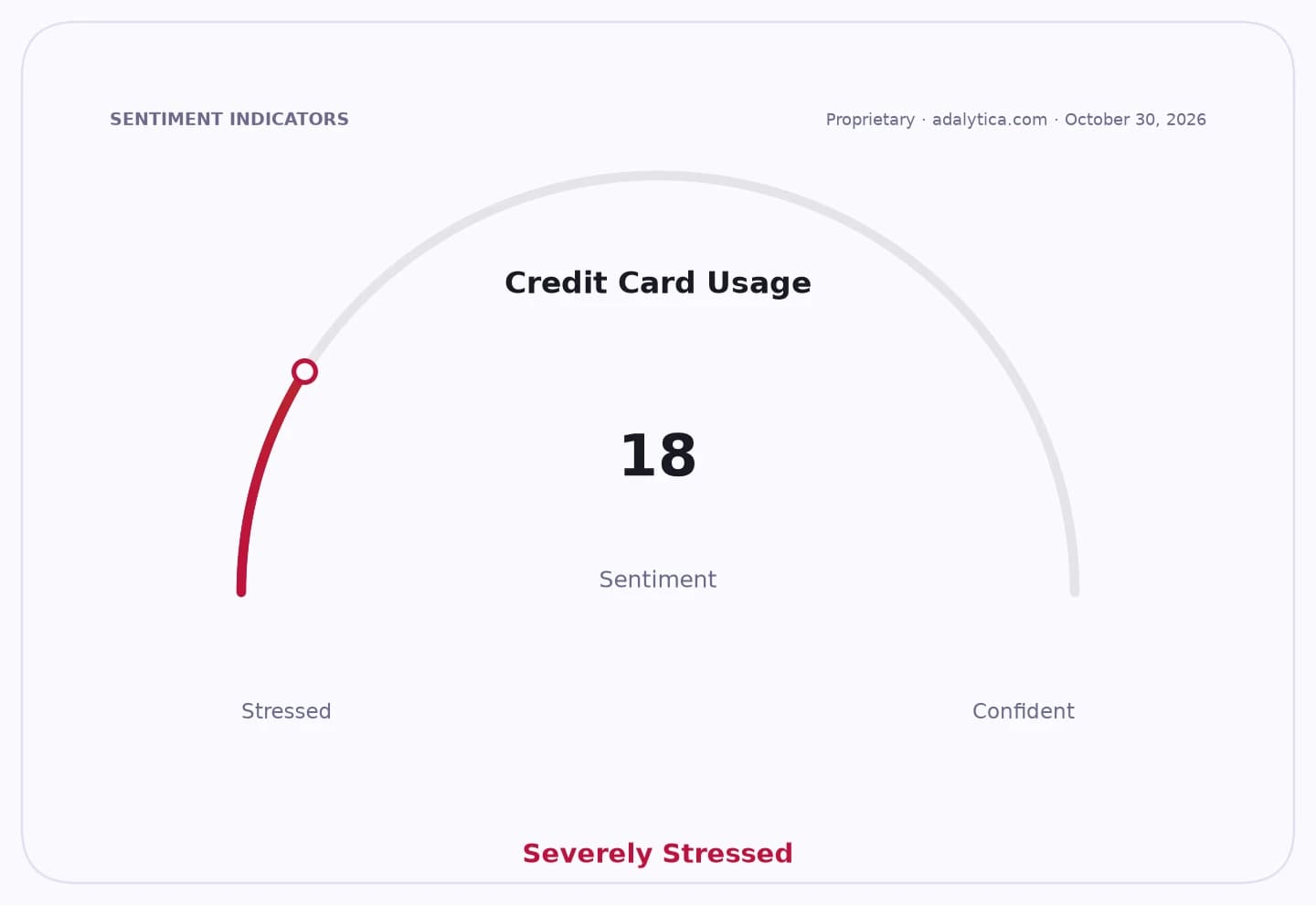
Household delinquencies are worsening fast enough to worry banks, even though the U.S. economy is still expanding and unemployment is holding near 4.1%.
U.S. Household Delinquencies Rise, Pressuring Banks
Debt Stress Indicators
That gap matters because it suggests credit losses may be building under a still-benign macro backdrop, leaving lenders exposed if growth slows. The New York Fed said 5.0% of outstanding household debt was in some stage of delinquency in the third quarter, up from 4.7% in the prior quarter and 3.1% at the end of 2023. In other words, stress is no longer confined to pockets of weaker borrowers; it is spreading across the consumer credit system.
Sentiment Indicators
The most troubling pressure point remains credit cards. Roughly 13% of card balances are now at least 90 days delinquent, only slightly below the global financial crisis peak. Auto loans are worse: more than 5.5% of balances are at least 90 days delinquent, already above the GFC high, with early-stage delinquencies still rising. Mortgages have also started to weaken, with the annualized transition into serious delinquency climbing to 1.60% from 1.28% a year earlier.
For banks, that combination is uncomfortable because consumer credit usually deteriorates late in the cycle, not when the labor market still looks relatively healthy. If delinquencies are this elevated now, lenders do not need a recession to see earnings pressure: a modest slowdown in wages, hiring or household spending could force a sharper jump in charge-offs and reserve builds. That is especially relevant for banks with heavier exposure to cards, auto lending or lower-income borrowers, where the New York Fed said distress has been most severe.
Debt Stress Indicators — 30-day sentimentadalytica.com
Explore this data interactively — full history, time series and cross-market comparisons.
The read-through for investors is that the market may be underestimating how much earnings power could be clipped by credit normalization. JPMorgan, Bank of America and Wells Fargo all face different mixes of consumer and commercial risk, but recent filings already show the sector is still managing non-trivial loss assumptions and charge-off trends. JPMorgan’s card allowance remains large, while Wells Fargo cited higher consumer net charge-offs in the third quarter, and Bank of America has been trimming reserves even as credit metrics remain a focus. None of that points to systemic strain today, but it does suggest balance sheets are being tested before the cycle has truly turned.
That is the core of the narrative behind the “good times are not as good as most believe” view: headline growth and low unemployment are masking a slow but broad deterioration in household credit quality. The risk is less a repeat of 2008 than a prolonged squeeze on bank profitability, capital allocation and lending standards as delinquencies, charge-offs and provisions climb together.
The bulls will argue that labor-market resilience and still-manageable mortgage stress should cap losses. The bears will counter that cards and autos are already flashing late-cycle warning signs, and that higher rates, depleted savings and weaker lower-income borrowers leave the system more fragile than the headline economy implies. For investors, the next key check is whether consumer credit deterioration stays contained or starts to pull broader bank earnings lower into 2027.
| Entity | Gains | Losses |
|---|---|---|
| Large banks | ▲Higher loan spreads if credit holds | ▼Rising charge-offs, bigger provisions |
| Community banks | ▲Conservative loan books | ▼If exposed to weaker local borrowers |
| Consumers with strong credit | ▲Access to lending | ▼Tighter standards for others |
| Bank shareholders | ▲If losses stay contained | ▼If credit costs keep rising |