The US labor market added just 29,000 jobs in September, reinforcing the case that hiring has stalled while pay growth slows and corporate layoffs increasingly reflect an AI-driven push to cut labor costs.
US Jobs Report Shows 29,000 Payroll Gain
The Bureau of Labor Statistics said nonfarm payrolls rose only modestly and revised down the prior two months by 60,000 jobs, including a downward revision that turned July’s previously reported gain into a loss. That leaves average monthly employment growth over the past year at just 45,000, a pace far too weak to absorb labor-force growth with any consistency.
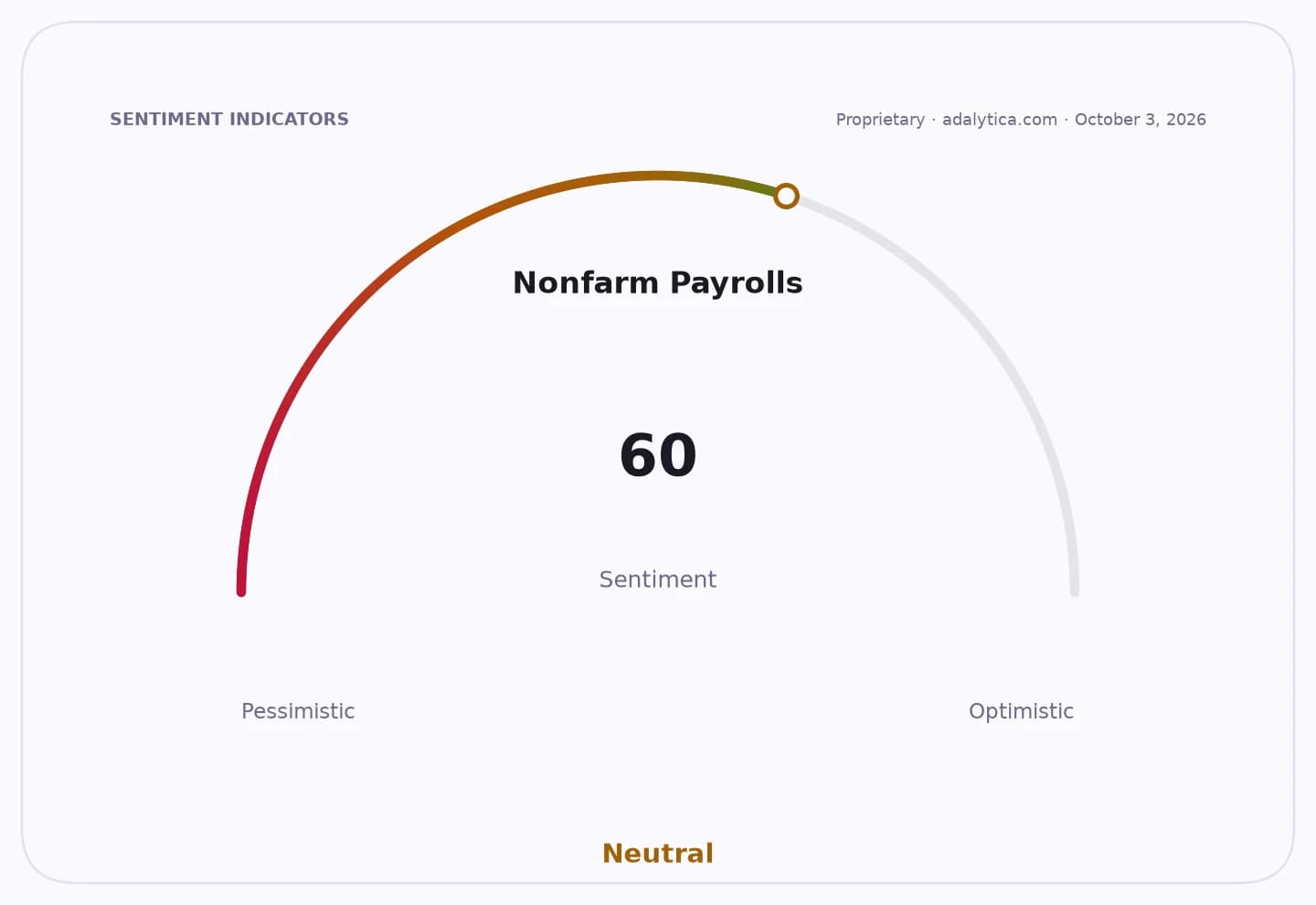
Sentiment IndicatorsⓘProprietary · adalytica.com · October 3, 2026
This is a snapshot — live sentiment, awareness and momentum for 130+ markets update continuously in the dashboard.Open AlphaPulse
The significance is less the single monthly print than the pattern it confirms: payroll gains have narrowed to a few sectors while broad hiring has gone nowhere. Healthcare added 17,000 jobs, construction 11,000 and manufacturing 9,000, but financial activities shed 7,000 and have lost 129,000 jobs since May, including 90,000 in insurance. Across major industries, employment changed little, a warning sign that labor demand is no longer keeping pace with the economy’s size or its population.
That matters economically because it points to a labor market that is losing momentum without yet showing the outright job losses typically associated with recession. The unemployment rate held at 4.2%, but that masks deeper slack: 7.1 million people were unemployed, 1.9 million had been out of work for at least 27 weeks, and 4.5 million were working part time for economic reasons. The labor-force participation rate remained 61.8% and the employment-population ratio 59.2%, both roughly unchanged and consistent with a market that is stuck rather than healthy.
Wage growth is offering little offset. Average hourly earnings rose just 5 cents, or 0.1%, in September to $37.81, with 12-month growth at 3.0%. For production and nonsupervisory workers, wages rose 0.2% to $32.60. That is not enough to suggest renewed wage pressure, and it strengthens the argument that inflation risks from the labor market are easing even as households still face elevated borrowing costs and sticky living expenses.
For investors, the immediate implication is that the Federal Reserve has more room to keep policy on hold or lean easier if weakness persists. That is why Wall Street treated the report as a positive for risk assets: the S&P 500 rose 0.7%, the Nasdaq gained 1.2% and Treasury yields initially fell before reversing. The 10-year Treasury later moved to 5.28% and the 30-year to 5.63%, underscoring that the bond market is still wrestling with the tension between slower growth and heavy government borrowing.
The sector detail also feeds a larger market narrative around automation. Finance and insurance have been among the clearest examples of workforce shrinkage, and the jobs data arrive as companies across technology, banking, logistics and customer service accelerate use of generative AI, workflow software and automated service systems to reduce headcount and raise margins. That makes the labor slowdown more than a cyclical soft patch: it is increasingly entangled with a structural shift in how firms produce output, and who captures the gains.
That dynamic helps explain the split between the macro message and the market reaction. For workers, the report signals weaker bargaining power, more involuntary part-time work and a thinner path to full-time employment. For stocks, it implies a friendlier rate backdrop and less pressure for tighter monetary policy. SPY is holding above its 50-day moving average and near the top of its recent range, while TLT remains below its 50-day and 200-day averages, reflecting a market that still doubts whether slower payroll growth will translate into sustained bond support.
The next test is whether the weakness broadens beyond a few sectors and whether wage growth softens further. If that happens, the Fed’s policy calculus shifts more clearly toward easing. If not, the September report may still be remembered as another step in a labor market that is no longer producing enough jobs to look robust, even if it is not yet in recession.
| Entity | Gains | Losses |
|---|---|---|
| Equity investors | ▲easier Fed stance | ▼weaker labor income |
| Treasury bulls | ▲slowdown narrative | ▼higher borrowing supply |
| Employers adopting AI | ▲lower payroll costs | ▼labor availability |
| Workers and job seekers | ▲little improvement | ▼job security and wage growth |