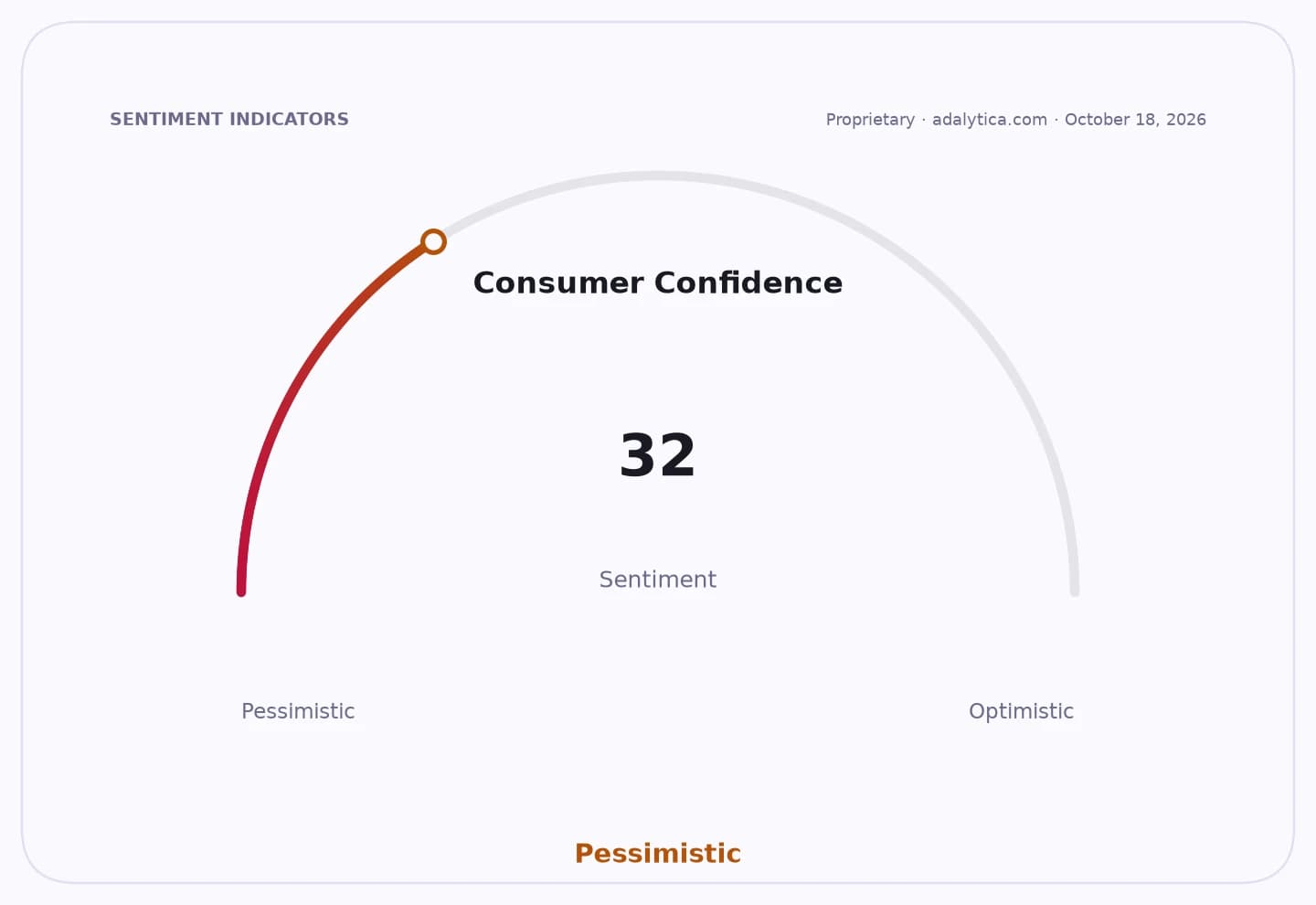
The U.S. labor market remains resilient heading into October, with job openings forecast to stay elevated even as unemployment edges only slightly higher, reinforcing the Federal Reserve’s cautious stance on cutting interest rates too quickly.
U.S. labor market stays resilient in October

The most important takeaway for the economy is that employers are still hiring at a pace that points to healthy underlying demand, not a labor market in recession. Job openings are projected at 7.35 million for October, down only modestly from 7.52 million in September and far above the levels seen before the pandemic. That suggests businesses have not yet retreated sharply on staffing despite softer growth in some sectors and the drag from higher borrowing costs.
Sentiment Indicators
The unemployment rate is expected to rise just a hair to 4.09% from 4.2% in September’s reading, keeping it near what many economists view as full employment. Payrolls are also projected to hold roughly steady at 159.1 million, after rising to 159.0 million in September. Taken together, the numbers point to a labor market that is cooling from its post-pandemic overheating but still generating enough jobs to support household income and consumer spending.
That matters for investors because a durable jobs backdrop reduces near-term recession risk, but it also complicates the case for aggressive monetary easing. A labor market that remains tight enough to keep wages supported can keep services inflation sticky, limiting how quickly the Federal Reserve can move to a more accommodative policy stance. Bond markets typically read that as a reason for yields to stay elevated, while equity investors see both a cushion for earnings and a ceiling on valuation multiples.
JTSJOL vs UNRATE — macro contextadalytica.com
Explore this data interactively — full history, time series and cross-market comparisons.
The resilience is also showing up in sector data. Staffing firms such as ADP, Paychex and ManpowerGroup have been signaling that U.S. employment demand has not broken down, with ADP’s same-store payroll growth for U.S. clients still running positive in recent filings and Manpower saying improving U.S. trends helped drive third-quarter revenue growth and margin improvement. That supports the view that labor demand is broadening beyond the tech-heavy layoffs that have dominated headlines.
At the same time, the market for workers is no longer as one-sided as it was in 2021 and 2022. Job openings have come down from the peak, and hiring appears more selective, especially in white-collar sectors where companies are trying to do more with less and leaning harder on artificial intelligence and automation. That is creating a split labor market: still healthy overall, but less forgiving for job seekers in some industries and more dependent on productivity gains than pure headcount growth.
For investors, the key question is whether this is a soft landing or simply a delayed slowdown. A steady labor market supports consumer demand, which is good for cyclical sectors and payroll-linked businesses. But if openings and payrolls stay firm while inflation proves sticky, the Fed may keep policy restrictive for longer, which would pressure rate-sensitive shares and longer-duration assets.
The next catalyst is whether the October employment data confirm that the labor market is settling into a lower-growth but stable equilibrium, or whether weakness in hiring finally starts to show up more clearly in the months ahead.
| Entity | Gains | Losses |
|---|---|---|
| Workers | ▲Job security and income support | ▼Faster wage pressure from tighter hiring |
| Employers | ▲Easier retention than in 2022 | ▼Higher labor costs in still-tight sectors |
| Federal Reserve | ▲Evidence of a soft landing | ▼Less room for quick rate cuts |
| Equities | ▲Consumer spending stays resilient | ▼Valuations capped by sticky rates |