They flocked to ATMs and emptied the banks, and the market’s message is the same: liquidity is being hoarded, not reused.
U.S. Liquidity Tightens as Fed Balance Sheet Shrinks
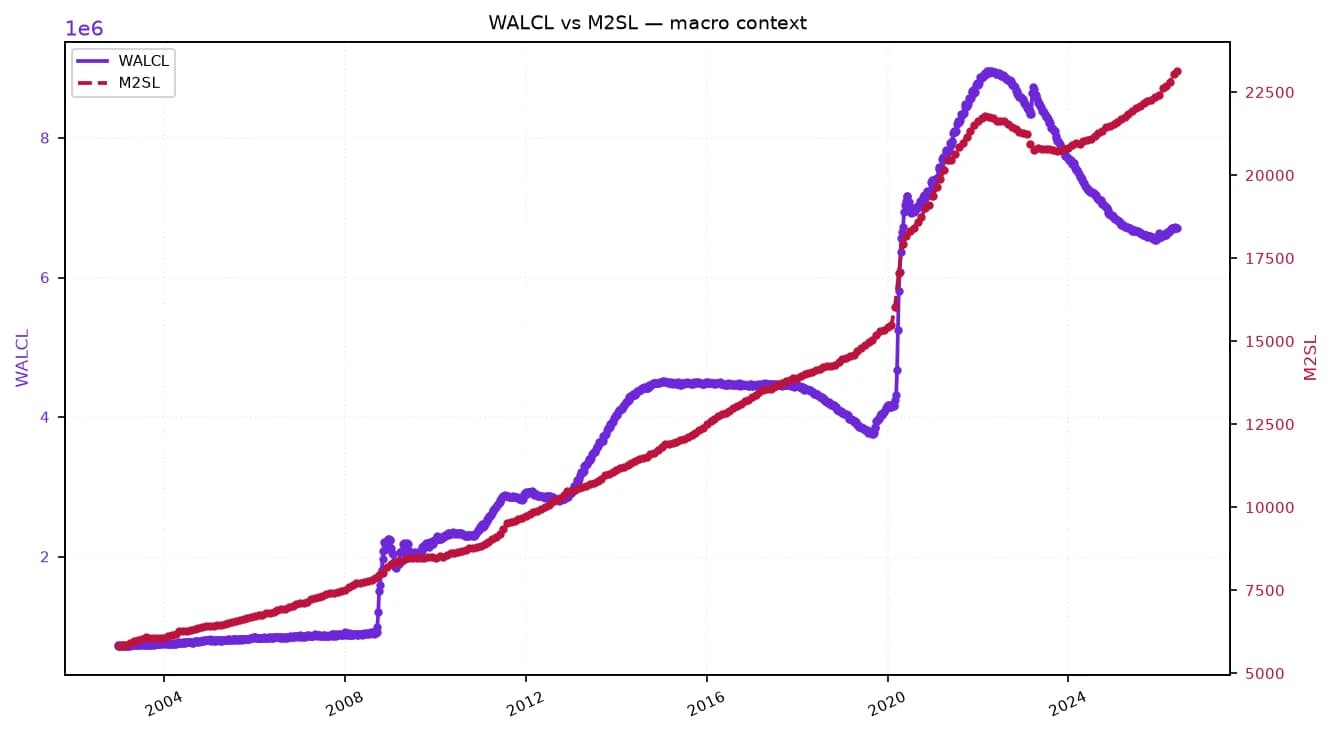
That matters because when deposits stop recycling through the financial system, credit creation slows, funding costs rise and the Treasury’s financing machine becomes more fragile. The latest data show the U.S. banking system’s balance sheet has shrunk sharply from its 2023 peak, while broad money growth remains far below the pandemic-era surge that fueled risk assets and easy credit.
Sentiment IndicatorsⓘProprietary · adalytica.com · August 19, 2026
This is a snapshot — live sentiment, awareness and momentum for 130+ markets update continuously in the dashboard.Open AlphaPulse
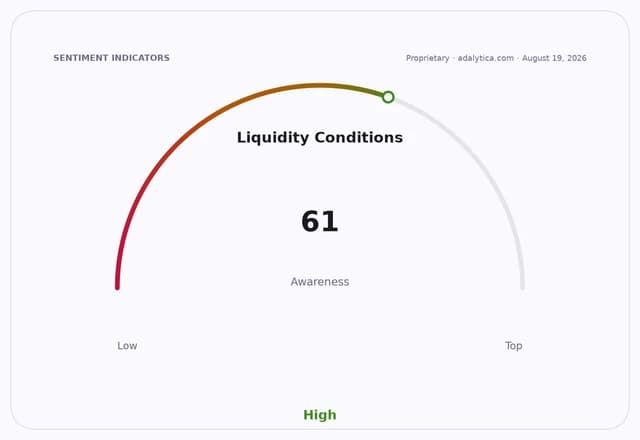
Federal Reserve assets, captured by the WALCL series, stood at about $6.76 trillion in mid-August 2026, down from roughly $8.73 trillion in March 2023 and off nearly 24% from the 2025 year-end level of $6.64 trillion. That is the opposite of the firehose liquidity investors grew used to after 2020. At the same time, M2 has recovered to about $23.3 trillion, but the pace is still only modestly expansionary, underscoring that the system is not being flooded the way it was during the last bull market in everything.
The stress is showing up in credit spreads and in the stock market’s own read on financial plumbing. High-yield spreads have narrowed to around 2.68 percentage points, a sign that investors are not pricing imminent systemic stress, but bank shares are still trading with a caution premium. KRE, the regional bank ETF, closed at $76.85 on Aug. 18, above its 50-day moving average and 200-day moving average, but its momentum has cooled from recent highs. JPMorgan and Bank of America have held up better, reflecting the market’s preference for scale, diversified funding and stronger liquidity buffers.
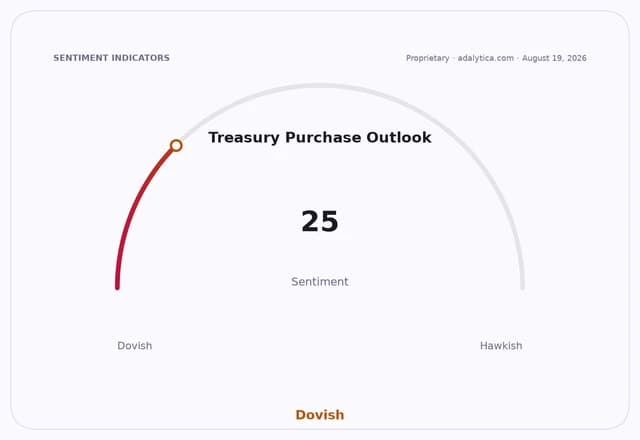
What makes this more than a bank-stock story is that Treasury markets sit at the center of the next phase. Adalytica’s Treasury Purchase Sentiment Outlook is deep in fear, even as awareness is extreme, suggesting that investors are intensely focused on supply, duration risk and balance-sheet absorption. In plain English, the market is worried that the private sector is being asked to buy more government paper just as deposits, reserves and excess liquidity are getting scarcer. That is a recipe for higher term premium, not a return to the easy-money regime that powered the last decade.
The dollar is reinforcing that message. Adalytica’s US Dollar Trade Signals show extreme fear on sentiment, even while awareness remains elevated, a combination that usually appears when markets are searching for a new liquidity anchor. If the dollar weakens while Treasury supply remains heavy, foreign buyers may demand more yield, adding pressure to funding costs across the curve. If the dollar strengthens instead, it can tighten global dollar liquidity and strain borrowers that live on cheap funding. Either way, the system is less forgiving than it was when central-bank balance sheets were expanding.
For investors, the implication is not simply “sell banks.” It is to favor the institutions and businesses that profit when liquidity becomes scarce and funding discipline matters more than beta. Large money-center banks with robust deposit franchises, excess capital and pricing power should keep taking share from regional lenders. Treasury-market volatility can also benefit brokers, exchanges and derivatives venues that monetize higher trading and hedging activity. Meanwhile, the losers are the borrowers most dependent on rolling cheap debt, the weaker regional banks with sticky deposit outflows, and any asset class priced as if balance-sheet liquidity will quietly return.
The broader narrative is one of transition: from a world where every crisis was met with more money, to one where money is being drained, normalized and rationed. That shift does not usually end quickly, and it tends to reward investors who position early for tighter liquidity, steeper funding discipline and a more expensive cost of capital. In that regime, balance sheet quality is the trade — and I believe the market still underestimates how powerful that edge can be.
| Entity | Gains | Losses |
|---|---|---|
| JPMorgan, Bank of America | ▲Deposit share, pricing power | ▼Less liquid competitors |
| Regional banks / KRE | ▲Limited upside, tighter funding | ▼Depositor outflows, funding stress |
| Treasury buyers | ▲Higher yields, better entry points | ▼Price volatility, absorption risk |
| Dollar bulls / cash holders | ▲Relative safety, funding leverage | ▼Commodity and EM borrowers |