The US midterm elections are unlikely to trigger a sharp break in Washington’s China policy, limiting the risk of an immediate geopolitical shock even as rhetoric in Congress may harden.
US Midterms Unlikely to Change China Policy
Geopolitical Risk
That matters because markets have spent the past two years pricing China as a high-friction, structurally constrained relationship rather than a normal trading tie. The real issue for investors is not whether US-China tensions persist — they do — but whether the midterms hand Congress enough leverage to force a more disruptive trade, technology or Taiwan policy shift. On the evidence available, the answer appears to be no. A senior Chinese official said the midterms may “reshape the political landscape” but would not necessarily deliver a “massive, disruptive blow” to China-US relations, underscoring Beijing’s view that the White House still retains broad discretion.
Sentiment Indicators
For investors, that means the most likely outcome is continuity rather than rupture: more noise, more hearings, more hawkish messaging, but no wholesale rewrite of the bilateral playbook. That is important for sectors most exposed to export controls and supply-chain restrictions, especially semiconductors, electronics and advanced hardware. Nvidia, Apple, Micron, Qualcomm and Intel have all flagged in recent filings that trade restrictions, tariffs and national-security rules can disrupt supply chains, raise costs and hit demand. Those risks remain real, but they look more like a rolling policy overhang than a sudden escalation tied to one election cycle.
The market tone is consistent with that read. FXI, the iShares China Large-Cap ETF, is trading at 34.94 after a volatile stretch, still below its 200-day moving average of 35.42 but above the recent lows, while its RSI has climbed to 62.8, suggesting improving momentum without a full trend reversal. EWH, the Hong Kong ETF, has also firmed to 23.21, sitting just above its 200-day average of 22.58 and above its 50-day average of 22.35. Neither chart says Washington-Beijing relations are healed. They do suggest investors are looking through worst-case political scenarios and positioning for a less disorderly backdrop than the headlines imply.
Geopolitical Risk vs FXIadalytica.com
Explore this data interactively — full history, time series and cross-market comparisons.
The deeper point is that US-China policy has already become a bipartisan, structural feature of American politics. Midterm control may affect the volume of the confrontation, but the executive branch still sets the pace on tariffs, export controls and diplomacy. That makes the election a secondary catalyst, not the primary driver, for the next phase of the relationship. The bigger swing factor remains whether Washington chooses calibrated containment or broad economic decoupling.
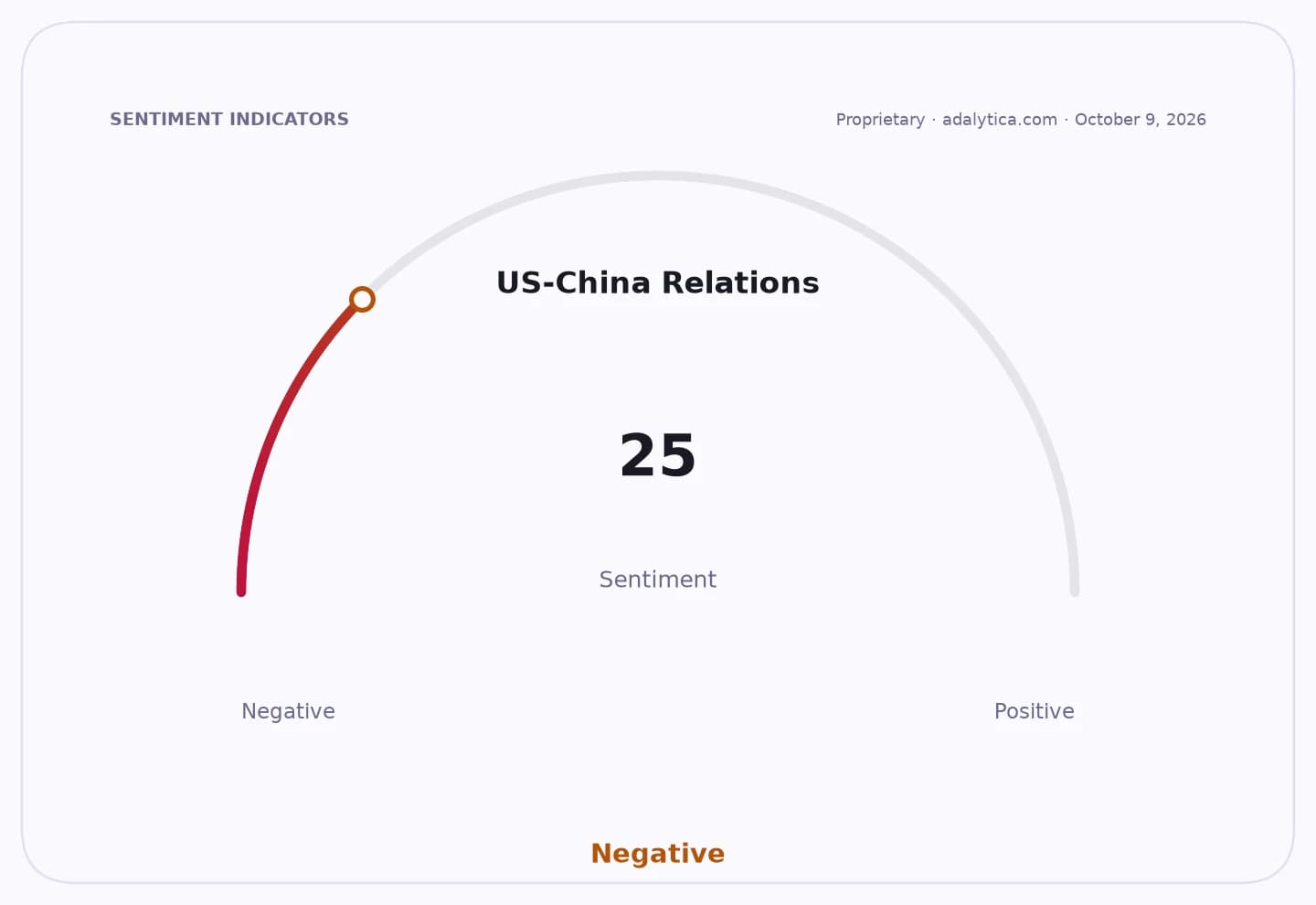
Oil and broader risk assets are also telling a similar story: geopolitical unease remains elevated, but not at panic levels. Adalytica’s Global Stability Sentiment sits at 75, while its US-China Relations Sentiment is at 75 as well, pointing to persistent concern without a full-blown crisis signal. In other words, the market is still pricing tension, but not a rupture.
For investors, the opportunity is to separate durable winners from headline-driven volatility. The best-positioned names are not the most China-dependent hardware suppliers, but the companies selling the picks and shovels of strategic competition — AI infrastructure, domestic manufacturing, defense, cybersecurity and supply-chain reconfiguration. If the midterms do little more than sharpen rhetoric, the real trade remains the same: own resilience, not reconciliation.
| Entity | Gains | Losses |
|---|---|---|
| White House | ▲Policy flexibility | ▼Less congressional pressure |
| Beijing | ▲No abrupt escalation | ▼Limited room for diplomatic relief |
| Semiconductors | ▲More predictable rules | ▼Ongoing export-control risk |
| China-linked ETFs | ▲Reduced breakup risk | ▼Continued policy overhang |