The average long-term U.S. mortgage rate stayed pinned at 7.4% this week, leaving homebuyers stuck with borrowing costs at their highest level in nearly three years and underscoring why the housing market remains frozen.
U.S. Mortgage Rates Hold at 7.4%
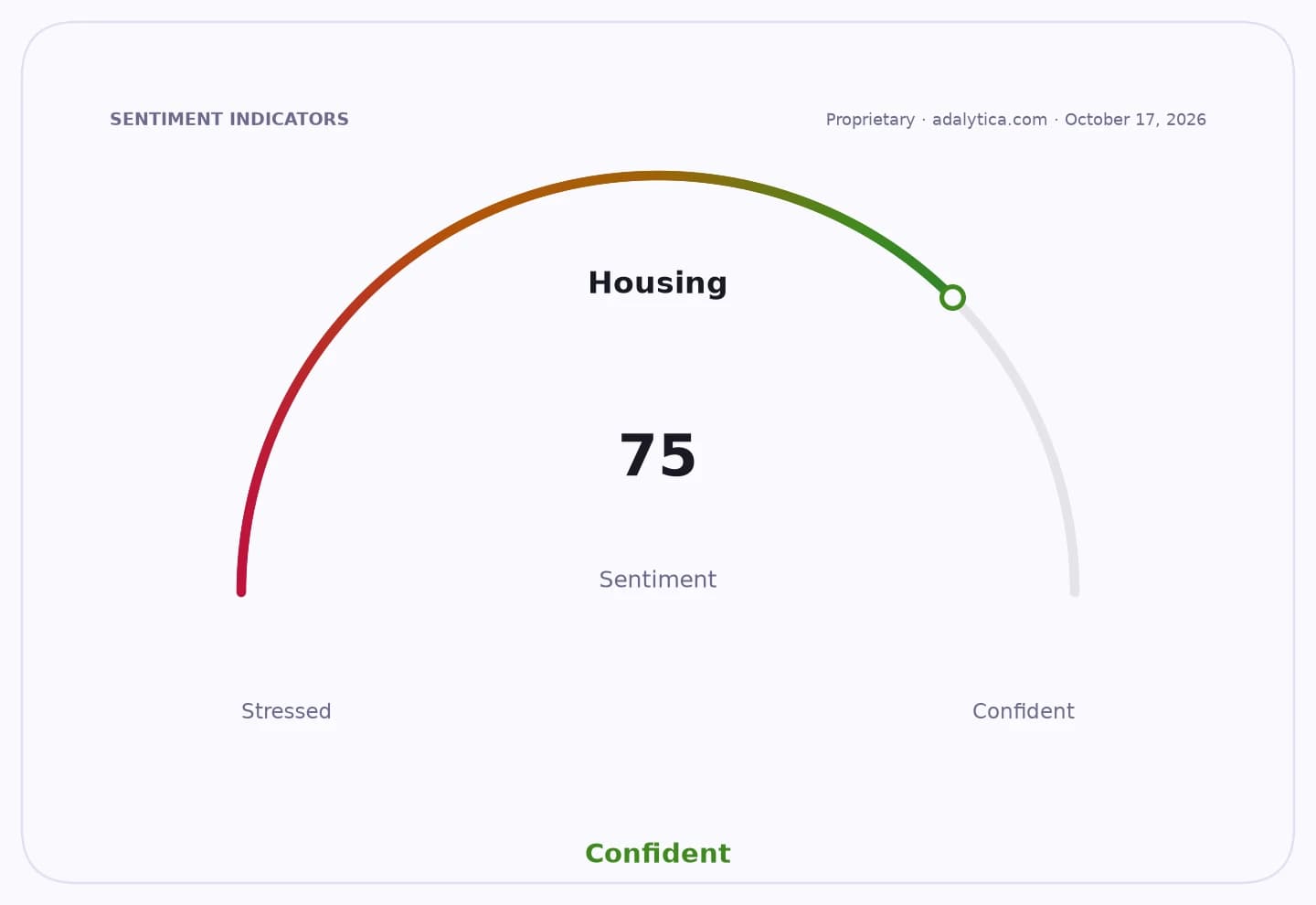
That is more than a headline about one week’s pricing move. Mortgage rates shape how many Americans can afford to buy, how fast home sales can recover, and how much demand flows into the broader economy. When a 30-year loan sits near 7.5%, the monthly payment burden rises sharply, pricing out first-time buyers and discouraging current owners from moving unless they are willing to give up ultra-low pandemic-era mortgages.
Sentiment IndicatorsⓘProprietary · adalytica.com · October 17, 2026
This is a snapshot — live sentiment, awareness and momentum for 130+ markets update continuously in the dashboard.Open AlphaPulse
Freddie Mac said the benchmark 30-year fixed rate was unchanged at 7.40%, the highest level since late 2023 and up from 6.27% a year ago. The rate had climbed for seven straight weeks before leveling off, while the 15-year mortgage eased slightly to 6.71% from 6.73%. That small break does little to change the bigger picture for the housing market.
The problem is not just the mortgage rate itself, but the direction of financing costs across the economy. Home loans generally track the 10-year Treasury yield, which has been pushed higher by inflation worries, strong economic data and bond-market volatility. Even after pulling back from a recent peak above 5.30%, the 10-year yield was still around 5.10% on Thursday, far above its pre-war-with-Iran level near 3.97%.
For buyers, the difference is brutal. Freddie Mac’s math shows the move from a 5.98% rate in late February to 7.40% now adds roughly $376 a month to the cost of financing a $400,000 home. That kind of increase matters more than almost any short-term market noise because it strikes directly at affordability, and affordability is what drives housing demand.
That is why existing-home sales remain sluggish, even after a modest monthly gain in September. The National Association of Realtors said sales were still slower than a year earlier, and the Mortgage Bankers Association reported mortgage applications fell 2.7% last week as rates rose. More borrowers are turning to adjustable-rate mortgages, which accounted for 10.5% of applications — the highest share in a year — a sign that households are still searching for a way around expensive fixed-rate financing.
Investors should care because housing weakness does not stay confined to housing. Builders, lenders, home-improvement chains, mortgage servicers and even consumer spending all feel the strain when mortgage rates stay high for long enough. The 30-year mortgage is one of the most important interest rates in the U.S. economy, and its current level tells you financial conditions are still restrictive even if the Federal Reserve pauses.
That said, the story is not simply bearish. If inflation cools meaningfully and Treasury yields fall, mortgage rates can ease quickly, unlocking pent-up demand from buyers who have been sitting on the sidelines for years. Fannie Mae is already projecting the 30-year rate will average 7.4% in the current quarter and 7.5% in 2027, which suggests relief may arrive slowly rather than all at once.
For long-term investors, the message is straightforward: housing is still under pressure, but the eventual reset could create opportunities in companies that can outlast the cycle. For now, though, elevated mortgage rates remain the single biggest obstacle to a broad recovery in U.S. home sales, and that makes this one of the most important macro stories to watch into year-end.
| Entity | Gains | Losses |
|---|---|---|
| Cash buyers | ▲More negotiating power | ▼Little direct effect from mortgage rates |
| Homebuyers using mortgages | ▲None | ▼Higher monthly payments |
| Homebuilders and Realtors | ▲Selective demand from move-up buyers | ▼Weaker sales volume |
| Mortgage lenders and servicers | ▲Higher refinance/search activity | ▼Slower purchase market |