US retail sales fell unexpectedly and sharply after a summer lift from tax refunds faded, underscoring how dependent the economy remains on temporary cash boosts even as borrowing costs stay high.
US Retail Sales Fall as Tax Refund Boost Fades
The drop matters because consumer spending is still the biggest engine of US growth. When retail receipts weaken after a short-lived fiscal bump, it raises the risk that households are pulling back on discretionary purchases just as inflation and interest rates keep pressuring budgets.
Sentiment IndicatorsⓘProprietary · adalytica.com · August 14, 2026
This is a snapshot — live sentiment, awareness and momentum for 130+ markets update continuously in the dashboard.Open AlphaPulse
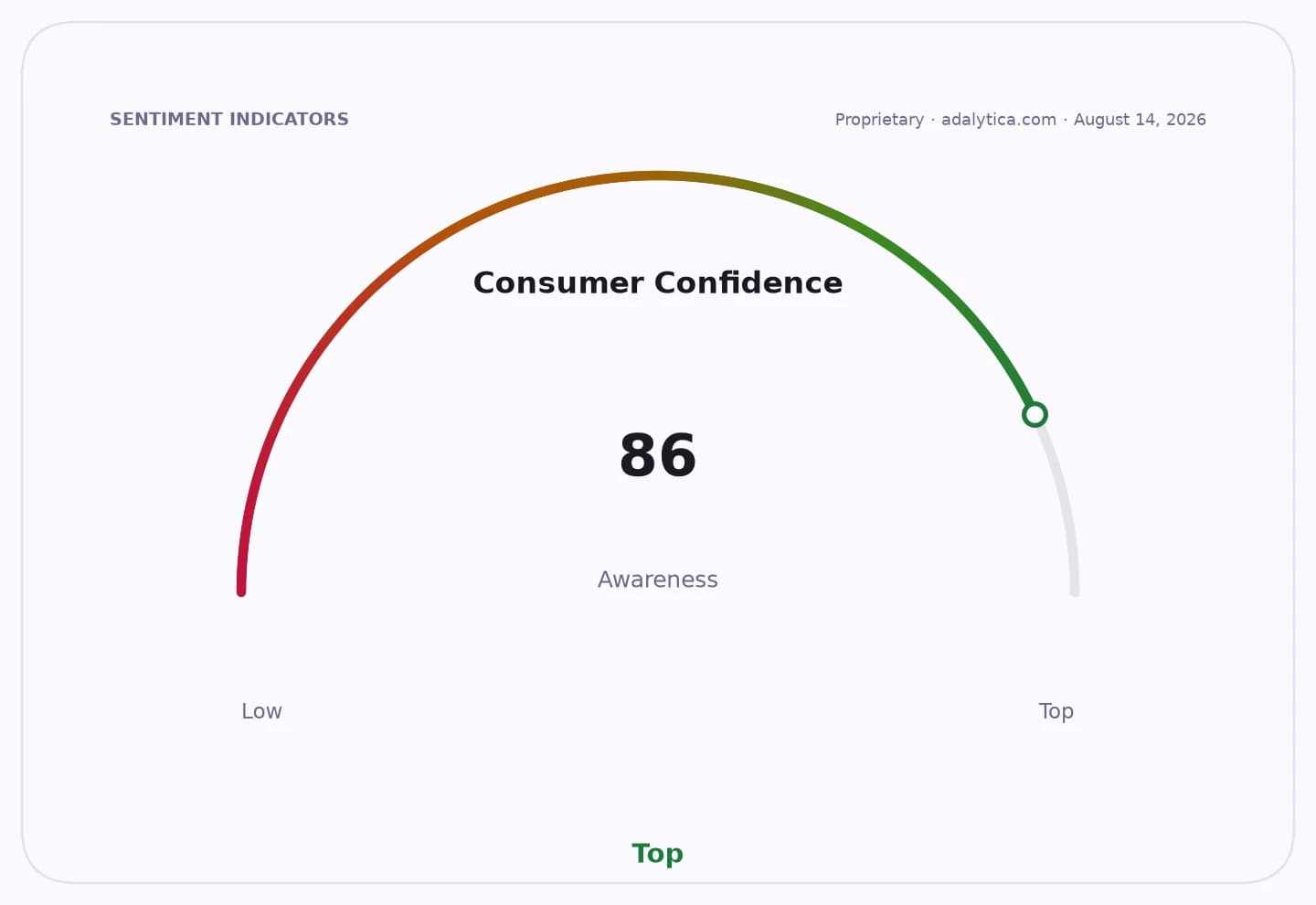
The decline also arrives with consumer mood deteriorating. Adalytica’s Consumer Spending Sentiment gauge stands at 29, in “Fear” territory, while its Consumer Confidence Recession Sentiment sits at 75, suggesting households remain uneasy about the outlook even after periods of stronger activity.
That combination is important for policymakers and investors because it argues against assuming the consumer can keep carrying the economy. A softer spending backdrop could slow GDP growth, cool pricing power for retailers and force markets to reassess how long the Federal Reserve can keep policy restrictive without hitting demand.
RSXFS vs UMCSENT — macro contextadalytica.com
Explore this data interactively — full history, time series and cross-market comparisons.Open AlphaPulse
Retail-linked equities are already showing strain and resilience in different pockets. The SPDR S&P Retail ETF, XRT, closed at $88.88 on Aug. 14, above its 200-day moving average at $85.06 but below its recent high near $90.48, while the Consumer Discretionary Select Sector SPDR Fund, XLY, finished at $118.17, still above both its 50-day and 200-day moving averages. The broader S&P 500 ETF, SPY, ended at $775.94, near record territory, highlighting the market’s split between strong index-level momentum and growing caution around consumer demand.
Big retailers have already flagged how uneven spending can be. Walmart and Costco have continued to post solid sales, but companies such as Target and Amazon have warned that demand can soften when customers face economic pressure, leaving investors watching whether the slowdown is broad-based or concentrated in lower-income and discretionary categories.
The next read on consumer demand will be critical. If spending fails to stabilize after the tax-refund effect washes out, retailers, manufacturers and growth stocks tied to discretionary demand could face further pressure, while bond markets may start to price in a weaker growth path.
| Entity | Gains | Losses |
|---|---|---|
| Bond bulls | ▲More rate-cut bets | ▼Softer growth signal |
| Defensive retailers | ▲Relative demand resilience | ▼Discretionary peers |
| Discretionary retailers | ▲— | ▼Weaker traffic and baskets |
| Consumers with buffers | ▲Better pricing power from weaker demand | ▼Lower confidence and spending |