U.S. stocks fell sharply on Friday as hotter inflation readings and a surge in oil prices revived fears that the Federal Reserve will keep monetary policy tighter for longer, prompting a broad pullback led by artificial intelligence and semiconductor shares.
U.S. Stocks Fall on Hot Inflation and Rising Oil

The Dow Jones Industrial Average lost 175.28 points, or 0.34%, to 52,002.41. The S&P 500 dropped 1.09% and the Nasdaq sank 2.14%, with the tech-heavy benchmark heading for its worst weekly loss since June and the S&P 500 set for its steepest weekly decline since January. Rising energy costs matter because they feed directly into inflation expectations, compress valuation multiples and make long-duration growth stocks, including AI names, less attractive when discount rates rise.
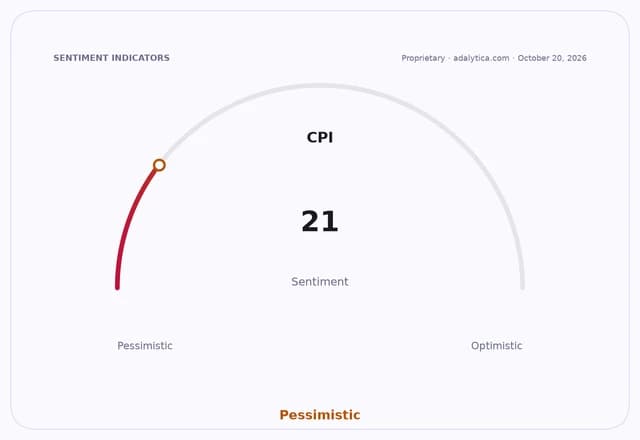
Sentiment IndicatorsⓘProprietary · adalytica.com · October 20, 2026
This is a snapshot — live sentiment, awareness and momentum for 130+ markets update continuously in the dashboard.Open AlphaPulse

The selloff was broad but concentrated where investors have been most exposed to momentum and leverage. Six of 11 S&P 500 sectors finished lower, with communication services down 2.52% and information technology off 2.38%. The Philadelphia semiconductor index fell 2.5% for an eighth straight decline, underscoring how quickly sentiment has turned against the market’s biggest winners this year.
CoreWeave was among the hardest hit, sliding 12% on the day and roughly 25% over five sessions. Its bonds were sold heavily as well, pushing yields above 15%, a sign that credit markets are beginning to question whether highly leveraged AI infrastructure companies can generate cash flow fast enough to service debt if borrowing costs stay elevated. Broadcom fell 3.6%, while Netflix dropped 2.9% after naming Peter Rice as chief content officer. Tesla slipped 2.5% after unveiling a redesigned Roadster, a reminder that even high-profile product news could not offset the broader de-risking.
DCOILWTICO vs CPIAUCSL — macro contextadalytica.com
Explore this data interactively — full history, time series and cross-market comparisons.Open AlphaPulse
Oil’s more than 3% jump added to the pressure, with traders citing supply concerns in the Middle East. That matters not just for energy stocks but for the entire market because sustained oil strength can lift headline inflation, complicate the Fed’s next move and keep Treasury yields elevated. The 10-year U.S. yield, at 5.09%, remains near multi-year highs, reinforcing the challenge for equity valuations.
The macro backdrop has turned less forgiving for the AI trade that dominated much of this year’s advance. Friday’s weaker action followed hotter-than-expected U.S. consumer and producer price data, which suggested inflation is broadening beyond energy. Barclays has shifted to expect a 25-basis-point Fed increase in December and another in January, while markets increasingly see the central bank holding rates steady this month. Kevin Warsh, a former Fed governor, said the U.S. economy still looks resilient, but that does little to ease pressure on rate-sensitive assets if inflation remains sticky.
That is especially relevant because the rally in the S&P 500 has remained highly concentrated. The index is still up about 12% this year, but much of that gain has come from AI-linked megacaps, while about half the index has returned 6% or less and roughly 185 companies are lower on the year. For investors, that narrow leadership increases fragility: when the market’s biggest growth names lose momentum, passive exposure can feel more like concentrated risk than diversification.
Next week’s third-quarter earnings season will test whether corporate profits can justify elevated valuations and tighter financial conditions. Tesla, Meta Platforms and Procter & Gamble are due to report, and LSEG data show analysts still expect quarterly earnings growth of more than 30%, powered largely by AI-related technology companies. The market will be looking for proof that revenue growth can outrun the higher cost of capital — and for any sign that the recent bond-market repricing is starting to hit spending plans.
| Entity | Gains | Losses |
|---|---|---|
| Energy producers | ▲Higher crude prices | ▼Demand concerns if growth slows |
| Value stocks | ▲Relative appeal rises | ▼Less upside from AI momentum |
| AI infrastructure firms | ▲None on Friday | ▼Higher funding costs, lower multiples |
| Fed hawks | ▲Stronger case for tighter policy | ▼Easing expectations get pushed out |