US stocks advanced on Sept. 25 even as Treasury yields climbed to levels not seen in nearly two decades, underscoring how far investors are still willing to lean into technology and artificial intelligence themes despite tighter financial conditions.
US Stocks Rise as Treasury Yields Hit Multi-year Highs

The Dow Jones Industrial Average rose 479 points, or 0.93%, to 51,829, while the S&P 500 gained 0.51% to 7,743 and the Nasdaq Composite added 0.5% to 27,069. The move came against a backdrop of the 10-year Treasury yield reaching its highest since 2007 and the 30-year yield hitting a peak since 2004, a warning sign that borrowing costs are still tightening across the economy even as equities hold near record territory.
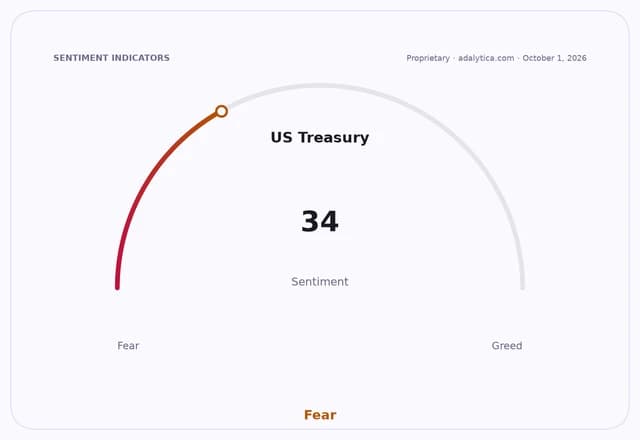
Sentiment IndicatorsⓘProprietary · adalytica.com · October 1, 2026
This is a snapshot — live sentiment, awareness and momentum for 130+ markets update continuously in the dashboard.Open AlphaPulse

That divergence matters because higher long-term yields typically compress equity valuations, especially for growth stocks whose earnings sit further in the future. Yet the market’s reaction suggested investors are still prioritizing earnings momentum and secular growth in large-cap technology over the drag from fixed-income competition. The information technology sector rose 3.1% for the week, the strongest among S&P 500 groups, helped by enthusiasm around Meta Platforms’ AI push and a 13% weekly gain in the stock. Akamai Technologies also climbed 3% after announcing a long-term partnership with Anthropic, reinforcing the market’s appetite for companies tied to artificial intelligence infrastructure and applications.
The resilience in equities also reflects a broader macro mix that is not entirely hostile to risk assets. Oil prices fell on hopes of a possible reopening of the Strait of Hormuz, easing some inflation anxiety after a week in which energy costs had helped drive yields higher. West Texas Intermediate fell 2.33% to $92.41 a barrel and Brent dropped 2.14% to $104.32. That decline offered some relief, but it did not fully offset the pressure from a bond sell-off fueled by hawkish Federal Reserve commentary, strong purchasing managers’ index readings and a futures market that now implies roughly a 64% chance of a rate increase in October.
DGS10 vs T10Y2Y — macro contextadalytica.com
Explore this data interactively — full history, time series and cross-market comparisons.Open AlphaPulse
For investors, the key question is whether equities can keep absorbing this kind of rate shock. Eric Diton of The Wealth Alliance said sentiment has deteriorated sharply as yields rise, though he called the market’s response “an incredible amount of resilience” given that the S&P 500 and Nasdaq remain within about 1% of recent highs. The technical picture in the Nasdaq-linked QQQ and S&P 500 proxy SPY also shows both ETFs trading above their 50-day and 200-day moving averages, with QQQ’s RSI near 68 and SPY’s near 52, indicating momentum remains intact even as the bond market tests valuations.
The week’s price action points to a market in transition rather than in outright retreat. If yields keep pushing higher, the burden on equities will rise quickly, particularly for rate-sensitive sectors and richly valued megacaps. But for now, the dominant narrative is that technology leadership is still strong enough to keep the major averages climbing, even with Treasury yields sending one of the clearest warnings yet that the cost of capital is moving up.
| Entity | Gains | Losses |
|---|---|---|
| Tech stocks | ▲AI optimism and earnings leadership | ▼Higher discount rates |
| Bond investors | ▲Higher yields on new debt | ▼Treasury prices |
| Big-cap growth names | ▲Relative outperformance | ▼Valuation pressure |
| Rate-sensitive sectors | ▲Limited benefit from growth rotation | ▼Higher borrowing costs |