Hotter-than-expected US inflation has put the yen’s latest defence under pressure, lifting USD/JPY back toward the 160 area that Japanese officials are widely seen as unwilling to tolerate for long.
USD/JPY Nears 160 as US Inflation Stays Hot

The immediate market significance is straightforward: stronger US price data keeps Treasury yields elevated, preserves the dollar’s rate advantage and forces Tokyo to weigh whether verbal warnings are enough or whether another intervention threat is needed to slow speculative yen selling. MUFG said the pair’s near-term range of 156 to 160 still leaves room for further dollar strength, but that a sustained break above 160 would be difficult to defend in the face of official resistance.
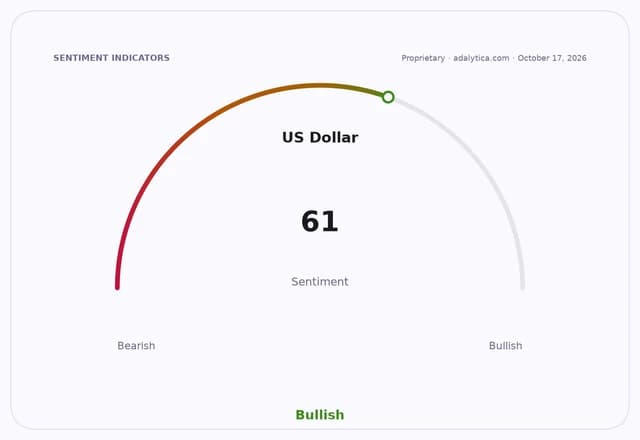
Sentiment IndicatorsⓘProprietary · adalytica.com · October 17, 2026
This is a snapshot — live sentiment, awareness and momentum for 130+ markets update continuously in the dashboard.Open AlphaPulse

Wednesday’s US CPI release showed core inflation rising 0.3% in September, above MUFG’s 0.2% expectation. That matters because it reinforces the case for the Federal Reserve to keep policy restrictive for longer, even as markets debate how many more hikes are still in play. The September print also matters for the yen because it arrived just as the currency was trying to recover from repeated tests of levels that have previously drawn Japanese intervention.
USD/JPY was trading around 157.99 on Oct. 16, above its 50-day moving average of 157.71 and just below the 200-day average of 158.56, after dipping to 153.42 in mid-September. The pair touched 160.18 in late April, underscoring how close the market has already come to the line that traders associate with intervention risk. MUFG’s Tokyo-based Teppei Ino said a move above the 200-day average could follow a renewed shift in US rate expectations, but argued that a break above 160 would likely prove hard to sustain.
That is the core tension for investors: the dollar still has macro support from relative interest-rate differentials, but the yen is no longer a one-way short when Japanese authorities have shown they are prepared to act near sensitive levels. Finance Minister Satsuki Katayama has described levels above 160 as an “extremely weak yen,” and that language, combined with repeated references from US officials to yen undervaluation, raises the cost of holding aggressive short-yen positions.
The policy backdrop in Tokyo also matters. MUFG pointed to fiscal messaging from the new administration as another source of support for the currency, with the government emphasizing budget discipline and the need to preserve market confidence. Prime Minister Sanae Takaichi has said fiscal policy will be managed with close attention to its effect on interest rates and exchange rates, while the Bank of Japan continues to leave the door open to further tightening after its September rate increase.
Still, the yen’s recovery is likely to be uneven rather than dramatic. MUFG said the currency may do better against non-dollar peers if the dollar remains broadly firm, but that is a narrower call than a decisive turn in USD/JPY itself. Japanese rates are rising from very low levels, yet domestic investors continue to buy foreign assets, limiting the pace of yen repatriation.
For investors, the trade now hinges on two catalysts: whether the Fed’s next moves remain as hawkish as markets have priced, and whether Tokyo escalates beyond warnings if USD/JPY pushes back toward 160. If US inflation remains sticky and the dollar stays bid, the pair can test the upper end of MUFG’s range. But if the market pushes too far, too fast, intervention risk could trigger a sharp squeeze lower.
| Entity | Gains | Losses |
|---|---|---|
| US dollar bulls | ▲Higher yields support the dollar | ▼Intervention risk caps upside |
| Yen bulls | ▲Verbal warnings and BOJ tightening help | ▼Persistent US inflation keeps pressure on yen |
| Japanese authorities | ▲Stronger messaging may deter speculation | ▼Credibility if 160 is breached repeatedly |
| Exporters with dollar revenue | ▲More favorable translation rates | ▼Importers face higher hedging costs |