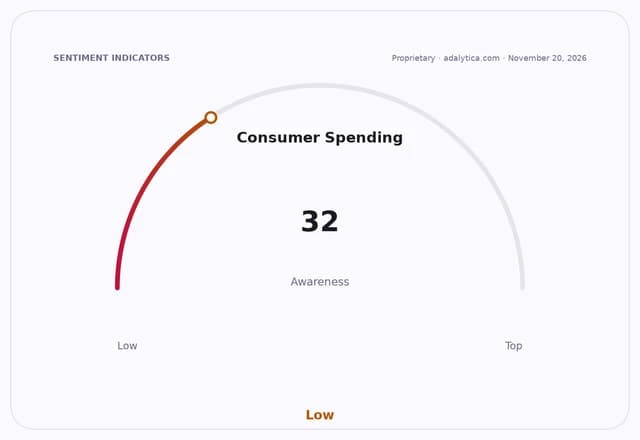
Thanksgiving grocery demand is arriving against a sharp turn in consumer caution, with Adalytica’s Food and Grocery Spending Sentiment sinking to 25 and its awareness gauge at 11, a sign households are becoming more price-sensitive even as they stock up for the holiday.
USFD, GO Face Holiday Trade-Down Demand
That matters for retailers, distributors and food suppliers because a lower-confidence shopper tends to buy smaller baskets, lean harder on promotions and trade down to cheaper staples. For the grocery aisle, the Thanksgiving run-up is normally a reliable volume event; this year it is shaping up more as a value test.
Sentiment Indicators
The broader Consumer Spending Sentiment snapshot also sits in Extreme Fear at 11, up 4 points on the day but still down 5 points over 30 days, underscoring how fragile holiday demand remains. In that environment, shoppers are more likely to stretch budgets across a longer list of essentials rather than splurge on premium items.
For wholesalers and grocers, the setup supports traffic but pressures margins. Promotions can keep volumes moving, but they also squeeze pricing power at a time when consumers are already scanning for discounts and meal substitutions.
Consumer Spending vs USFDadalytica.com
Explore this data interactively — full history, time series and cross-market comparisons.
One company watching that mix closely is U.S. Foods Holding Corp. (USFD), which has said in its latest filing that case volumes rose 1.5% in the third quarter, helped by independent restaurants, healthcare and hospitality customers. That resilience suggests food distributors can still capture demand tied to holiday meal prep, but chain volume remains under pressure and pricing competition is intense.
Grocery Outlet Holding Corp. (GO) faces a similar trade-down backdrop. Its shares have been volatile, falling to $11.43 on Nov. 19 from $13.69 on Nov. 4, as investors weigh whether bargain-focused retail can offset still-weak consumer appetite and heavier promotional activity.
The immediate investor question is whether Thanksgiving traffic translates into enough basket growth to offset discounting. If shoppers keep prioritizing savings into year-end, the winners are likely to be value grocers, wholesalers and private-label sellers, while premium food brands and higher-cost retailers could feel the squeeze.
| Entity | Gains | Losses |
|---|---|---|
| Value grocers | ▲Higher traffic | ▼Lower margins |
| Wholesalers/distributors | ▲Steadier case volume | ▼Pricing power |
| Premium food brands | ▲— | ▼Trade-down demand |
| Budget-conscious shoppers | ▲Lower holiday bills | ▼Fewer discretionary items |