Vancouver-area home sales fell 8.4% in September while prices weakened, a sign that Canada’s most expensive housing market is still being squeezed by borrowing costs even as sellers are starting to adjust.
Vancouver Home Sales Fall as Prices Weaken
The slowdown matters because Vancouver is not just another local market. It is a high-beta read on Canadian housing, consumer confidence and the affordability ceiling that continues to cap demand in the country’s major cities. When sales fall and prices soften at the same time, it usually means buyers are not stepping in to defend valuations — even in one of North America’s most supply-constrained markets.
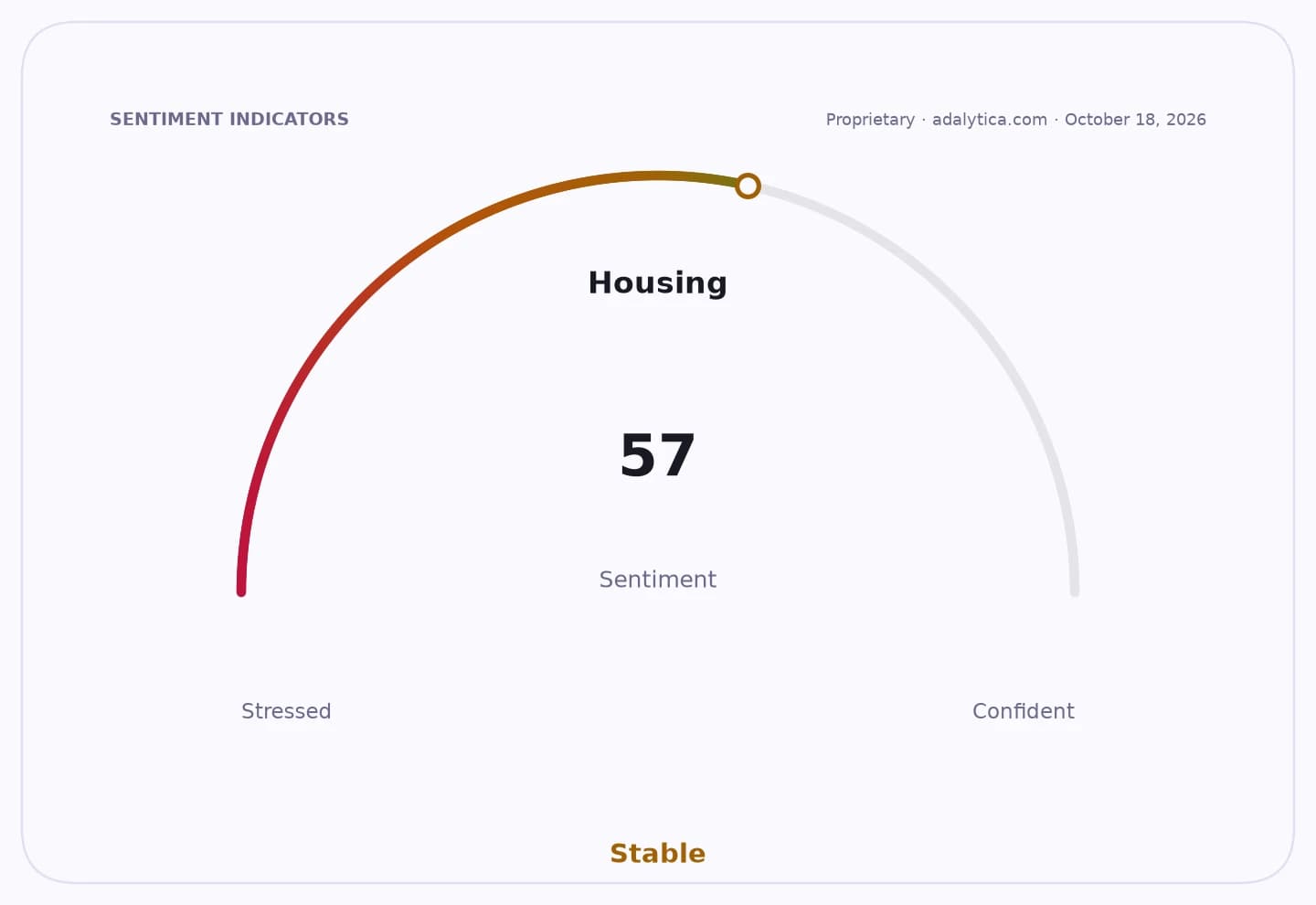
Sentiment IndicatorsⓘProprietary · adalytica.com · October 20, 2026
This is a snapshot — live sentiment, awareness and momentum for 130+ markets update continuously in the dashboard.Open AlphaPulse
That pressure is showing up just as mortgage rates remain punishingly high by recent standards. The average 30-year U.S. mortgage rate was running near 7.4%, underscoring the broader North American reality that financing remains a drag on housing demand. For Canadian borrowers, the same direction of travel in rates keeps monthly payments elevated and limits how far prices can reaccelerate without a meaningful easing in policy.
The weakness also has broader macro significance. Housing is a powerful transmission channel for wealth, consumer spending and credit growth. When turnover slows, it tends to dampen commissions, renovations, furnishings and related household spending. It also reduces the incentive for move-up buyers to trade, which can further freeze the market and leave prices vulnerable to incremental declines.
That backdrop matters for investors because the housing trade has become far more selective. U.S. homebuilder ETFs such as XHB and ITB have already rolled over from their earlier strength, with both trading below their 50-day moving averages and their 200-day benchmarks in the case of the latest readings. The weakness in Vancouver adds to the argument that housing exposure needs to be targeted around balance-sheet quality, land scarcity and pricing power rather than broad-market beta.
Real estate investment trusts tied to housing are also in focus. VNQ has held up better than builder shares, but it too has slipped beneath its 50-day moving average, reflecting a market that is no longer rewarding generic real estate exposure. Investors are increasingly distinguishing between landlords with durable rent growth and developers or transaction-dependent names that need stronger demand to clear inventory.
The domestic policy angle is just as important. Vancouver’s housing market has long been a pressure point for local voters, and the city’s political shift adds another layer of uncertainty around housing policy, zoning and affordability measures. Any change in the regulatory backdrop could alter supply expectations, but it will not fix demand weakness if borrowing costs stay restrictive.
My view is that the market underestimates how long housing fatigue can last once transaction volumes begin to fall. Lower sales are not just a monthly data point; they are an early warning that affordability stress is still doing the work of tightening policy. That creates opportunity for investors who avoid overexposed housing cyclicals and focus instead on the few beneficiaries of persistent scarcity, including quality rental operators and selective infrastructure-linked real estate.
The takeaway: Vancouver’s softer sales are another sign that North American housing remains stuck in a high-rate, low-affordability regime. Until mortgage costs ease materially, the better trade is not chasing a rebound — it is owning the scarce, income-producing assets that can still compound while the broader market stalls.
| Entity | Gains | Losses |
|---|---|---|
| Quality rental REITs | ▲Higher tenant demand | ▼Homebuying slowdown |
| Homebuilders | ▲Possible inventory clearance | ▼Lower sales volumes |
| Sellers | ▲Less overbidding | ▼More price pressure |
| Buyers | ▲Slightly better pricing power | ▼High mortgage costs |