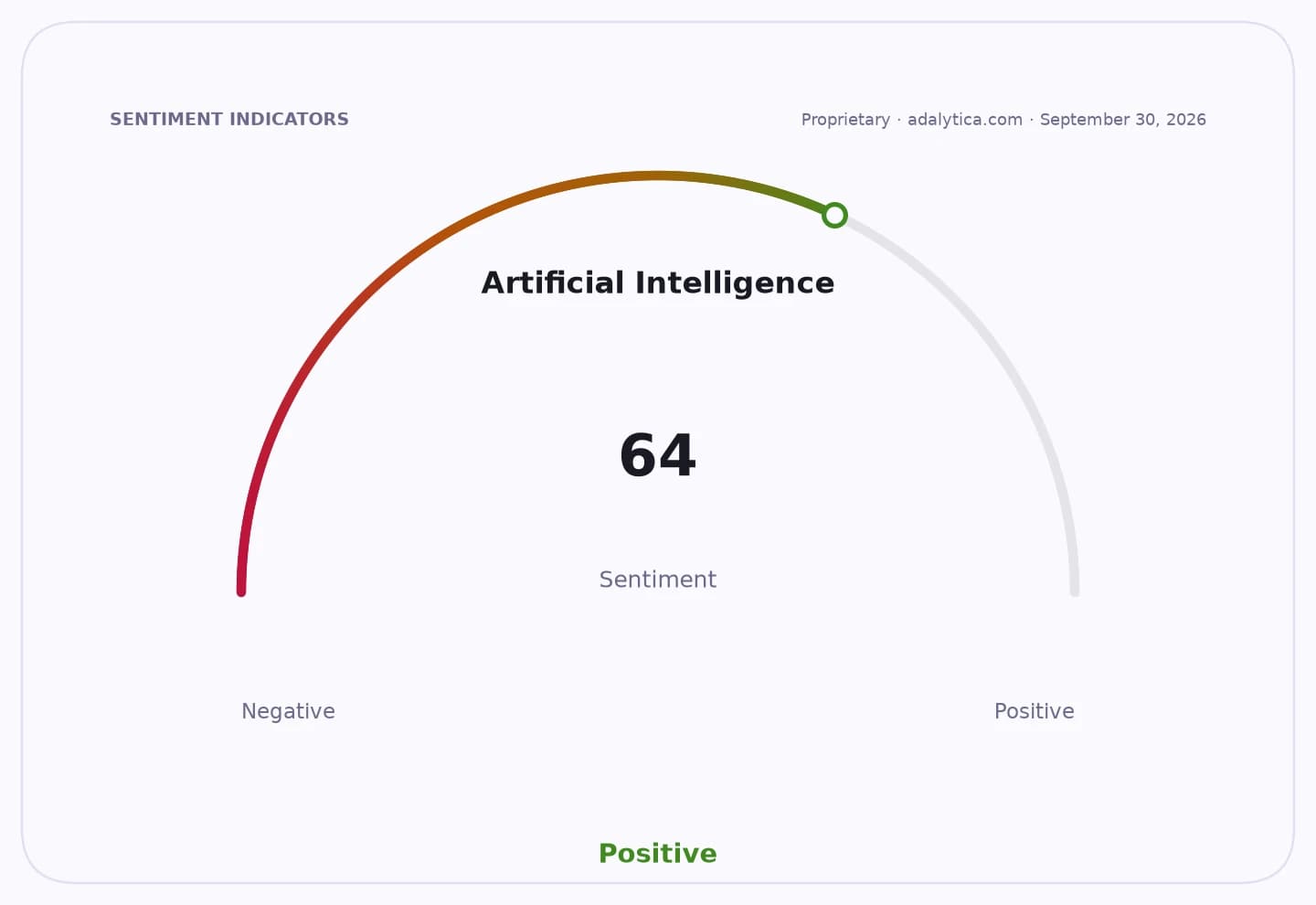
Vietnam is moving faster than many of its Southeast Asian peers toward an AI economy, with formal business adoption rising to 26% from 18% a year earlier and nearly 245,000 companies now using the technology day to day. That pace, if sustained, is the clearest evidence yet that the country’s bid to become ASEAN’s AI center by 2030 is shifting from aspiration to commercial reality.
Vietnam AI adoption rises to 26% in businesses

The economic case is straightforward: AI is already showing up in output, revenue and cost cuts. In the AWS-commissioned survey of 1,000 business leaders and 1,000 consumers, 72% of companies said productivity improved, while 64% reported direct revenue gains averaging 15%. About 75,000 firms adopted AI for the first time over the past 12 months, or roughly one new user every seven minutes, a scale that gives Vietnam a domestic test bed large enough to refine products before exporting them across the region.
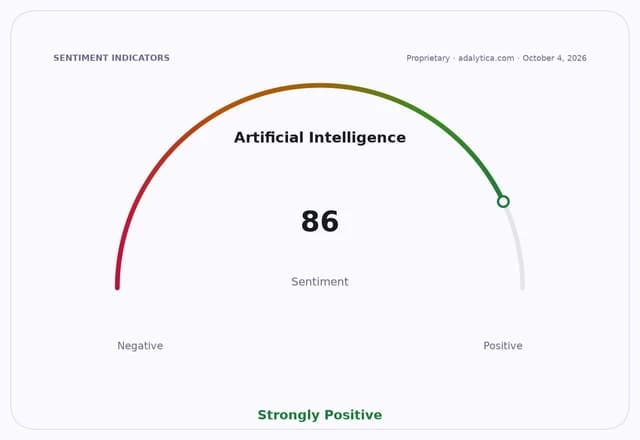
Sentiment IndicatorsⓘProprietary · adalytica.com · October 4, 2026
This is a snapshot — live sentiment, awareness and momentum for 130+ markets update continuously in the dashboard.Open AlphaPulse
That matters for investors because it creates a pipeline of demand for cloud, software, data infrastructure and AI services, while also strengthening the case for local startups. AI-native companies were said to be 4.8 times more likely to clear $1 million in annual revenue and grew sales 147% faster than traditional peers, suggesting the biggest winners may be the platforms and vendors supplying the buildout rather than only the end users.
The early commercial proof points are increasingly sector-specific. Financial services is leading adoption at 41%, well above the national average, with 79% of firms saying AI lifted productivity through fraud detection and data analysis. In healthcare, adoption is lower at 23%, but 69% of users reported better operating efficiency, helped by models designed to meet stricter requirements for explainability and scientific validation.
Vietnam’s push is also being supported by policy and infrastructure. The country’s AI law taking effect in March 2026 would make it the first in Southeast Asia with a risk-based AI governance framework, while AWS Local Zone capacity launched in Vietnam in June is aimed at reducing latency and meeting local data-storage requirements. Together, those moves lower two of the biggest barriers to enterprise adoption: compliance risk and technical friction.
The remaining bottlenecks are less about enthusiasm than execution. The survey found 61% of firms are still stuck in pilot or exploration mode, while just 8% have fully embedded AI in core operations. Nearly half said they lack a reliable way to measure return on investment, a problem that can slow budget approvals even as management teams see the strategic need to move faster.
For investors, the key question is whether Vietnam can convert widespread experimentation into a durable ecosystem of local champions, regional exporters and foreign platform providers. The next catalysts are likely to be whether adoption broadens beyond finance, whether the new AI law accelerates enterprise spending, and whether local startups can keep turning Vietnam’s early scale advantage into export revenue.
| Entity | Gains | Losses |
|---|---|---|
| Vietnamese enterprises | ▲Higher productivity, faster revenue growth | ▼Higher implementation complexity |
| AWS and cloud providers | ▲More local AI workloads and infrastructure demand | ▼Pricing pressure from rivals |
| AI-native startups | ▲Faster scaling and export sales | ▼Legacy firms with slow transformation |
| ASEAN peers competing for AI hub status | ▲Spillover investment and talent | ▼First-mover advantage if Vietnam keeps pace |