Young workers entering Vietnam’s labor market are increasingly being judged less on immediate technical polish than on whether they will stay, adapt and finish the job.
Vietnam Employers Value Soft Skills and Retention
That shift matters because employers say the cost of hiring and training new graduates is rising just as many leave before becoming productive, forcing companies to rethink recruitment, supervision and retention at a time when Southeast Asia’s manufacturing and services expansion depends on a steadier talent pipeline.
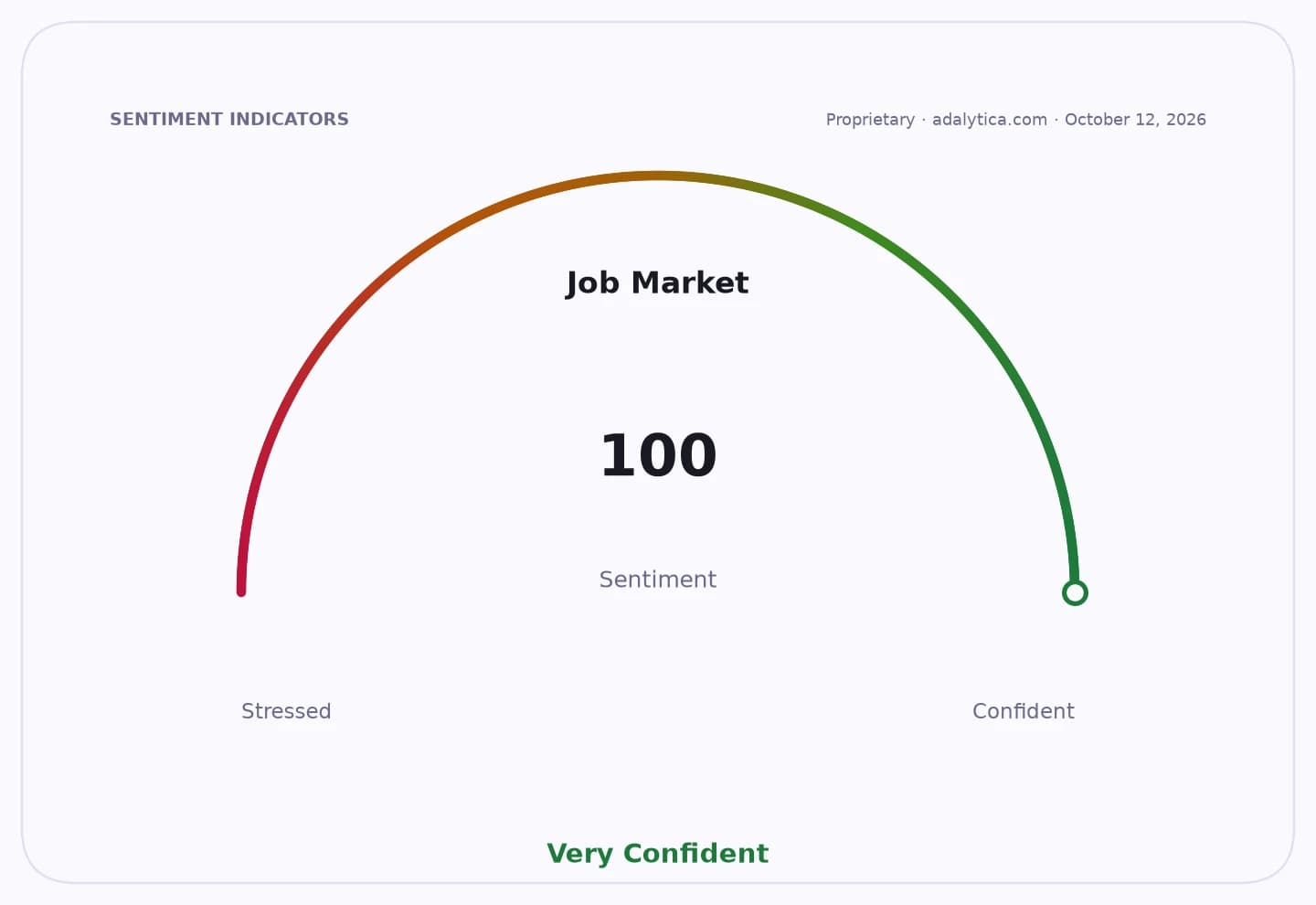
Sentiment IndicatorsⓘProprietary · adalytica.com · October 12, 2026
This is a snapshot — live sentiment, awareness and momentum for 130+ markets update continuously in the dashboard.Open AlphaPulse
At a recent forum on developing talent in the digital era, Navigos Search managing director Ngo Thi Ngoc Lan said many businesses are frustrated by young hires who quit almost as soon as they start. Employers, she said, are now paying close attention to attitude, commitment and resilience when evaluating inexperienced candidates, rather than relying mainly on academic credentials.
The concern is not just anecdotal. A report by British University Vietnam and Decision Lab, based on surveys of 375 hiring decision-makers in Hanoi and Ho Chi Minh City and 20 in-depth interviews, found a clear gap between what recruiters value most and what they see from new graduates. Time management was the largest mismatch: 80% of employers said it mattered, but only 54% said fresh graduates demonstrated it, a 26-point gap. Problem solving showed a 23-point gap, with importance at 84% and actual performance at 61%.
For employers, that gap translates directly into money. More time spent onboarding and correcting mistakes means lower productivity per hire and a higher risk that companies freeze recruitment or narrow intake to candidates they think can contribute faster. One manufacturing executive interviewed for the study said high turnover among new graduates had already led the company to pause hiring and reassess its people management model.
The findings also help explain why soft skills have become a harder filter in recruitment. Recruiters interviewed for the report said they want candidates who can prioritize work, flag delays early, ask useful questions and seek solutions rather than wait for instructions. In practice, that means punctuality, accountability and persistence are being treated as economic assets, not just personality traits.
The debate is not one-sided. Nguyen Thi Thu Anh, a member of Vietnam’s National Council for Education and Human Resource Development, pushed back against the idea that young workers as a group are unreliable or unwilling to solve problems. She said she has seen many capable, responsible young people, and argued that project-based learning can build creativity, self-study and a stronger sense of ownership.
That points to the broader issue facing employers and universities alike: firms want job-ready graduates, but schools cannot bridge the gap alone. The survey found 59% of employers offer internships and 43% recruit graduates directly, yet only 15% help shape curricula or sit on advisory boards, and just 10% support thesis projects or joint research. The imbalance suggests companies want a better talent pipeline without always investing in the training infrastructure needed to create it.
For investors and business leaders, the implication is that labor quality is becoming as important as labor cost. Companies able to design stronger apprenticeship, internship and retention systems should have an edge in productivity and hiring efficiency, while employers that continue to churn through junior staff may face higher operating costs and slower execution. In sectors that depend heavily on entry-level talent — from manufacturing to business services — the ability to keep young employees long enough to develop them is increasingly a competitiveness issue.
The most likely outcome is a gradual recalibration rather than a clean break. Young workers will still move quickly when pay, culture or development prospects disappoint, but employers appear to be responding by putting more weight on attitude, resilience and adaptability at the point of hire. The companies that turn those traits into a structured training path, rather than a vague expectation, are likely to win the next round of talent competition.
| Entity | Gains | Losses |
|---|---|---|
| Employers with strong training systems | ▲Better retention | ▼Lower onboarding waste |
| Young workers with resilience | ▲Faster advancement | ▼Less patience for weak fit |
| Universities that co-design programs | ▲Stronger employer links | ▼Less room for theory-only curricula |
| Firms with high turnover | ▲Short-term flexibility | ▼Productivity and hiring costs |