Vietnam’s consumer economy kept expanding in September, with total retail sales of goods and services rising 13.4% from a year earlier, a pace that points to resilient household demand and supports the outlook for third-quarter growth.
Vietnam retail sales rise 13.4% in September
The data from the finance ministry’s statistics office showed total retail sales and services revenue at 690.6 trillion dong in September, up 1.7% from August and 14.1% from a year earlier. For the third quarter, the measure rose 3.3% from the previous three months and 14.5% year on year, underscoring broad-based spending momentum despite a still-cautious global backdrop.
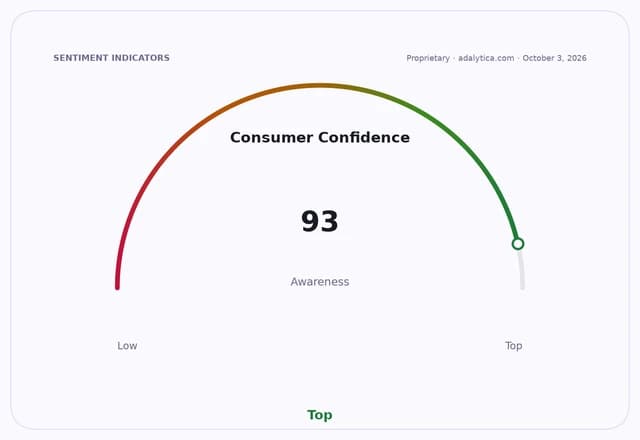
Sentiment IndicatorsⓘProprietary · adalytica.com · October 3, 2026
This is a snapshot — live sentiment, awareness and momentum for 130+ markets update continuously in the dashboard.Open AlphaPulse

The strength matters because retail activity is a major driver of Vietnam’s domestic demand, helping offset external volatility in trade-dependent sectors. Stronger household spending also tends to support tax revenue, service activity and inventory restocking, which can feed into broader industrial output and GDP growth.
Most retail categories improved from both the prior month and a year earlier. Household goods sales rose 2.9% month on month and 9.7% year on year, while repairs of motor vehicles and motorcycles climbed 2.4% and 15.2%, respectively.
Other categories were even stronger on an annual basis, including wood and building materials, up 24.2%, other goods, up 17.6%, and fuel products, up 14.9%. There were mixed pockets: car sales rose 5% from August but fell 1% year on year, while jewelry slipped 3.2% from a year earlier.
For investors, the report reinforces the case for consumer-linked sectors such as retail, transport, autos and discretionary spending in Vietnam, while also signaling that domestic demand remains a key cushion if export growth cools. With third-quarter retail spending still accelerating on an annual basis, markets will be watching whether the momentum carries into year-end and whether policymakers see enough strength to avoid additional support.
| Entity | Gains | Losses |
|---|---|---|
| Vietnamese retailers | ▲Higher sales volumes | ▼None immediate |
| Consumer goods firms | ▲Stronger domestic demand | ▼Slower export-linked growth |
| Auto dealers | ▲Monthly rebound in sales | ▼Year-on-year softness |
| Government revenue | ▲Better tax intake potential | ▼More pressure if spending slows |