Rewards on credit and debit card spending could be capped at 10%, a move that would hit the economics of Visa, Mastercard and American Express just as U.S. consumer spending sentiment remains elevated and payment networks are already trading at rich valuations.
Visa, Mastercard, AmEx Face Rewards Cap Risk

The proposed ceiling matters because cashback and points programs are one of the key tools issuers use to keep cardholders spending and to steer transactions toward higher-fee rails. Any limit on rewards would force banks and card companies to rethink acquisition and retention strategies, and could eventually pressure interchange economics, merchant acceptance costs and margins across the payments stack.
Sentiment Indicators
Visa is the clearest bellwether. The stock has surged to 413.59 on Oct. 30 from 329.26 in early December, extending well above its 50-day and 200-day moving averages even after some recent consolidation. Mastercard has climbed to 638.01 from 550.19 over the same span. American Express, meanwhile, has lagged the two networks in relative performance but still rebounded to 319.11 after sliding as low as 289.66 in March. Those moves leave all three vulnerable to any policy that trims one of the most lucrative growth levers in the card business.
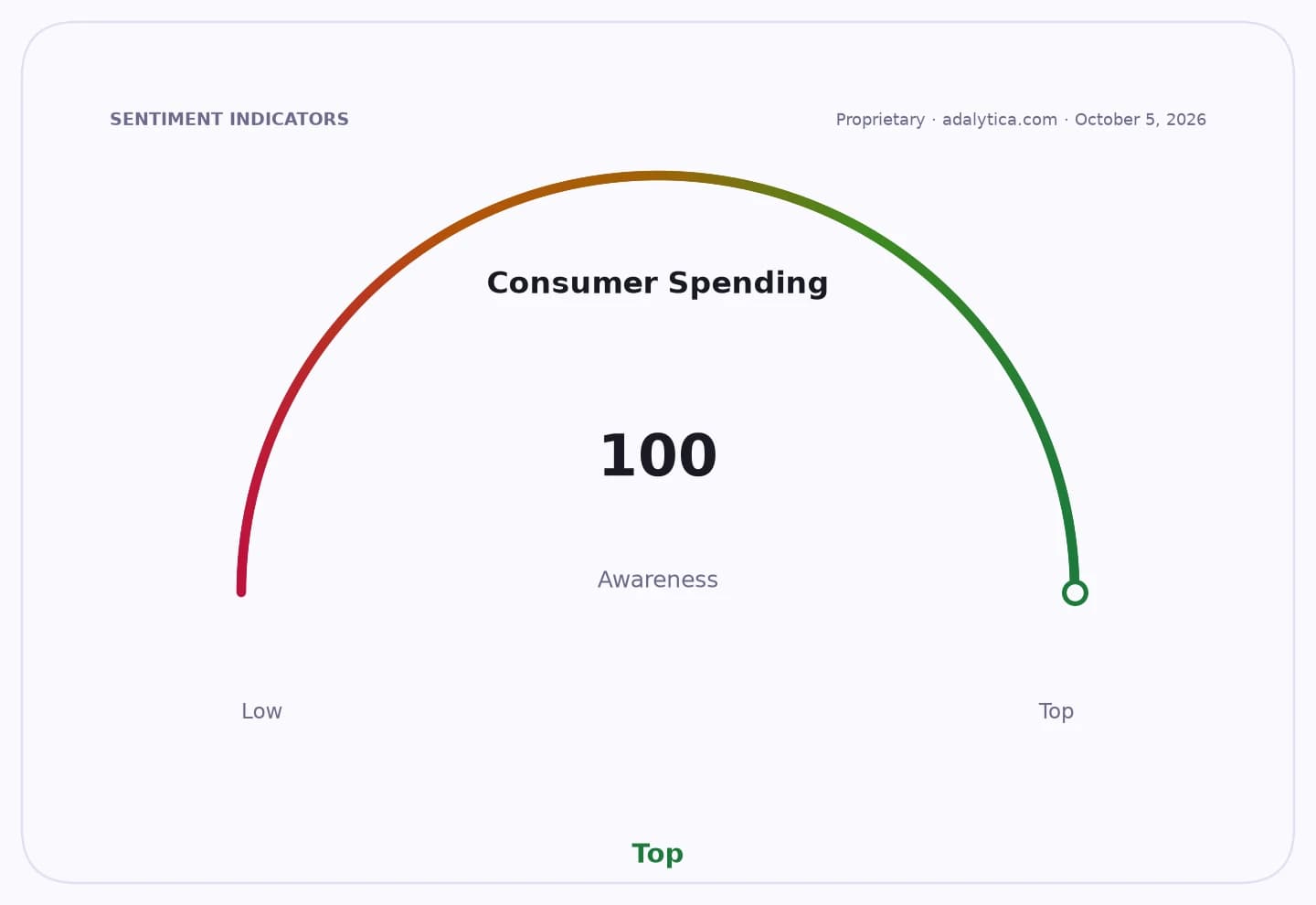
The timing is notable. Adalytica’s consumer spending sentiment gauge sits at 93, in “Extreme Greed,” suggesting households are still willing to spend even as broader S&P 500 trade signals show fear. That combination has supported payment volumes, but it also means rewards restrictions would not be landing in a weak-consumption environment where issuers could easily blame slower spending growth for margin pressure. Instead, the industry would likely face a direct hit to unit economics at a time when transaction demand remains relatively resilient.
For investors, the issue is less about immediate revenue loss than about valuation risk. Visa and Mastercard trade like high-quality compounders because the market expects durable double-digit growth, asset-light margins and little regulatory interference. A cap on rewards would raise the odds of slower card spend growth, narrower spreads and more intense competition for premium customers. It would also revive a long-running bear case that payments networks are exposed to political pressure whenever interchange fees, consumer incentives or merchant costs come under scrutiny.
The bullish view is that any cap would be hard to implement, easy to litigate and unlikely to change consumer behavior quickly. Cardholders who value points, airline miles or cash back may still favor premium cards, while banks could respond by shifting rewards into other perks or annual-fee structures. The bear case is that even a modest cap would weaken the economics of acquisition and retention, especially in premium and co-branded cards, and could eventually feed through to slower volume growth and lower return on invested capital.
For now, the market is treating the policy risk as manageable. But with Visa and Mastercard near record territory and American Express already sensitive to changes in consumer credit trends, any serious move toward capping rewards would force investors to reassess how much of the payments growth story depends on ever-richer incentives.
| Entity | Gains | Losses |
|---|---|---|
| Merchants | ▲Lower acceptance-cost pressure | ▼Less card-promo volume |
| Consumers who pay cash | ▲Potentially fairer pricing | ▼Fewer rewards perks |
| Visa / Mastercard / AmEx | ▲None in the near term | ▼Rewards economics, margins |
| Banks and card issuers | ▲Cleaner pricing model if adapted | ▼Customer acquisition and retention |