Wall Street is still minting record profits from the Fed’s post-crisis liquidity regime, even as the central bank leaves its benchmark rate pinned at 3.63% and the 10-year Treasury yield holds near 4.6%, a combination that keeps money flowing into risk assets while preserving wide spreads for financial markets businesses.
Wall Street profits tied to 3.63% Fed rate
That is the core opportunity the market keeps underestimating: abundant liquidity is not just a backdrop for higher asset prices, it is the engine of fee income, trading volumes and balance-sheet returns. The latest data show the policy rate has stayed flat through the summer and is projected to remain near 3.625% next month, while the 10-year yield sits around 4.62%, a level that still rewards capital-market intermediaries, market makers and exchanges. At the same time, unemployment has drifted down to 4.1%, giving the Fed room to avoid choking off the cycle and allowing risk appetite to remain intact.
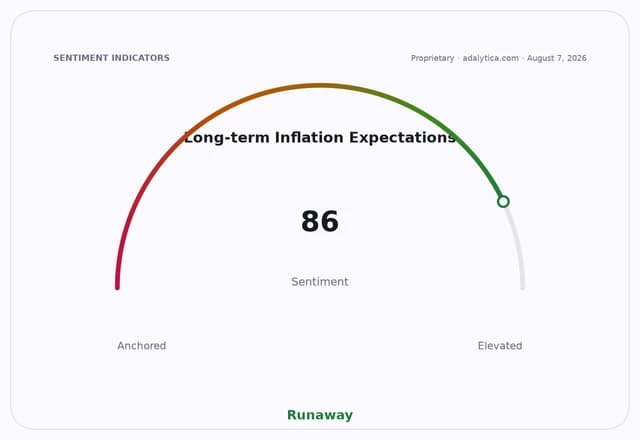
Sentiment IndicatorsⓘProprietary · adalytica.com · August 7, 2026
This is a snapshot — live sentiment, awareness and momentum for 130+ markets update continuously in the dashboard.Open AlphaPulse

The result is a market that continues to reward liquidity providers more than liquidity takers. The S&P 500 ETF, SPY, has climbed to 773.26, well above its 50-day moving average of 746.61 and 200-day average of 700.13, with RSI readings near 69.6 and a bullish MACD setup. The Nasdaq-100 ETF, QQQ, is back to 723.03 after a sharp late-July washout, while the Russell 2000 ETF, IWM, has pushed to 301.56, reclaiming its 50-day and 200-day moving averages. That broad rebound matters: when megacap tech, small caps and the wider market all recover together, liquidity is working through the system, not sitting idle on the sidelines.
Adalytica’s 5-year inflation breakeven sentiment has surged to 86, labeled Extreme Greed, while CPI sentiment is at 99 and confidence in the Fed’s 2% target remains only neutral. In plain English, investors are pricing a world where inflation stays sticky enough to keep nominal growth elevated, but not so hot that the Fed is forced into a crushing tightening cycle. That is exactly the sweet spot for Wall Street earnings. Trading desks thrive on volatility and flow, exchanges benefit from heavier volumes, and banks can harvest wider spreads and stronger capital-markets activity.
FEDFUNDS vs DGS10 — macro contextadalytica.com
Explore this data interactively — full history, time series and cross-market comparisons.Open AlphaPulse
That is why the names most tied to market plumbing deserve a premium. Cboe Global Markets, with its exposure to VIX and SPX options, is one of the cleanest ways to play persistent demand for hedging and speculation. Morgan Stanley’s latest filing highlights how liquidity resources remain central to institutional activity, while peers such as Goldman Sachs and Charles Schwab continue to stress market movements, collateral and funding conditions as key drivers of revenue and risk. In this regime, the winners are not the companies pleading for cheap money, but the firms charging tolls on every trade, hedge and allocation.
Investors should see this as a multi-year setup, not a one-day trade. As long as the Fed stays on hold, inflation expectations remain elevated and the yield curve offers positive carry, Wall Street has a direct path to harvesting daily liquidity into record profits. The practical takeaway is to stay overweight market infrastructure, exchanges, high-quality brokers and trading-heavy financials while the liquidity cycle remains alive.
| Entity | Gains | Losses |
|---|---|---|
| Wall Street market makers | ▲Wider spreads, heavier flow | ▼Lower volatility regimes |
| Exchanges like Cboe | ▲Higher derivatives volume | ▼Quiet trading markets |
| Large banks and brokers | ▲Trading and fee income | ▼Tighter funding conditions |
| Rate-sensitive borrowers | ▲Stable policy rates | ▼Higher-for-longer yields |