Walmart is emerging as retail’s clearest AI winner because the company already has the scale, data and digital traffic to turn automation into margin leverage faster than peers.
Walmart AI Efficiency Could Support Margin Growth
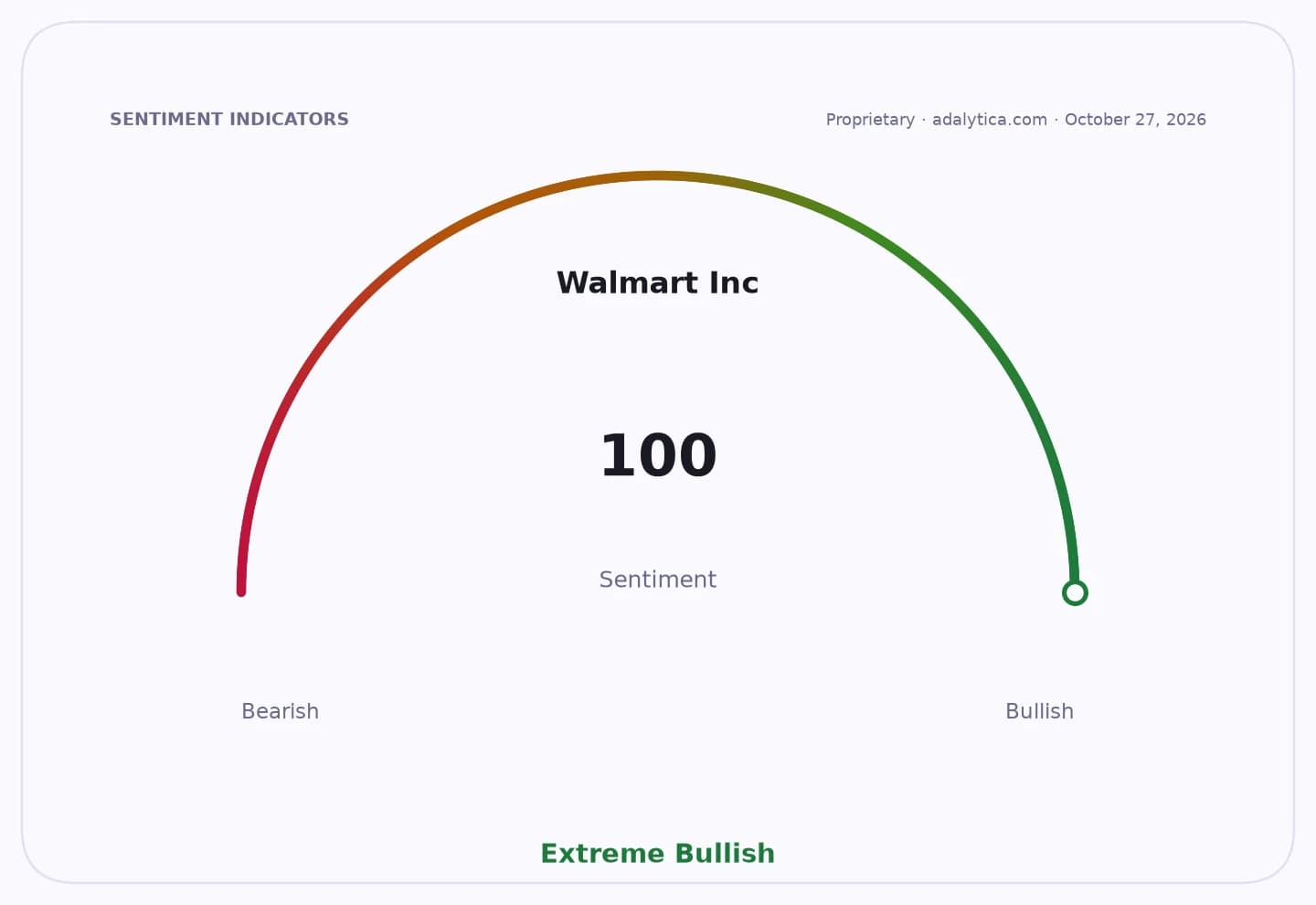
Walmart Inc
That matters because the next phase of retail competition is shifting from who has the lowest shelf price to who can use AI to run inventory, logistics, advertising and customer service more efficiently. For Walmart, that could mean lower operating costs, better product availability and more profitable e-commerce growth at a time when consumer spending remains firm and rivals are still fighting for traffic.
Sentiment Indicators

The case is showing up in the numbers. Walmart U.S. e-commerce sales contributed about 4.9% to comparable sales in the latest quarter and 5.1% over the first half of fiscal 2026, according to its 10-Q, underscoring that digital operations are no longer just an expense line but a driver of top-line growth. Sam’s Club U.S. e-commerce added another 3.1% to comparable sales over the same periods.
At the same time, the broader retail backdrop remains supportive. Industrial production is forecast to edge higher to 104.0484 in October from 103.9506 in September, while the latest consumer-spending gauge sits at 100 with “extreme greed,” suggesting demand has not rolled over even as investors worry about growth. That gives Walmart room to press its advantages without sacrificing volume.
Shares have reflected that optimism. Walmart closed at $118.61 on Oct. 28, near its 200-day moving average of $118.11 and above its 50-day average of $109.69, while its RSI at 73 points to stretched but still powerful momentum. The stock has been volatile, but the trend says investors are paying up for defensive growth and AI-enabled efficiency.
Adalytica’s Walmart earnings sentiment gauge is also at 93, or “extreme greed,” even as awareness remains low, suggesting the market is increasingly convinced that Walmart’s scale can turn AI investment into a competitive moat before the benefit becomes fully visible in reported results. By contrast, Target’s shares at $148.55 are still below their 50-day average of $157.36, a sign that investors are less convinced it can convert the same technology shift into comparable operating leverage.
The investor takeaway is straightforward: if AI is going to matter first in retail, it is likely to show up in a business like Walmart’s, where small efficiency gains can scale across thousands of stores, a huge online base and a dense supply chain. The next catalyst is Walmart’s next earnings update, where traders will look for signs that AI-driven productivity is filtering into margin, fulfillment and inventory execution.
| Entity | Gains | Losses |
|---|---|---|
| Walmart | ▲Margin leverage from AI | ▼Higher reinvestment burden if execution slips |
| Target | ▲Pressure to catch up on efficiency | ▼Share performance if AI gains lag |
| Consumers | ▲Better availability and service | ▼Fewer promotions if efficiencies widen |
| Retail rivals | ▲Technology wake-up call | ▼Slower cost improvement versus Walmart |