Walmart’s push to use AI inside its stores is becoming more than a technology upgrade — it is a profit lever that can widen the company’s moat in a retail market where small gains in speed, inventory accuracy and labor efficiency compound fast.
Walmart AI Push May Lift Efficiency and Margins
That matters because Walmart does not need AI to invent a new business model; it needs it to make the world’s biggest retail network run tighter, cheaper and faster. In a low-margin industry, even modest improvements in stock availability, replenishment and worker productivity can translate into hundreds of millions of dollars in operating leverage. For investors, that is the kind of quiet transformation that can support earnings growth long after the initial AI excitement fades.
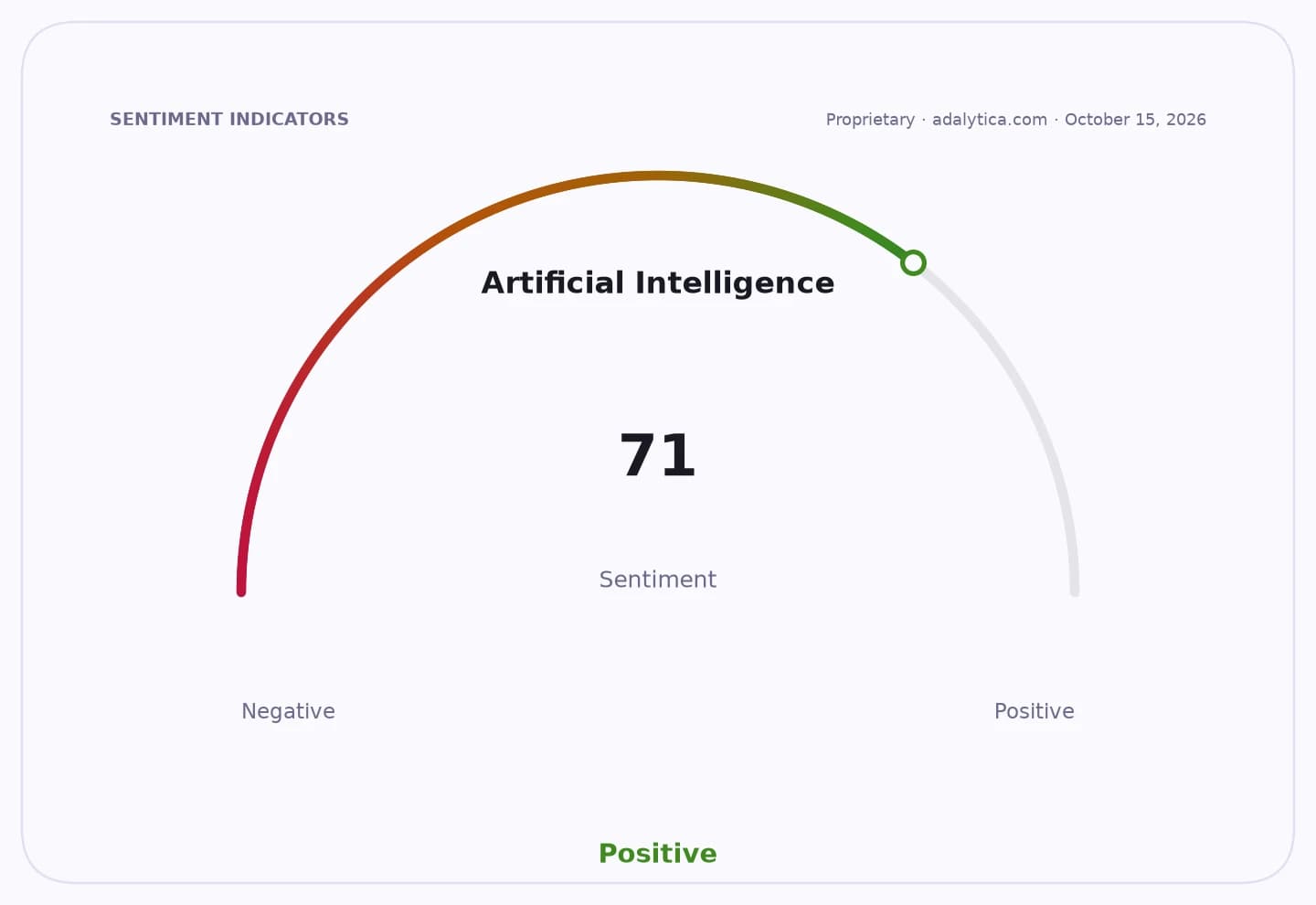
Sentiment IndicatorsⓘProprietary · adalytica.com · October 15, 2026
This is a snapshot — live sentiment, awareness and momentum for 130+ markets update continuously in the dashboard.Open AlphaPulse
The market is already rewarding the story. Walmart shares have surged to around $116, above the 50-day moving average of roughly $109 and back near the upper end of their recent trading range, with the stock recently pushing through the $113-$116 zone on stronger volume. Momentum indicators have firmed as well, with the relative strength index climbing into the low 70s and the MACD turning positive, showing investors are willing to pay up for proof that AI is not just a narrative but a real operating tool.
The timing is important. Retailers are fighting a consumer environment that is still price-sensitive and highly promotional, while workers remain expensive and supply chains still require constant fine-tuning. Walmart’s edge has always come from scale and execution; AI simply gives management a faster decision engine. If algorithms can improve store-level merchandising, reduce shrink, sharpen demand forecasting and direct labor more efficiently, Walmart can defend traffic while lifting margins — a combination that is hard for rivals to match.
That is where the broader investment case gets compelling. Walmart is not the pure-play AI stock many traders chase, but it may be one of the best real-world beneficiaries of the rollout. The market often overpays for the companies building the models and underprices the companies using AI to squeeze more productivity out of massive physical networks. Walmart, with its size, data advantage and omnichannel reach, sits squarely in the second camp.
There is also a second-order effect here for the rest of retail. If Walmart’s AI tools improve in-store execution, competitors such as Target and even club rivals like Costco face a tougher fight on service consistency, assortment and labor efficiency. Target’s stock, while far stronger than in earlier periods of the year, remains well below its 2026 highs, underscoring how quickly retailers can be separated by execution. Costco remains the premium operator in warehouse retail, but Walmart’s scale plus AI-driven efficiency is a powerful combination that the market may still be underestimating.
The key catalyst now is whether the AI rollout shows up in the numbers: stronger comparable sales, better inventory turns and steady margin expansion. Walmart does not need a dramatic leap for the thesis to work. It only needs incremental gains across thousands of stores to create a meaningful earnings tailwind. That is why I believe the stock can keep re-rating: this is not AI hype, it is AI embedded in the most important retail machine in America.
For investors, the takeaway is straightforward: Walmart remains a core defensive holding, but the AI angle gives it offensive upside too. The market is still catching up to the idea that the best AI beneficiaries may not be the flashiest names, but the companies turning intelligence into operational leverage. Walmart is one of them.
| Entity | Gains | Losses |
|---|---|---|
| Walmart | ▲Higher efficiency, margin lift | ▼None if execution holds |
| Target | ▲Forced to match productivity gains | ▼Pricing and service pressure |
| Costco | ▲Benefits from sector AI adoption | ▼Less differentiation if Walmart closes the gap |
| Walmart shareholders | ▲Earnings leverage and rerating potential | ▼Little near-term if valuation stretches |