Walmart is expanding its employee health package with more than 250 free medications, including GLP-1 drugs for workers with type 2 diabetes, in a move that underscores how far U.S. employers are going to manage rising healthcare costs and retain labor.
Walmart expands employee health benefits and free drugs
The nation’s largest private employer said the benefit will take effect as part of its annual enrollment period ending Nov. 6, and will also cover no-cost specialist evaluations for associates examined for or diagnosed with conditions such as multiple sclerosis and Parkinson’s disease. The plan adds to an already broad benefits lineup that includes 20 free therapy sessions a year and about $20,000 for fertility, adoption or surrogacy services.
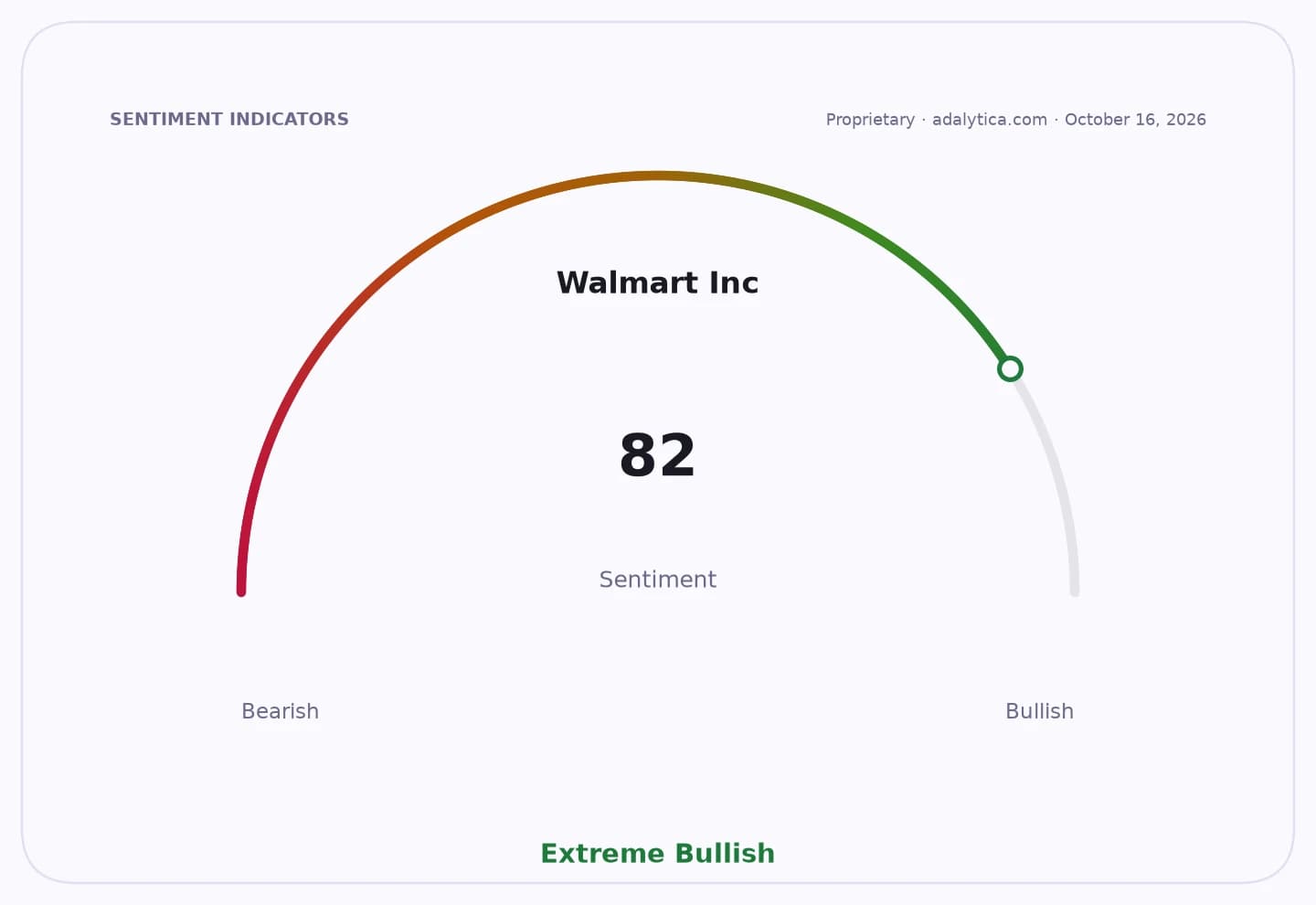
Sentiment IndicatorsⓘProprietary · adalytica.com · October 16, 2026
This is a snapshot — live sentiment, awareness and momentum for 130+ markets update continuously in the dashboard.Open AlphaPulse
For investors, the immediate question is not whether the package is generous, but whether it can be absorbed without materially worsening Walmart’s already rising associate healthcare bill. Walmart disclosed in its latest quarterly filing that higher associate healthcare benefit costs, driven by increased enrollment and medical cost inflation, were one of the factors lifting expenses in the period ended July 31. The company is also raising starting health insurance premiums by $1.50 per biweekly pay period to $39.80, which suggests it is trying to offset part of the added cost rather than simply absorb it.
That balance matters because healthcare has become one of the more stubborn inflation lines in corporate America. A tight labor market has kept benefits central to retention, especially for a company that employs more than 1 million U.S. workers and relies on a large hourly workforce. Walmart’s move is a competitive one as much as a welfare measure: richer benefits can help lower turnover, reduce absenteeism and support recruitment, even if they pressure near-term margins.
The GLP-1 component is particularly important. Weight-loss and diabetes drugs have become a focal point for employers because of their clinical value and their price. Covering them free for eligible workers could improve adherence and long-term health outcomes, but it also exposes companies to a category of pharmacy spending that has been among the fastest-growing in employer plans. In that sense, Walmart is making a strategic bet that the cost of treating chronic disease upfront may be cheaper than the downstream cost of unmanaged illness.
The market reaction has been shaped by that tension. Walmart shares have been consolidating after a strong run, with the stock trading around its 50-day average and just below its 200-day average, while momentum gauges such as RSI and MACD have recently turned firmer. Eli Lilly, the clearest public-market proxy for GLP-1 demand, has also been strong, while Novo Nordisk has been more volatile as investors reassess pricing and competitive pressure. The Walmart benefit news does not change the drug market’s fundamentals by itself, but it reinforces that demand for GLP-1 therapies is broadening beyond direct consumer spending into employer-sponsored coverage.
The broader narrative is that large U.S. employers are increasingly using benefits design as a cost-control and talent strategy at the same time. Walmart is effectively choosing to spend more on healthcare access while nudging employees to absorb a modest premium increase. If the program helps curb turnover and improves health outcomes, it could support productivity and ease longer-term claims pressure. If utilization of expensive therapies rises faster than expected, it will add another layer of cost inflation to an already compressed retail margin structure.
For investors, the key watchpoints are whether Walmart can keep healthcare expansion from leaking into operating leverage, and whether other large employers follow with similar GLP-1 coverage. That would deepen the structural demand pool for the drug class, but it would also intensify the debate over who ultimately pays for one of the most expensive new medicines in the U.S. system.
| Entity | Gains | Losses |
|---|---|---|
| Walmart employees | ▲Free drugs and broader care | ▼Slightly higher premiums |
| Walmart | ▲Retention, productivity, recruitment | ▼Higher healthcare costs |
| Eli Lilly, Novo Nordisk | ▲Broader GLP-1 coverage demand | ▼Pricing pressure, payer scrutiny |
| Employers generally | ▲Benchmark for benefits strategy | ▼Higher plan costs if copied widely |