When money becomes stable and accumulated rather than scarce, the habits that built wealth can start to work against it.
Wealthy Households May Stay Overly Defensive

That is the central message for households and investors alike. Frugality, constant vigilance and an all-cash safety bias are often essential in the accumulation phase, but once balance sheets are stronger those same habits can leave capital underdeployed, returns too low and lifestyle decisions misaligned with real financial capacity. The shift matters economically because it influences consumer demand, household savings behavior and the flow of capital into productive assets at a time when sentiment around spending and saving is already fragile.
Sentiment IndicatorsⓘProprietary · adalytica.com · July 29, 2026
This is a snapshot — live sentiment, awareness and momentum for 130+ markets update continuously in the dashboard.Open AlphaPulse
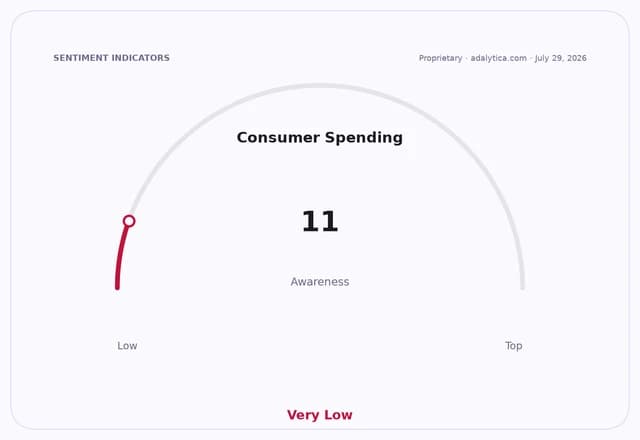
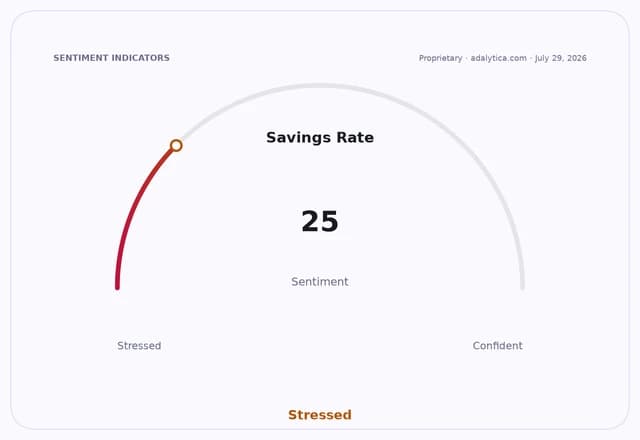
The clearest market signal behind that shift is a sharp deterioration in spending and savings confidence. Adalytica’s Consumer Spending Sentiment gauge has fallen to 25, or “Fear,” while its Household Savings Rate Sentiment is also at 25, reflecting “Fear,” even after periods earlier this year when both gauges were far stronger. That suggests households are not just becoming cautious; they are reassessing what “financial safety” means once wealth has been accumulated. For affluent consumers, the risk is no longer overspending in isolation. It is allowing money to sit idle, or making every purchase and investment decision through the lens of scarcity long after scarcity has eased.
That has economic consequences. Wealth that is preserved but not deployed does little to support growth, whether through consumption, entrepreneurship or long-duration investment. The wealth-management context points to the same issue at a broader level: Europe’s households hold substantial wealth per adult, yet underinvest in growth, while wealth is becoming more concentrated in the U.S. through intergenerational transfers. In both cases, accumulation alone is not the endgame. The real question is whether capital gets reallocated into assets, businesses and experiences that sustain both household welfare and broader economic activity.
Consumer Spending — 30-day sentimentadalytica.com
Explore this data interactively — full history, time series and cross-market comparisons.Open AlphaPulse
For investors, the implications are two-sided. The bull case is that higher-net-worth households eventually relax defensive habits and shift toward more active spending, portfolio diversification and professional advice, supporting sectors tied to wealth management, travel, premium consumer goods and asset allocation services. The bear case is that fear persists even after financial independence, leading to chronically low consumption, excessive cash holdings and underexposed portfolios. In that environment, firms that depend on a healthy affluent consumer may face slower demand than headline wealth figures imply.
Market behavior in U.S. Treasuries and equities reinforces the tension. The iShares 20+ Year Treasury Bond ETF, TLT, has been oscillating around its 50-day moving average, with momentum still tentative and the RSI recovering from deeply oversold levels. The S&P 500 ETF, SPY, is likewise trading below its 50-day average after a strong spring run, reflecting an investor base that remains sensitive to growth, rates and risk appetite. When household behavior turns defensive, it can amplify that caution across markets: more demand for safe assets, less willingness to fund discretionary spending and a slower rotation into higher-risk opportunities.
The practical lesson is that financial discipline should evolve with wealth. What helps a household escape financial fragility is not always what helps it preserve prosperity. Once the emergency fund is full and long-term assets are in place, the challenge is to spend deliberately, invest intelligently and avoid confusing caution with prudence. For investors, the next catalyst will be whether affluent consumers begin to loosen those habits — or whether fear keeps capital trapped in low-return positions longer than markets expect.
| Entity | Gains | Losses |
|---|---|---|
| Wealth managers | ▲Higher advice demand | ▼DIY cash hoarding |
| Affluent households | ▲Better capital deployment | ▼Lifestyle underconsumption |
| Consumer sectors | ▲Stronger premium demand | ▼Defensive spending bias |
| Treasury bulls | ▲Safe-haven demand | ▼Risk-on capital flows |