Household borrowing is now doing the heavy lifting in the Western Balkans, and the World Bank’s warning matters because it shows credit growth is being driven by consumption rather than the more productive corporate channel just as bank profitability weakens and sovereign exposure stays high.
Western Balkans banks see household loan growth rise
In its latest Western Balkans economic report, the lender said private-sector credit was expanding at double-digit rates across Albania, Bosnia and Herzegovina, Kosovo, Montenegro, North Macedonia and Serbia, but household lending was outpacing corporate lending in several markets. That is a crucial economic shift: it can support near-term growth, but it also points to a credit cycle that is increasingly tied to household balance sheets, housing demand and rate-sensitive spending rather than business investment.
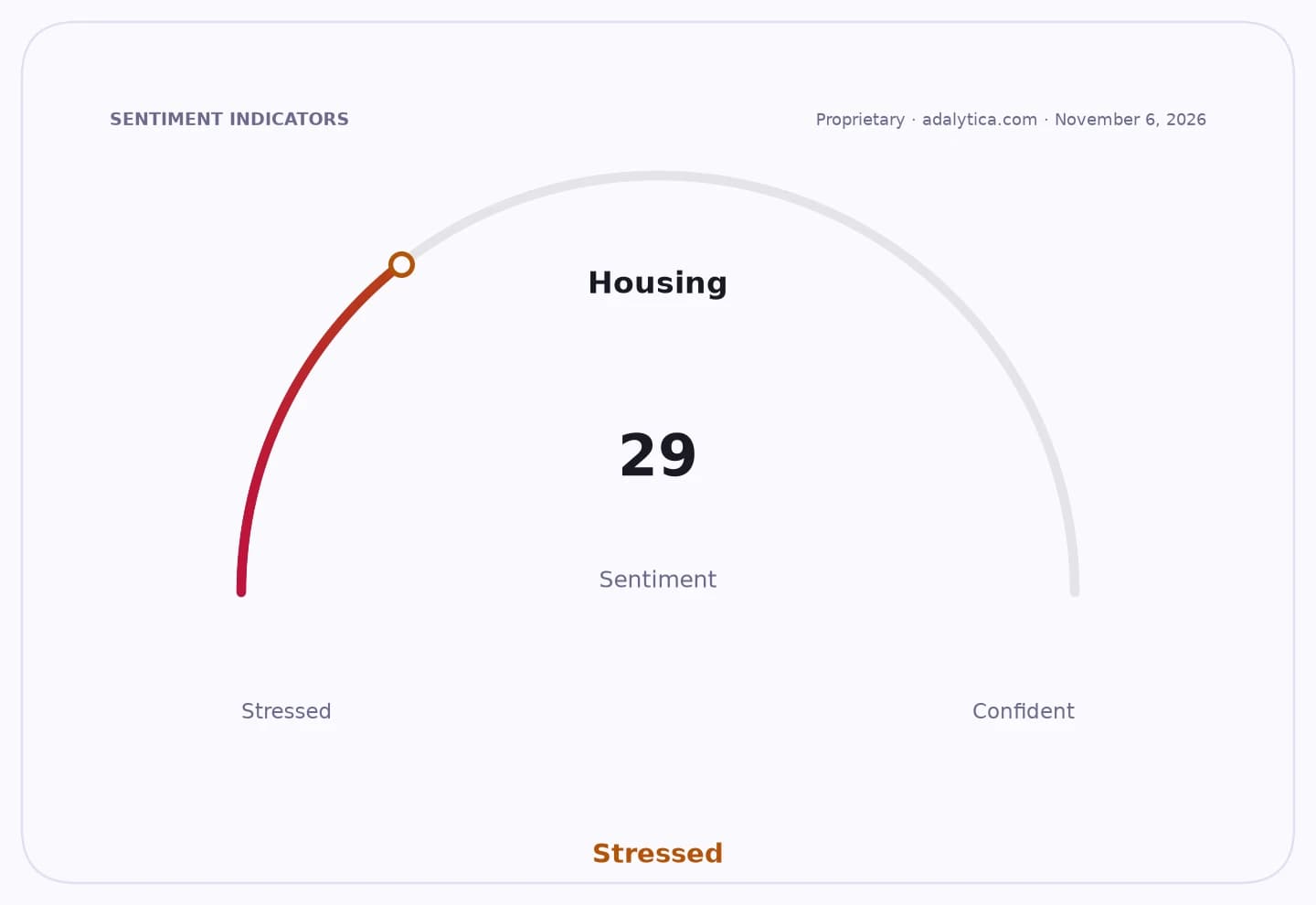
Sentiment Indicators
The region is growing faster, which is part of the problem and part of the opportunity. The World Bank expects GDP growth in the six economies it tracks to pick up to 3.1% in 2026 from 2.6% in 2025, then reach 3.4% in 2027 and 2028, helped by consumption and investment. Yet much of that consumption is being financed by banks whose capital buffers remain strong but whose earnings are under pressure. Average capital adequacy stood at 19.3%, far above the Basel minimum, while nonperforming loans have fallen to historic lows. But return on assets has slipped to 2.1% and return on equity to 15.4%, with fee income softening and operating costs rising across the board.
That is why investors should pay attention. A banking system can look healthy on capital and asset quality while still becoming less attractive on returns. The World Bank said non-interest expenses rose as a share of gross income in all six countries, a warning that margin compression and cost pressure are already eating into profitability. In Albania, bank profit fell 8.5% in the first half of 2026 as lower rates and rising expenses cut returns. In Montenegro, net profit fell 6.5% on weaker fee income and higher staff costs. Serbia still posts the strongest return on equity at 17.9%, but even there the growth mix is increasingly skewed toward households.
Serbia is the clearest example of the new lending pattern. Household credit rose 20.0% in June 2026, compared with 11.7% for corporate loans, driven by easier credit standards, promotional pricing and government support for lower-income borrowers and youth housing loans. Bosnia also saw household lending surge ahead of business credit, with mortgages climbing 21% and consumer loans 10% as housing prices rose. Albania’s mortgage lending jumped 16.7% as banks became more willing to take risk. North Macedonia’s household lending grew 16.1%, prompting regulators to tighten debt-service and repayment rules.
The macro implication is straightforward: banks are helping sustain demand, but the credit engine is tilting toward assets that can inflate quickly and become vulnerable if rates, employment or housing prices turn. The World Bank also singled out a second risk that investors often underprice in emerging European banking systems: sovereign exposure. Albanian banks hold government securities equal to 26.7% of assets, well above the lender’s 20% threshold for elevated exposure, while sovereign holdings in North Macedonia and Bosnia are now at or above 100% of regulatory capital. That creates a bank-sovereign feedback loop that can turn a fiscal shock into a financial one.
For investors, the trade-off is clear. This is not a crisis story; it is an early-cycle warning that the best balance-sheet story in the Western Balkans may no longer be the best earnings story. Well-capitalised banks can still benefit from credit expansion, but the more attractive play is likely to be the lenders with the strongest deposit franchises, the lowest funding costs and the least sovereign concentration. The weaker names are those leaning too heavily on mortgage growth, fee income and government paper.
The next catalyst is likely to come from regulation and credit pricing. As supervisors respond to faster household leverage and thinner liquidity, loan-growth limits, stricter debt rules or weaker promotional lending could cool the hottest markets first. That would pressure bank earnings before it shows up in bad loans. For now, the message is simple: the Western Balkans credit boom is real, but the market should focus less on volume and more on quality.
| Entity | Gains | Losses |
|---|---|---|
| Household borrowers | ▲Easier credit, lower rates | ▼Higher debt burdens |
| Banks with strong franchises | ▲Loan growth, stable capital | ▼Margin pressure, rising costs |
| Governments holding bank demand | ▲Support for consumption and housing | ▼Larger bank-sovereign nexus risk |
| Corporate borrowers | ▲Less immediate pressure than households in some markets | ▼Slower credit growth vs. households |