Winter wheat markets are being pulled between a cleaner near-term supply picture and mounting questions over how much crop stress producers can absorb into the next harvest, with the move showing up most clearly in grain-linked exchange-traded funds and benchmark crop prices.
Wheat ETFs rise as winter crop stress lingers
The sharper economic point is that a period of easing disruption risk from the Black Sea and improved U.S. new-crop availability has reduced the panic premium that pushed wheat to multi-year highs, but it has not removed the broader vulnerability in global wheat supply. That matters for food inflation, milling margins and farm income because wheat remains a politically sensitive staple, and prices can still re-rate quickly if yield models flag weaker winter production in key regions.
Sentiment IndicatorsⓘProprietary · adalytica.com · September 8, 2026
This is a snapshot — live sentiment, awareness and momentum for 130+ markets update continuously in the dashboard.Open AlphaPulse
In the U.S. market, the Teucrium Wheat ETF, WEAT, has climbed to $26.49 from $20.95 in early November, while the Invesco DB Agriculture Fund, DBA, has risen to $28.85 from $25.62 over the same general period. Both funds are trading above their 50-day and 200-day moving averages, a sign that money has stayed in the sector even after the latest pullback from overbought levels. WEAT’s relative strength index peaked at 87.0 on Sept. 2 and was still elevated at 63.6 on Sept. 4, while DBA’s RSI reached 82.9 on Sept. 1 and held at 64.7 on Sept. 4, suggesting the recent run was driven by genuine accumulation rather than a one-day squeeze.
That backdrop gives a practical financial rationale for interest in interpretable yield-estimation systems such as the BO-TCBDA deep-learning framework for winter wheat. Multi-source remote sensing models matter because they can improve yield estimates before harvest, helping commodity traders, insurers, lenders and government buyers distinguish between temporary pricing dislocations and real production shortfalls. In a market where geopolitics can change shipping assumptions overnight and weather can reshape output in weeks, better forecast visibility is increasingly a pricing input, not a research luxury.
Food & Groceries vs WEATadalytica.com
Explore this data interactively — full history, time series and cross-market comparisons.Open AlphaPulse
The broader macro setting is not disinflationary enough to make crop shocks irrelevant. U.S. consumer prices remain elevated relative to pre-pandemic norms, with the CPI index at 332.813 in July and forecast at 333.9723 for August, while industrial production continues to rise only gradually. At the same time, producer prices have eased from earlier peaks but remain high enough to keep input costs meaningful for the farm economy. For wheat growers, that means margins still depend heavily on yield, not just price, and for buyers, the risk is less about a single supply event than about a sequence of smaller weather and logistics disruptions that tighten the market again.
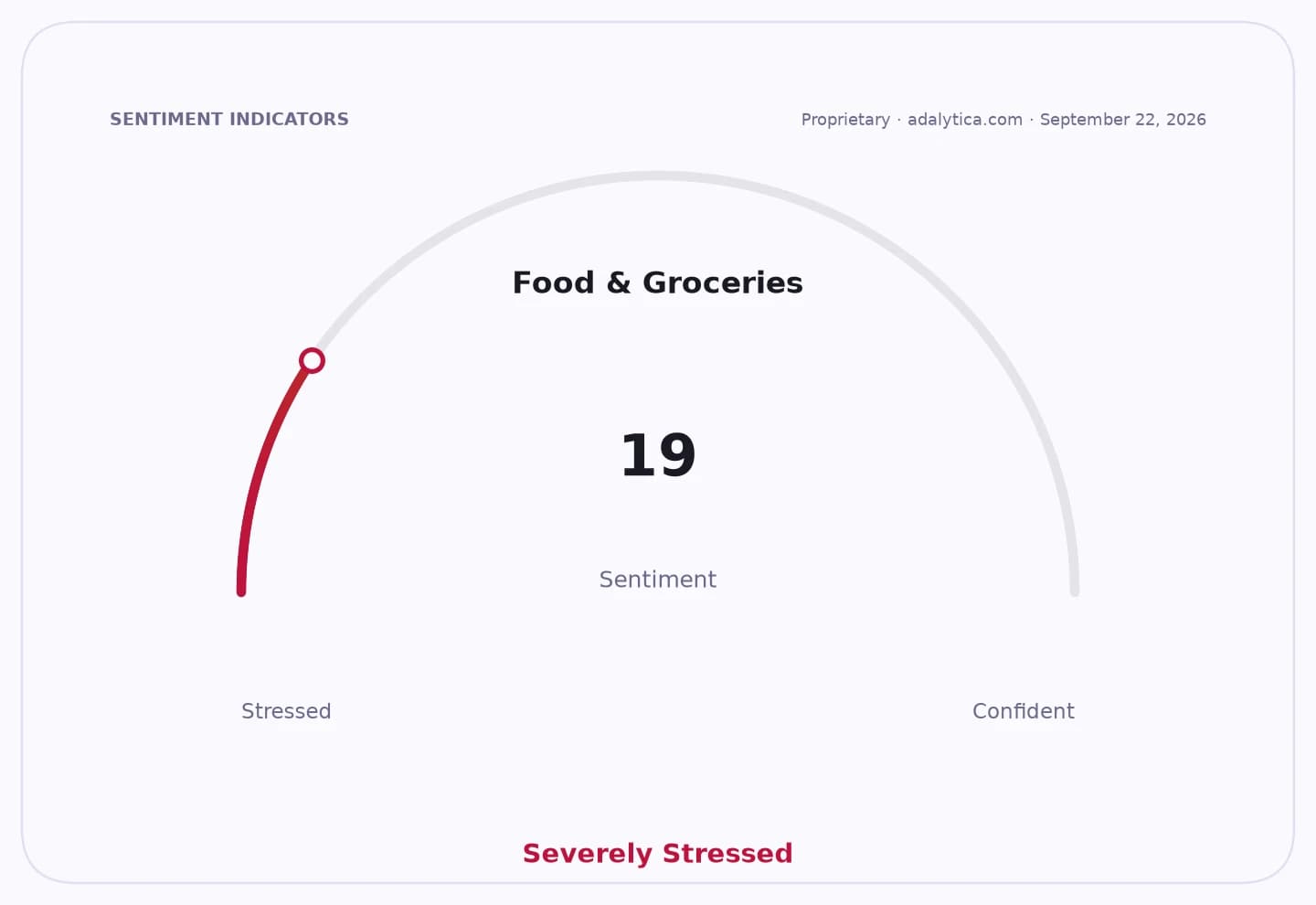
Adalytica’s food and grocery spending sentiment remains in fear territory, underscoring how quickly consumers react to staple-price volatility even when headline inflation is not accelerating sharply. That is one reason investors have kept a close watch on agricultural exposure: if winter wheat forecasts soften, the upside can be fast, but so can the reversal if Black Sea exports, U.S. harvest availability and Southern Hemisphere supply all improve at once.
For investors, the key question is whether the current rally in wheat-related assets reflects a durable shift in supply expectations or a temporary risk premium after a volatile geopolitical stretch. If remote-sensing models and field data confirm weaker winter wheat yields, the bullish case for grain exposure strengthens. If not, funds such as WEAT and DBA may give back part of their gains as markets refocus on improved supply flow and the absence of an immediate shortage.
| Entity | Gains | Losses |
|---|---|---|
| Wheat ETF holders | ▲Price momentum | ▼Entry at stretched levels |
| Grain buyers / millers | ▲Easier near-term supply | ▼Lower cover needs if prices fall |
| Winter wheat farmers | ▲Higher selling prices | ▼Weather-driven yield risk |
| Food consumers | ▲Relief if wheat stabilizes | ▼Higher prices if yields disappoint |