Wheat prices continued to slide this week on global exchanges, hitting a three-month low as traders looked past intermittent Black Sea disruption and focused instead on soft international demand and rising signs of supply competition.
Wheat Prices Fall to Three-Month Low

That matters because wheat remains one of the most politically sensitive staples in the food chain: when futures weaken, it can ease pressure on flour mills, feed users and ultimately consumer food inflation, but it also squeezes grain exporters whose margins depend on stronger world prices.
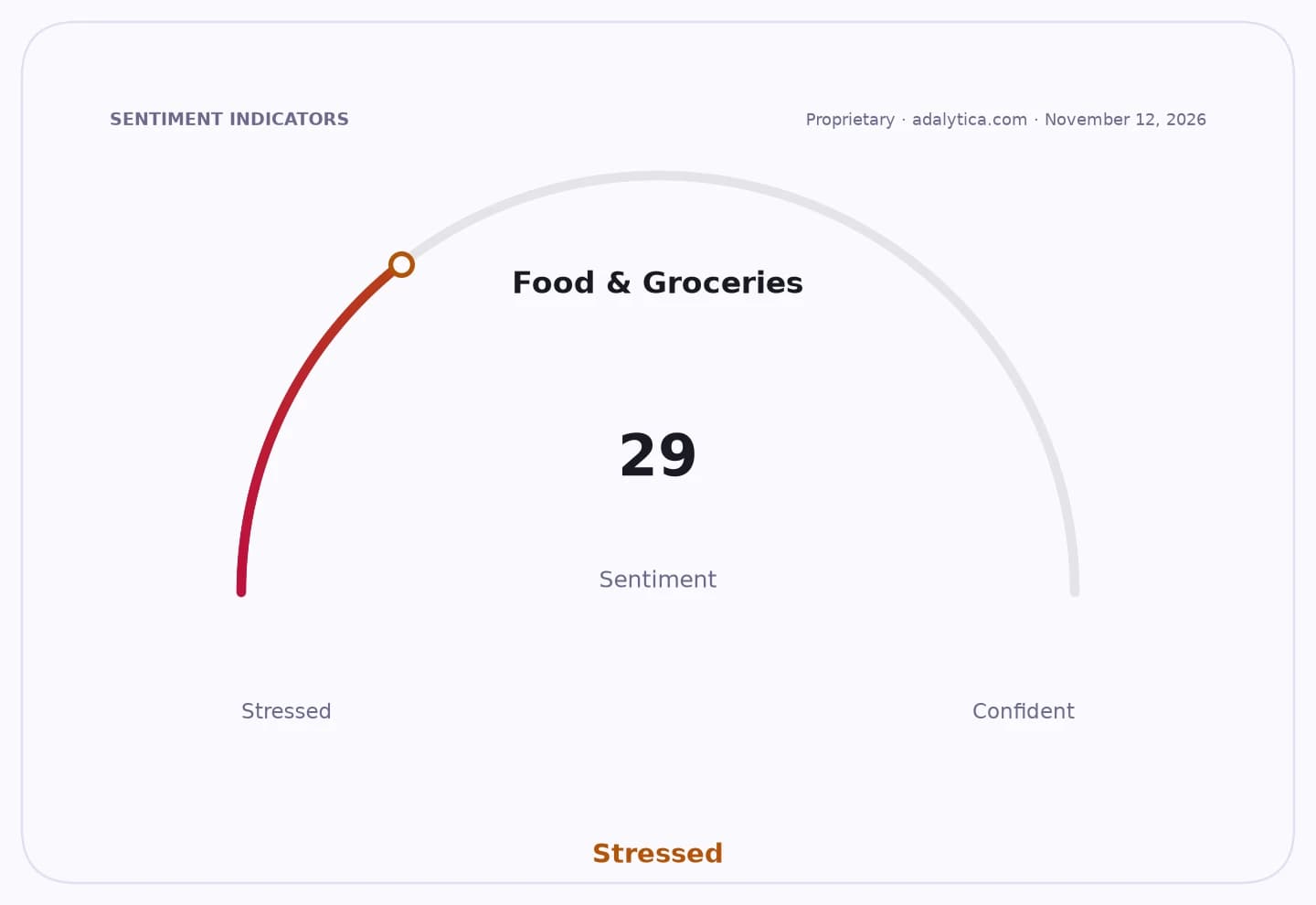
Sentiment Indicators
Food & Groceries
According to analysts at the Sofia Commodity Exchange, the December wheat contract in Chicago traded around $220 a tonne, while the December Euronext contract fell to roughly 223-225 euros a tonne. The slide reflects a market that is not yet willing to price in tighter conditions, even as logistics across the Black Sea remain uncertain and Russian exports have slowed sharply to about 2 million tonnes from 6 million tonnes in the same period a year earlier.
Argentina is also back on traders’ radar, with the first doubts emerging over the size of its crop. But for now, that is not enough to stop the downtrend. The bigger force is a market still flooded by bearish fundamentals: weak buying interest, ample competition among exporters and a lack of urgency from importers.

For investors, the move reinforces a broader disinflation trade across agricultural commodities. The weakness in wheat has been mirrored by corn, which also fell to a three-month low in Chicago, while sugar slipped to a one-month low. That combination points to easing pressure in parts of the global food basket, which can matter for food manufacturers, packaged-food margins and central banks watching commodity-driven inflation.
In practice, the trade is splitting winners and losers. Grain buyers, millers and food processors benefit from lower input costs, while farmers, exporters and agribusinesses with direct exposure to spot grain prices face a softer pricing environment. In Europe, the drop also keeps a lid on imported wheat costs for countries reliant on seaborne supply, even as geopolitical risk keeps a floor under volatility.
The investment takeaway is simple: the market is underestimating how quickly grain prices can reset when demand stays weak and supply routes, while noisy, do not fully tighten the balance sheet. Until importers step in or weather turns decisively adverse, wheat looks more like a fading inflation hedge than a momentum trade.
| Entity | Gains | Losses |
|---|---|---|
| Flour mills and food processors | ▲Lower input costs | ▼Less pricing power for grain sellers |
| Wheat importers | ▲Cheaper supply | ▼Exporters with weaker realizations |
| Farmers and grain exporters | ▲— | ▼Softer world wheat prices |
| Consumers and inflation-sensitive sectors | ▲Lower food-cost pressure | ▼— |