WTI crude has slid nearly 6% in a week, breaking below its 200-day moving average and putting oil bulls on the defensive just as the market struggles to hold the low-$80s.
WTI crude falls below 200-day moving average
That matters because crude is not just another commodity line on the tape. A sustained drop in WTI eases inflation pressure, cuts revenue expectations for producers and resets positioning across energy equities, oil services and inflation-sensitive assets. With WTI at $83.62 a barrel on Nov. 22, the benchmark sits about 5% below its 200-day average near $88 and 25.5% under its April peak of $112.25, a clear sign that momentum has turned negative.
Sentiment Indicators
The technical picture is now doing the heavy lifting. WTI’s latest close came after an intraday slide to $82.04, and the chart shows support first at that level, then at $79.11 and around $75.06 if sellers press their advantage. On the upside, the market needs to reclaim the $86.35-$86.45 band and then the 200-day line to signal that the recent stabilization is more than a pause in a broader decline.
That weakness is showing up across the energy complex. The SPDR Energy Select Sector ETF, XLE, has dropped sharply from its late-October highs and is now trading near $60, with its RSI in the mid-30s and the share price well below its 50-day average. The VanEck Oil Services ETF, XOP, has been hit even harder, falling to the mid-$160s from above $200 in October, a reminder that when crude rolls over, the second-order losers are often the drillers and service names leveraged to producer spending.
For investors, the market underestimates how quickly a softer oil tape can ripple through portfolios. Lower crude can help transport, chemicals and consumer sectors by easing input costs, while also giving bond markets a little relief through cooler inflation expectations. But for energy investors, the message is the opposite: the risk now is not a shortage rally, but a breakdown in price support that forces earnings revisions and capital discipline across the patch.
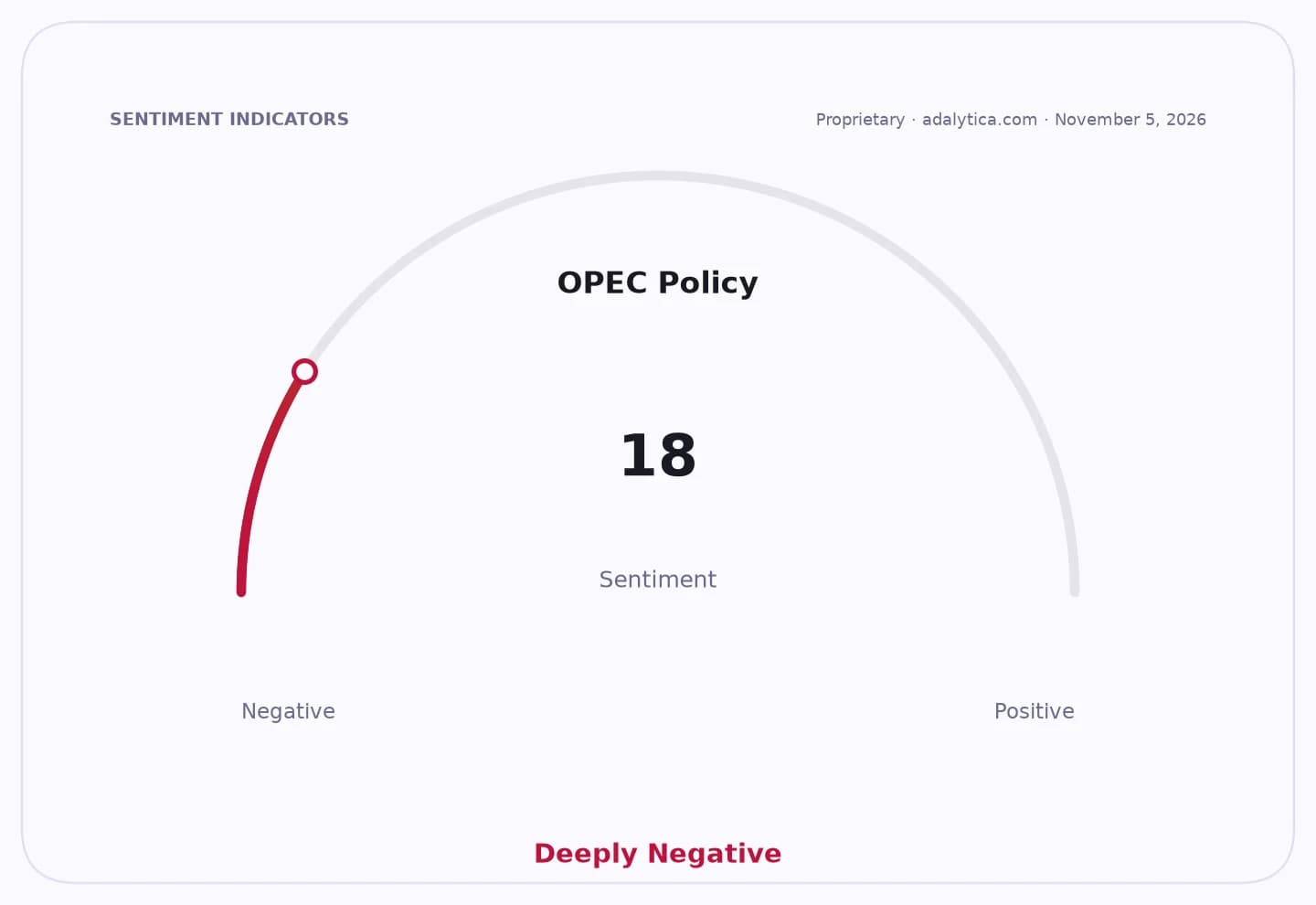
Adalytica’s Oil WTI Trade Signals snapshot shows sentiment still neutral, but awareness has dropped into fear, which fits a market that is no longer chasing upside and is instead watching whether the recent bounce can survive another leg lower. Until WTI reclaims the 200-day average, the asymmetric trade remains on the downside.
The actionable takeaway is simple: favor beneficiaries of cheaper crude over upstream producers until oil can reclaim key technical levels. Energy stocks are no longer the easy inflation hedge; in this tape, they are the risk.
| Entity | Gains | Losses |
|---|---|---|
| Airlines, transport, chemicals | ▲Lower fuel costs | ▼Less inflation hedge |
| Energy producers | ▲— | ▼Lower crude revenue |
| Oil services firms | ▲— | ▼Capex caution, weaker drilling demand |
| Consumers and importers | ▲Lower gasoline and diesel costs | ▼— |