US retail sales are still rising, but only just, as weak consumer confidence and thin operating margins keep the sector from seeing any meaningful acceleration in pay or demand.
XRT at $91.46 as US retail sales rise 0.24%

The latest data show retail sales at $666.1 billion in June, up just 0.24% from May, while a forecast for July points to only a 1.32% gain to $674.8 billion. At the same time, the University of Michigan consumer sentiment index slipped to 49.5 in June from 49.8 in April and 44.8 in May, underscoring households’ reluctance to spend freely even as the labor market remains relatively firm.
Sentiment IndicatorsⓘProprietary · adalytica.com · August 3, 2026
This is a snapshot — live sentiment, awareness and momentum for 130+ markets update continuously in the dashboard.Open AlphaPulse
That mix matters because retail is one of the clearest gauges of whether consumers can keep driving the US economy. Unemployment held at 4.2% in June and is forecast at 4.18% for July, suggesting jobs are not the immediate problem; rather, shoppers appear constrained by caution, price sensitivity and a still-fragile mood. For retailers, that leaves little room to expand payrolls or raise wages materially without squeezing already tight margins.
The market is already reflecting that pressure. The SPDR S&P Retail ETF, XRT, has been volatile but is up to $91.46, above its 50-day and 200-day moving averages, while momentum readings such as RSI and MACD have turned positive after a sharp spring selloff. That rebound suggests investors are betting the worst of the consumer slowdown may be behind the sector, but the improvement is not broad enough to imply a clean demand recovery.
Consumer Spending vs XRTadalytica.com
Explore this data interactively — full history, time series and cross-market comparisons.Open AlphaPulse
Individual chains show the same split. Walmart shares are holding near $110.71, below the 200-day moving average but recovering from a June low, while Target has surged to $149.35, well above both its 50-day and 200-day averages, as investors price in a stronger turnaround. Even so, the broader message is that retailers are still depending on traffic management, promotions and mix rather than robust wage-led demand growth.
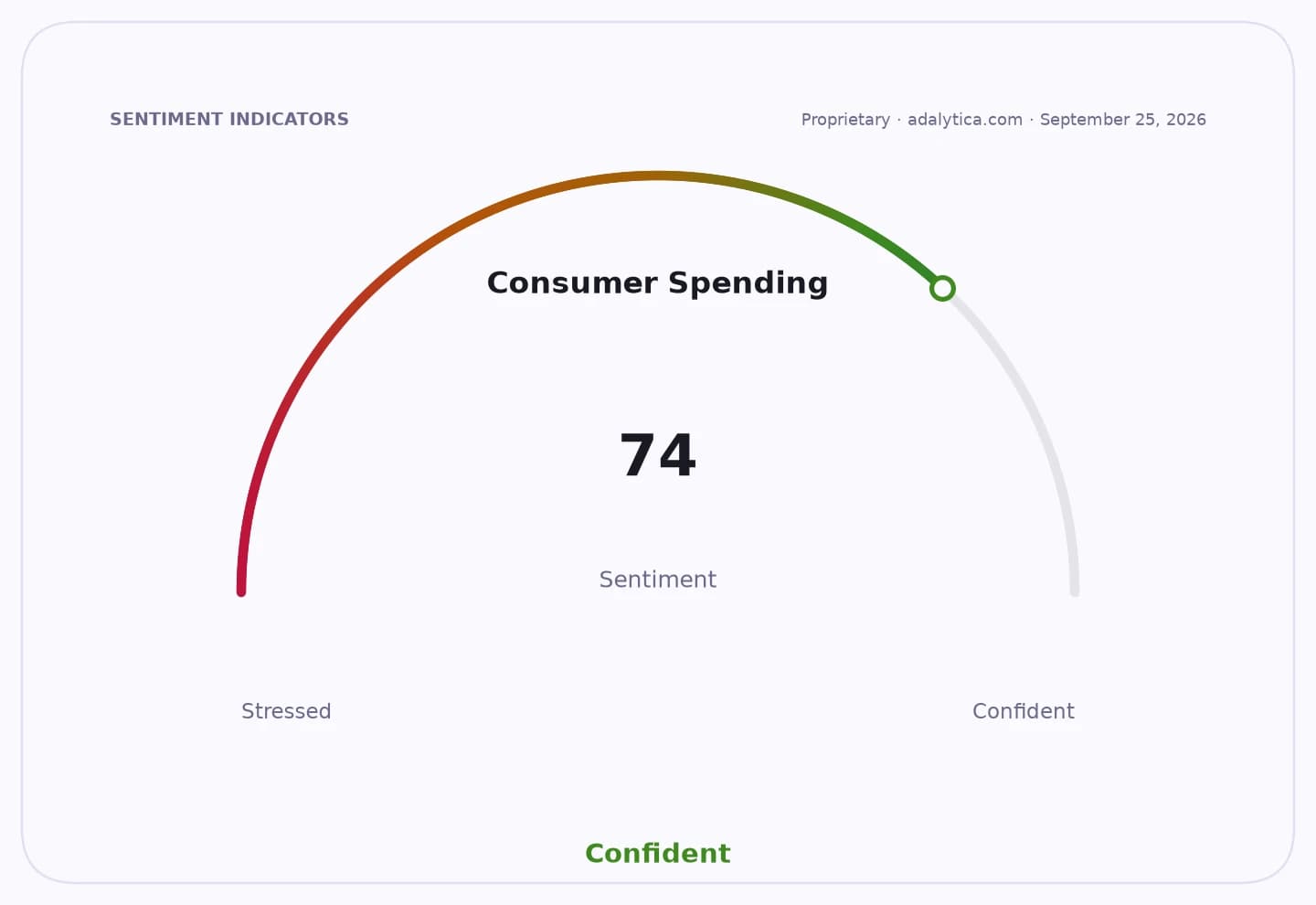
Adalytica’s Consumer Spending Sentiment gauge shows sentiment at 21, in “Fear,” after a steep one-day drop, while its Retail Sales Sentiment measure sits at 92 in “Extreme Greed.” That divergence points to a market still expecting sales to hold up even as households themselves remain uneasy, a combination that can support selective retail winners but leaves the sector exposed if consumers pull back further.
The next test is whether July sales and upcoming corporate updates from major chains confirm stabilization or show that spending remains too soft to justify broader wage gains, inventory rebuilds or margin expansion.
| Entity | Gains | Losses |
|---|---|---|
| Consumers | ▲Lower price pressure | ▼Better wage growth |
| Retailers | ▲Steady sales volumes | ▼Margin expansion |
| Walmart and Target | ▲Defensive traffic | ▼Broad discretionary demand |
| Retail investors | ▲ETF rebound potential | ▼Another weak sales print |