The yen is trading near 159 per dollar even as Moscow’s latest clash with Tokyo over the Northern Territories nudges investors toward safety, underscoring that Japan’s currency remains a macro policy story first and a geopolitical hedge second.
Yen Near 159 as Japan-Russia Tensions Rise

Russia’s summons of Japan’s ambassador and refusal to entertain Tokyo’s protest over the disputed islands adds another layer of diplomatic friction, but the bigger market takeaway is that the yen is still being pinned by the wide gap between Japanese and U.S. rates. The dollar-yen pair was last around 159.33, close to the year’s upper end, with the 50-day moving average at 161.14 and the 200-day average at 158.19, showing how firmly the exchange rate is sitting in a weak-yen regime even after recent pullbacks.
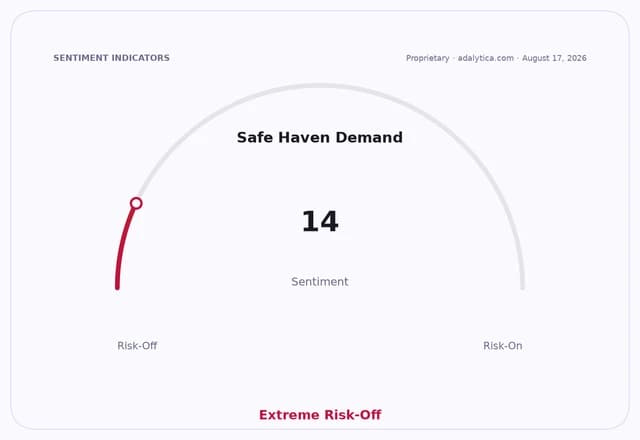
Sentiment IndicatorsⓘProprietary · adalytica.com · August 17, 2026
This is a snapshot — live sentiment, awareness and momentum for 130+ markets update continuously in the dashboard.Open AlphaPulse

That matters economically because a soft yen is a direct tax on Japanese importers and consumers while boosting the overseas earnings translation of exporters. It also feeds inflation through higher energy and food costs, leaving the Bank of Japan in a difficult position if it wants to normalize policy without choking growth. The market’s technical picture matches that tension: RSI is down near 27, which points to heavy selling pressure, while the MACD remains negative. In other words, the yen is stretched, but not yet obviously reversing.
For investors, the more important question is not whether a single diplomatic flashpoint can move USD/JPY for a day, but whether it can compound the safe-haven bid just as traders reassess Japan’s policy path. Adalytica’s FX Safe Haven Trading Signals show extreme fear at 14, suggesting the market is far from fully comfortable with geopolitical risk. Still, the Japanese currency’s own trade signal is only neutral, which tells you the market is not pricing a sustained rush into yen. That leaves room for volatility, not necessarily a durable trend change.
Safe Haven Demand vs JPY=Xadalytica.com
Explore this data interactively — full history, time series and cross-market comparisons.Open AlphaPulse
The investment implication is straightforward: if the yen stays weak, Japanese exporters, global manufacturers with yen-linked costs, and companies with large foreign revenue streams keep a currency tailwind. If geopolitical stress deepens and the Bank of Japan turns less tolerant of import-driven inflation, the reversal trade could get crowded fast. For now, the asymmetry still favors watching for dips in the yen rather than assuming Russia-Japan tensions alone can trigger a major FX regime shift.
The market underestimates how much of this is really about policy credibility, not diplomacy. The Northern Territories dispute may keep headlines hot, but the next sustained move in the yen will come from the spread between Japanese and U.S. yields, not from Moscow’s rhetoric. Investors should stay positioned for weakness in the currency until the BOJ changes the rate story.
| Entity | Gains | Losses |
|---|---|---|
| Japanese exporters | ▲Translation tailwind | ▼— |
| Japanese importers | ▲— | ▼Higher import costs |
| Yen bears | ▲Weak-currency carry trade | ▼Risk of sharp squeeze |
| Safe-haven buyers | ▲Temporary flight-to-quality bid | ▼If policy-driven weakness resumes |