The Chinese yuan’s recent rebound is looking increasingly fragile as a stronger dollar, softer China growth sentiment and still-elevated trade-war caution point to renewed pressure on the currency, according to Rabobank.
Yuan at 6.75 as dollar strength pressures currency

That matters because the yuan sits at the center of China’s financial stability story and helps shape export competitiveness, capital flows and broader risk appetite across Asian markets. When the currency weakens, imported costs can rise and investors often reassess whether Beijing will tolerate more depreciation to support growth.
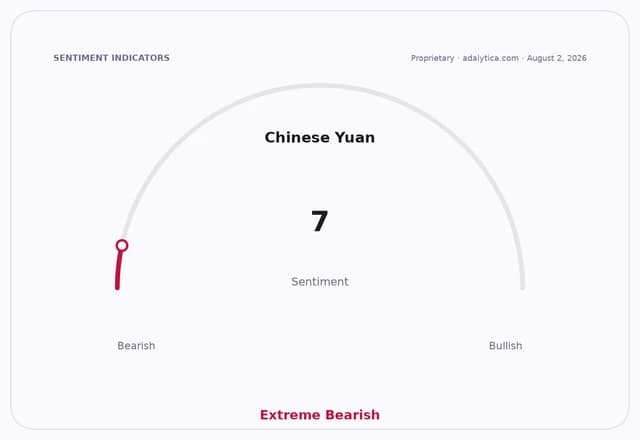
Sentiment IndicatorsⓘProprietary · adalytica.com · August 2, 2026
This is a snapshot — live sentiment, awareness and momentum for 130+ markets update continuously in the dashboard.Open AlphaPulse
Onshore yuan traded around 6.75 per dollar on the latest data, after sliding from 6.84 in late February and briefly recovering to 6.96 in mid-March. Technical readings now look stretched on the downside: the 14-day relative strength index is 26.6, while the currency remains below its 200-day moving average of 6.91, a sign the broader trend is still weak even after the short-term bounce.
By contrast, the U.S. dollar is drawing support from stronger trade signals and renewed market demand. Adalytica’s U.S. dollar gauge shows sentiment at 75, or “Greed,” with awareness at 97, while the yuan’s trade signal snapshot sits at 7, labeled “Extreme Fear,” underscoring how lopsided positioning has become. The FX carry trade gauge also shows awareness at 96, suggesting investors are closely watching whether yields and rate differentials continue to favor the greenback.

The macro backdrop is not helping China. Adalytica’s China growth-target sentiment remains only neutral at 36, while the latest news flow around geopolitical tensions adds another layer of caution for risk assets and emerging-market currencies. That combination leaves the yuan vulnerable if traders conclude that recent gains have run ahead of fundamentals.
For investors, the key question is whether this is just a pause in a broader dollar downtrend or the start of another leg lower in the yuan. A sustained break below recent levels could pressure Chinese equities tied to domestic demand and importers, while exporters and some offshore yuan hedges may benefit. The next catalysts are likely to be Federal Reserve policy expectations, U.S.-China trade headlines and any sign from Beijing on whether it is willing to defend the currency more aggressively.
| Entity | Gains | Losses |
|---|---|---|
| U.S. dollar bulls | ▲Stronger relative demand | ▼Less upside if risk appetite improves |
| Chinese exporters | ▲Better price competitiveness | ▼Higher imported input costs |
| Chinese importers | ▲— | ▼Higher foreign-currency costs |
| Yuan shorts | ▲Trend lower resumes | ▼Forced covering if Beijing stabilizes the currency |