The real story for investors is not Jim Cramer’s opinion itself, but the market backdrop he is arguing into: a still-elevated 10-year Treasury yield near 5.1% that keeps pressure on stock valuations and raises the hurdle for anything priced for perfection.
10-Year Treasury Yield Near 5.1% Pressures Stocks

That matters because interest rates remain the market’s gravity. When the 10-year yield is around 5.10% and the 2-year sits near 4.77%, borrowing costs stay high, discount rates stay stubborn, and the equity market has less room to shrug off weak earnings or stretched multiples. The yield curve has just barely steepened, with the 10-year above the 2-year by roughly 0.35 percentage point, a sign that investors still expect policy to stay restrictive even if the economy cools.
Sentiment IndicatorsⓘProprietary · adalytica.com · October 19, 2026
This is a snapshot — live sentiment, awareness and momentum for 130+ markets update continuously in the dashboard.Open AlphaPulse
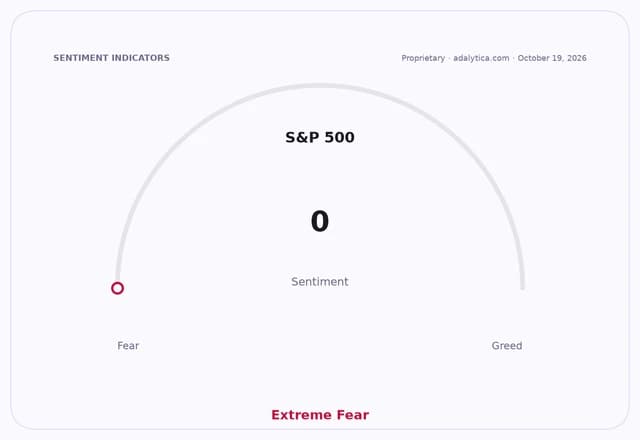
For stock investors, that is the key tension. The S&P 500 remains far above its 200-day average, but it has been wobbling around the 50-day line, while the Nasdaq is still trading below its 50-day average after a rough patch. That tells you the market is not in a clean risk-on mood. Adalytica’s S&P 500 trade signals show “Extreme Fear,” reinforcing what the price action already says: investors are nervous, not euphoric.
Cramer’s stance lands in that environment because it is a bet on resilience, not easy money. If rates stay high, leadership has to come from companies with real pricing power, strong cash flow and durable growth, not just long-duration promises. That is why megacap technology, quality cash-generating businesses and firms tied to secular trends such as AI and cloud computing still deserve attention, even if the market gets choppy.
DGS10 vs DGS2 — macro contextadalytica.com
Explore this data interactively — full history, time series and cross-market comparisons.Open AlphaPulse

The flip side is that higher yields remain a direct headwind for rate-sensitive parts of the market. Traders may see that in the muted tone of volatility gauges and the fact that the VIX proxy has eased from earlier spikes, but the underlying message is unchanged: bond yields are still competing with equities for investor capital. Adalytica’s U.S. Treasury bond signals show extreme greed in bonds, while the dollar has slipped into fear territory, a mix that points to shifting positioning rather than clear conviction.
For long-term investors, the takeaway is simple. This is not a market to chase blindly, but it is also not a market to abandon. Elevated yields make stock selection matter more, and they reward patience over speculation. If Cramer is leaning in, the practical lesson is to keep building around quality, diversification and time in the market — because the companies that can compound through a 5% Treasury world are often the ones that become the best long-term holdings.
| Entity | Gains | Losses |
|---|---|---|
| Quality stocks | ▲Durable cash flow premium | ▼Narrow, speculative names |
| Treasury bonds | ▲Higher yield appeal | ▼Price pressure if yields rise further |
| S&P 500 investors | ▲Selective buying opportunities | ▼Broad multiple expansion |
| Rate-sensitive sectors | ▲Little immediate benefit | ▼Higher financing costs |