AdaptHealth shares collapsed this week after the home medical equipment provider’s latest filing underscored a balance-sheet squeeze that leaves investors increasingly focused on liquidity, receivables collection and the chance of additional financing.
AdaptHealth shares fall 49% after Aug. 4 filing
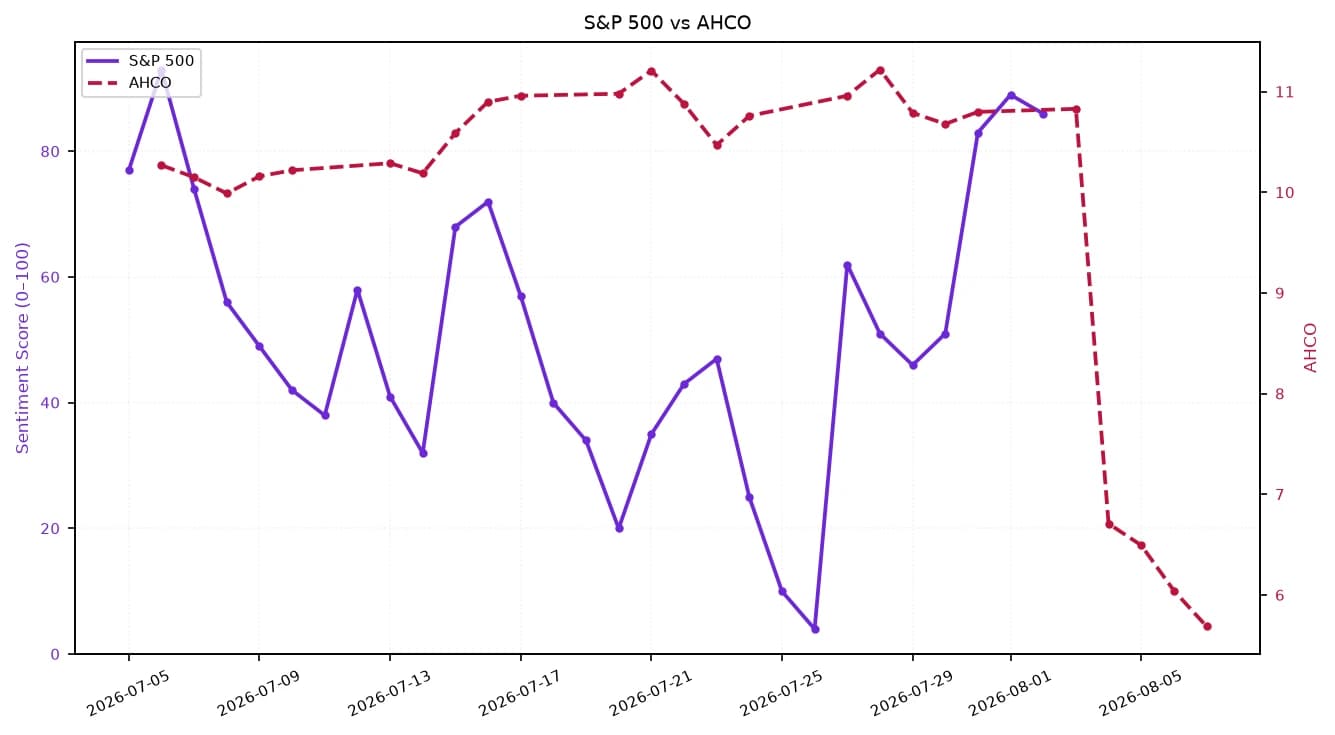
The stock fell to $5.69 on Aug. 7 from $11.22 on July 28, a drop of about 49%, after three straight sessions of heavy selling and volume that surged to almost 10 million shares on Aug. 5, well above recent trading. The selloff pushed the shares far below both the 50-day and 200-day moving averages, while the relative strength index sank to deeply oversold levels, reflecting how abruptly sentiment turned against the name.
Sentiment IndicatorsⓘProprietary · adalytica.com · August 9, 2026
This is a snapshot — live sentiment, awareness and momentum for 130+ markets update continuously in the dashboard.Open AlphaPulse
The catalyst was not a broad healthcare move. Peers such as Cardinal Health and Omega Healthcare Investors were comparatively stable in the same period, while the broader market remained in a risk-on tone. That left AdaptHealth’s decline looking like a company-specific repricing of financial risk rather than a sector rotation.
In its Aug. 4 quarterly filing, AdaptHealth said it had negative working capital for continuing operations of $79.3 million at June 30, widening from $19.3 million at year-end 2025. It also reiterated that a significant share of current assets consists of accounts receivable from third-party payors, which can be slow to convert into cash. The company warned it may seek additional equity or debt financing, particularly to support growth and acquisitions, and said tougher capital-market conditions could make such funding more difficult or expensive.
That combination is what investors sold. Negative working capital is not automatically fatal in healthcare services, where receivables can be substantial and collections can be predictable, but it becomes more dangerous when leverage is already elevated and financing options depend on market confidence. For AdaptHealth, the market appears to be discounting the possibility that any future capital raise could come at a steep cost to existing shareholders.
The 10-Q also showed the company is still contending with earnings pressure even as it manages through operational adjustments. Adjusted EBITDA in the quarter came in at $132 million, down from $136 million a year earlier, and margin slipped to 17.8% from 20.8%. Those figures do not suggest an outright operational collapse, but they do not provide much cushion if cash conversion deteriorates or if refinancing becomes necessary.
For investors, the key issue now is whether AdaptHealth can stabilize collections and preserve flexibility before the market forces a funding decision. Bulls may point to the company’s scale in home medical equipment and the possibility that receivables normalize over time. Bears will argue that the shares are repricing a classic liquidity overhang: weaker margins, a stretched working-capital position and an explicit acknowledgement that outside financing may be needed.
The stock’s violent break lower also leaves it vulnerable to further technical pressure if sellers continue to dominate. Any recovery will likely depend less on sector sentiment than on evidence that cash flow, receivables and leverage are moving in the right direction.
| Entity | Gains | Losses |
|---|---|---|
| AdaptHealth creditors | ▲Higher financing spread | ▼More default risk |
| New equity buyers | ▲Potentially cheaper entry | ▼Dilution risk |
| Existing AHCO shareholders | ▲None immediately | ▼Capital dilution, lower valuation |
| Healthcare peers | ▲Relative share-support | ▼Sector contagion concerns |




