South Africa’s debate over undocumented migration is usually framed as a border-security fight, but the bigger story is that Africa’s vast informal labour pool remains one of the continent’s most mispriced economic assets.
Africa Migration Debate Hides Investment Winners

That matters because migration is not just a political flashpoint; it is a distribution problem for wages, housing, remittances, consumer demand and public services. When governments clamp down without creating legal channels, they do not eliminate labour flows — they push them further underground, making economies less productive and more volatile. For investors, that creates both risk and opportunity: the risk is renewed social tension and policy disruption, while the opportunity sits with the companies and assets that benefit from scarcity, urbanization and cross-border economic integration.

The market is already signaling that investors are paying up for exposure to South Africa and the wider Africa complex when the narrative turns from fear to growth. The iShares MSCI South Africa ETF, EZA, has been volatile but has still climbed well above its 200-day moving average this year, showing that capital is willing to look through political noise when the underlying thesis is improving. Anglo American owner Rio Tinto and Shell have also held up better than the region’s domestic cyclical assets, a reminder that global capital prefers hard-currency, export-linked cash flows when local policy debates turn messy.
That is the key mispricing here. The market tends to treat undocumented migration as a headline risk, yet in economic terms it is a signal that Africa’s labour force is mobile, abundant and underutilized. South Africa is one of the continent’s most advanced economies, but it still depends on migrant labour in agriculture, construction, mining, retail and household services. The problem is not the existence of cross-border labour; it is the absence of a framework that turns it into tax revenue, productivity gains and formal consumption.
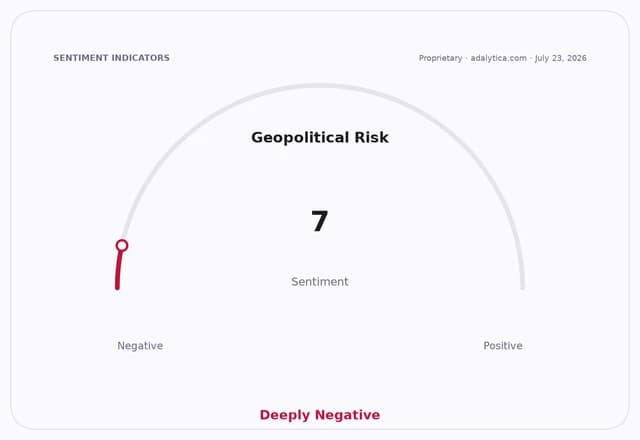
Geopolitical Risk vs EZAadalytica.com
Explore this data interactively — full history, time series and cross-market comparisons.Open AlphaPulse
This is why the issue matters far beyond South Africa. A continent with weak job creation, large youth cohorts and uneven growth cannot afford to treat labour mobility as purely a law-enforcement matter. If policymakers keep leaning on raids and deportations instead of permits, infrastructure and regional trade rules, they will preserve the informal economy and starve productive sectors of labour. If they move toward legalization and mobility corridors, the upside is broader: more stable wages, better remittance flows, stronger retail demand and more investable urban growth.
For investors, the asymmetry is clear. Beneficiaries of a more formal, more mobile Africa include infrastructure, telecoms, banks, payments and consumer names tied to urban migration and remittances. Losers are political actors betting on permanent scarcity and businesses exposed to unrest, policy shocks and abrupt enforcement campaigns. Resource exporters such as Shell and Rio Tinto remain attractive because they sit above the local noise, while South African domestic equities need a more selective approach, favoring firms with pricing power, regional diversification and strong balance sheets.
The uncomfortable truth is that undocumented migration is not a side issue in Africa’s growth story — it is part of the mechanism through which labour, capital and demand are reallocated across one of the world’s youngest regions. The countries that convert that reality into legal, productive flows will win. The ones that keep fighting the symptom will keep missing the opportunity. For investors, the play is to own the toll roads of African mobility, not the politics around them.
| Entity | Gains | Losses |
|---|---|---|
| Formal migration channels | ▲Tax revenue, productivity | ▼Informality premium |
| South African exporters | ▲Cheaper labour access | ▼Policy uncertainty |
| Domestic anti-migration politicians | ▲Short-term support | ▼Long-term growth |
| Infrastructure, banks, payments | ▲Urban demand, transaction volume | ▼Social unrest risk |




